

Alan Hale Jr. Had A Small Role In A Kirk Douglas Western That's Worth Revisiting
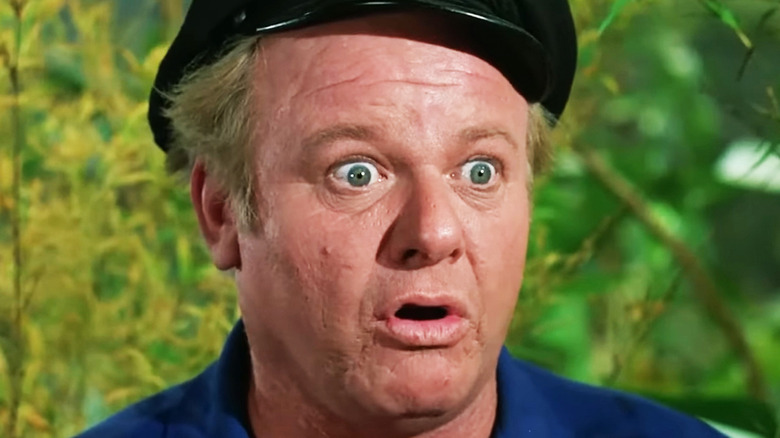
Well before he portrayed Captain Jonas Grumby, aka. The Skipper, on "Gilligan's Island," Alan Hale Jr. appeared in the Kirk Douglas Western "The Big Trees." The 1952 feature was just one example of Hale Jr. working alongside renowned Western stars, with the future Skipper actor also having appeared in Gary Cooper and Gregory Peck oaters. But Douglas was the only one of these screen legends with whom Hale Jr. worked post-"Gilligan's Island," when the pair both starred in 1970's "There Was a Crooked Man..."
That movie was directed by Joseph L. Mankiewicz, brother of Herman J. and an esteemed filmmaker in his own right. Mankiewicz worked as a producer on the classic romantic comedy with a perfect Rotten Tomatoes score that is "The Philadelphia Story" before transitioning to directing, winning four Academy Awards for 1950's "A Letter to Three Wives" and 1951's "All About Eve." By the time he came to helm "There Was a Crooked Man...," he had overseen a truly impressive array of features that included "Cleopatra." Still, in all that time, he had never overseen a Western, which, considering he came to prominence at a time when the genre basically ruled Hollywood, is fairly surprising.
In another sense, however, he was hardly new to oaters. Mankiewicz penned many in his early days, including versions of "The Virginian" and "Three Godfathers." With "There Was a Crooked Man...," though, he finally stepped up to direct his first Western, and as he told journalist Gordon Gow at the time, he was intent upon "having a little fun with the mythology of the Wild West" (via TCM). Sadly, however, Mankiewicz himself had less fun working on the project, as he suffered a physical injury at his home that led to him using a motorized wheelchair in the final weeks of production.
Alan Hale Jr. isn't given much to do in There Was a Crooked Man...
After "Gilligan's Island," Alan Hale Jr. appeared in one of Clint Eastwood's most important Westerns, "Hang 'Em High," playing a member of a crew that makes the grave mistake of lynching Eastwood's character. But that was far from the only oater to feature Hale Jr. following his misadventures on Gilligan's Isle.
Two years later, he appeared in "There Was a Crooked Man..." The film stars Kirk Douglas as Paris Pitman, a criminal who, after stealing $500,000 from rancher Mr. Lomax (Arthur O'Connell), is sentenced to 10 years at a remote Arizona penitentiary. At first, Pitman seems to have it easy, as the prison's warden, Francis E. LeGoff (Martin Gabel), agrees to allow his escape for a share of the Lomax fortune. But after LeGoff is killed, a new warden arrives in the form of Henry Fonda's Sheriff Woodward W. Lopeman. Seemingly much more principled than his predecessor, Lopeman attempts to reform the prison and rehabilitate Pitman, but the criminal sees only an opportunity for manipulation.
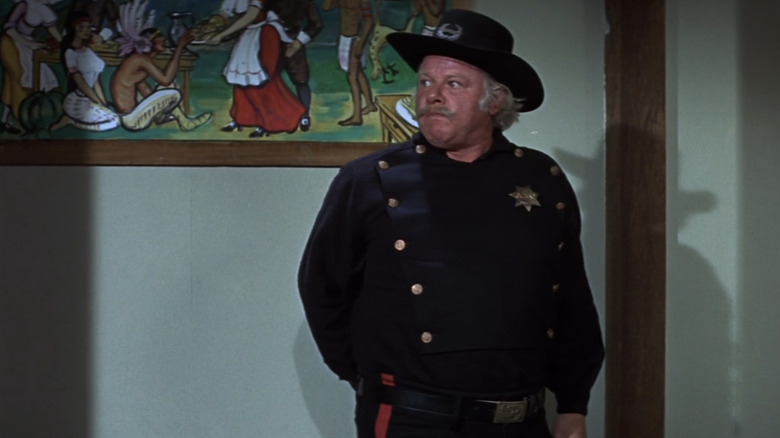
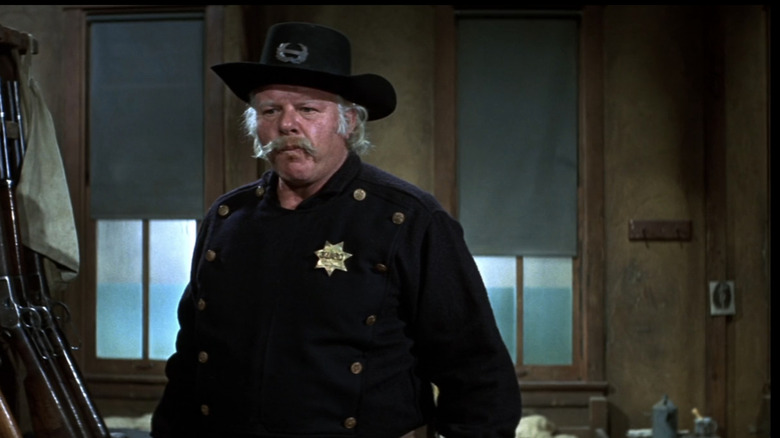
Among the film's supporting cast were well-known character actors like Burgess Meredith, Lee Grant, Warren Oates, and Hume Cronyn, who had previously appeared alongside Douglas in 1951's "Detective Story." That film debuted a year prior to "The Big Trees," which, again, marked Douglas and Hale Jr.'s first collaboration — though they hardly shared much screen time. The same is true of "There Was a Crooked Man...," in which Hale Jr. portrays prison guard Tobaccy and isn't given a whole lot to do besides being felled by Meredith's legendary bandit The Missouri Kid. No wonder The Skipper remained Hale Jr.'s favorite role for the rest of his life.
There Was a Crooked Man... is well worth revisiting
By the early 1970s, Westerns were undergoing a major metamorphosis. After Clint Eastwood and Sergio Leone rewrote filmmaking rules with their "Dollars" trilogy, Westerns would never be the same. Gone were the simple white hat vs. black hat days. In their place came a revisionist ethos that saw the genre deconstructed and the traditional Western undermined at its very foundation.
"There Was a Crooked Man..." fit awkwardly into that cultural landscape. Like Leone before him, Joseph L. Mankiewicz struck a tone somewhere between parody and earnestness. All the same, his attempt to "have a little fun with the mythology of the Wild West" impressed critics, with Vincent Canby of the New York Times praising the film's "taste, intelligence, and somewhat bitter humor" and remarking that it was "one of the more pleasant things you're likely to see this season." Modern viewers mostly seem to have enjoyed it, too. On Letterboxd, one user writes, "Comedic Western with a monster cast, a real kick seeing this bunch together on screen," while another described it as a "highly entertaining Western comedy with a little satirical bite."
To bring us this highly entertaining Western, Mankiewicz spent the final four weeks of the film's production directing from a wheelchair after slipping a disc in his back. Still, at least the resulting movie remains worth rewatching to this day — if not for the brief Alan Hale Jr. appearance, then for Kirk Douglas and Henry Fonda's characteristically great performances. That and the whole thing was shot on location in Joshua Tree, California, where as AFI has noted, a massive 1880s prison set was built spanning four acres. Hard to imagine such a thing in the modern age, but it's there on film in "There Was a Crooked Man..."