

This Forgotten 1959 War Movie Is One Of The Best (And Bleakest) You'll Ever See
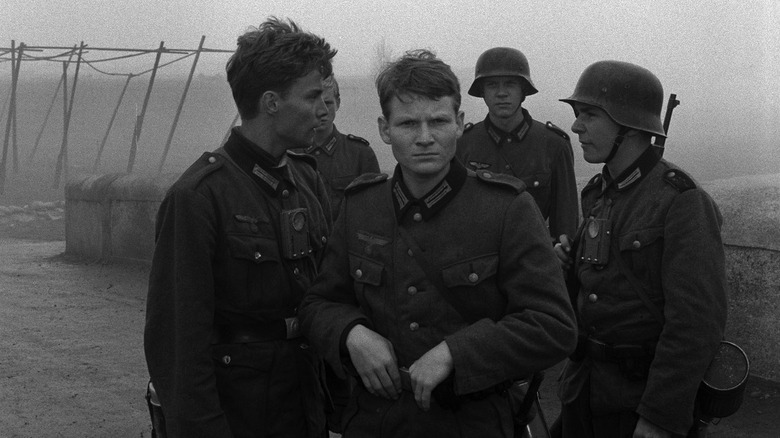
Bernhard Wicki's 1959 German film "Die Brücke," or "The Bridge," is one of the most tragic, powerful antiwar films ever made. It reveals the emptiness of patriotism during wartime, the futility of combat, and the ephemeral nature of a soldier's life. It confronts the very notion that "serving your country" should be viewed as heroic, standing in direct opposition to the pro-combat philosophy that undergirds the vast bulk of American military cinema.
"The Bridge" takes place in a small unnamed German town during the last days of World War II. The Americans are moving in, and the war will be over in about 96 hours. The film's opening scenes reveal that most of the adults in the town are pulling up roots and getting out of Dodge. They don't want to be present when their town falls.
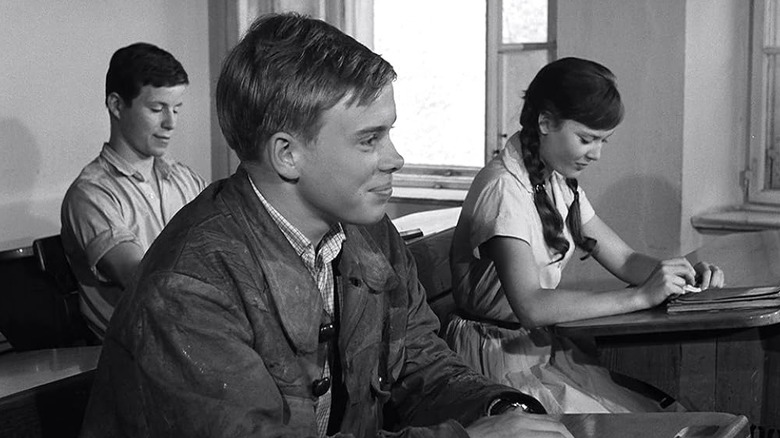
The protagonists of "The Bridge" are a group of seven teenage boys who have merely been going to school during the war, and have been carefully shielded from violence all over Europe. Their teacher, Mr. Stern (Wolfgang Stumpf), has spent the bulk of the war filling the boys' heads with ideas that serving Germany will be a noble endeavor, and that they will eventually live up to their usefulness as citizens once they are drafted. Before the end of the movie, they will be. Never mind that the war is already lost.
A bomb has dropped near their village, nearly hitting the town bridge, a small stone edifice that bears no real significance whatsoever. By the end of the film, it will not gain any significance. Indeed, the bridge will end up being the site of a meaningless wartime skirmish that the history books never cited. Your heart will be blown out of your chest when you see "The Bridge."
The Bridge is about the futility of combat and the dangers of patriotism
(Spoilers ahead.)
The first two-thirds of "The Bridge" are a seemingly quaint but ultimately damning view of the seven lead teens' viewpoints. One of them, Walter (Michael Hinz), hates that his father, a Nazi solider, has seemingly abandoned his duty, puffing up his own desire to serve in the military. Jürgen (Frank Glaubrecht) saw his own father die in action, and wants to serve to mythically even the score. Karl (Karl Michael Balzer), meanwhile, is trying to make his move on his father's comely assistant, only to find that his father had already begun an affair with her first. This leads to a dark streak of teen misogyny, and, in a not-so-roundabout way, leads into his desire to fight. "The Bridge" finds a link between propaganda, hate, self-pity, misogyny ... and the desire to kill others in combat.
Because we know the war is coming to an end, we can see that this will end poorly. In the film's final act, the boys are all drafted into the Nazi military, like they've always dreamed. Of course, with the war at an end, and the village about to fall, what do they do? Their drafting is almost a favor to them, and their teacher asks that they be kept away from the action. They will be allowed to wear their uniforms for a day, and then say they did their patriotic duty.
Then the military tanks show up. The final 20 minutes of "The Bridge" is a bloody, gory litany of violence, loss, and tragedy that will rip up your insides. There was nothing at stake, and no one needed to die. Only the echoes of propaganda and the myth of the "brave solider" kept the kids going.
The Bridge ends on a very bleak note
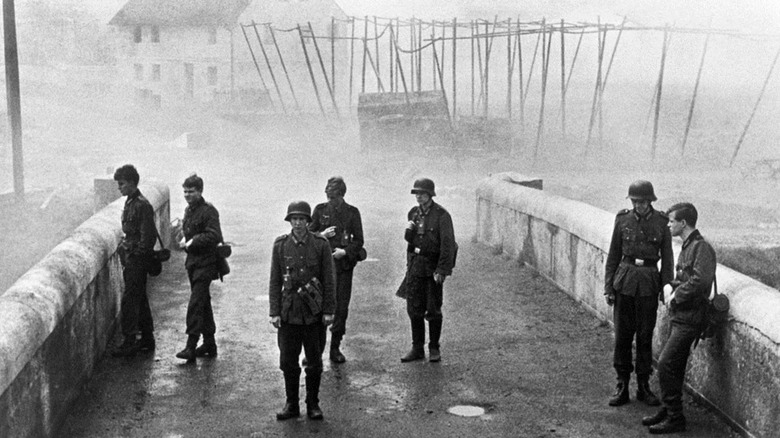
A chyron at the end of "The Bridge" informs viewers that what we just witnessed was actually a true story. But it was such an insignificant moment in World War II, it was never even recorded. The "nobility" of combat, in this case, didn't even rise to the point of being a footnote.
"The Bridge" was the first outwardly antiwar film to come out of Germany after the end of World War II (as declared by the Criterion Collection), and it may be one of the best antiwar films of all time, almost matching the tragedy of Lewis Milestone's 1930 masterpiece "All Quiet on the Western Front." It was widely celebrated when it was released, earning four German Film Awards, and it was nominated for Best International Feature at the Academy Awards. It lost to "Black Orpheus."
Bernhard Wicki's work was so impressive that he was tapped to direct the German segments of the 1962 war epic "The Longest Day," probably the director's highest-profile gig. That film, too, was nominated for Best Picture at the Oscars. In 1964, Wicki directed "The Visit," which was nominated for the Palme d'Or at Cannes.
"The Bridge," meanwhile, remains a masterpiece. Although it's one of the bleakest and most powerful war pictures I have encountered in a long while, it doesn't seem to be mentioned much at film schools, and is rarely listed as "essential viewing" by professors. Perhaps some don't want to see teenagers serving the Nazi army as sympathetic figures. But make no mistake, "The Bridge" does not sympathize with the Nazi war effort. Indeed, it shows that anyone who fell for the propaganda was tragically duped into participating in a doomed, deathly endeavor that will eventually forget them.