

What Is An M-Class Planet? Star Trek's Habitable Worlds Explained
We may receive a commission on purchases made from links.
Welcome to Trekspertise, a series where we break down the technology, history, details, and decisions that make the Star Trek universe so complex — and so fun.
Attentive Trekkies might have noticed that when the USS Enterprise arrives at a new planet on its merry star trek, a member of the crew may briefly announce many details about the planet's native flora, fauna, population, and environmental makeup. As we all know from middle-school science classes, Earth's air is a gaseous mixture of mostly nitrogen, but also oxygen, water vapor, argon, carbon dioxide, and a slurry of other trace chemicals. As it so happens, many worlds in the "Star Trek" universe have a near-identical, Earth-like gaseous mix, and, if the weather permits, humans can beam down to such worlds and walk around without a space suit, breathing with impunity. The aforementioned crew member on the Enterprise will often also announce that such a world can be classified as an "M-Class planet." M-Class planets are, in brief, the planets on "Star Trek" that can naturally support human life.
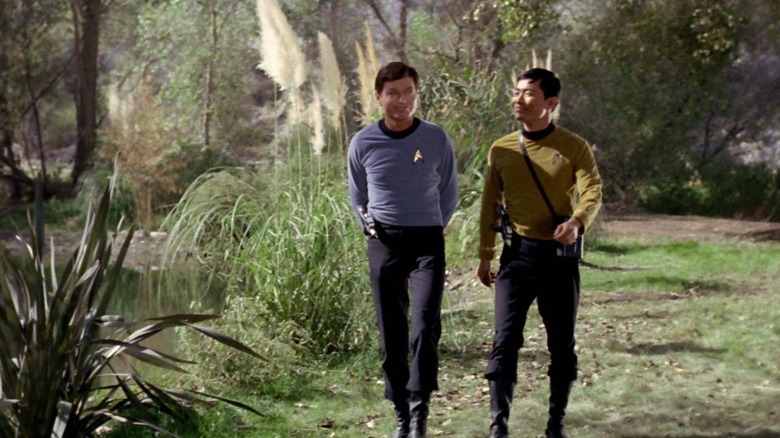
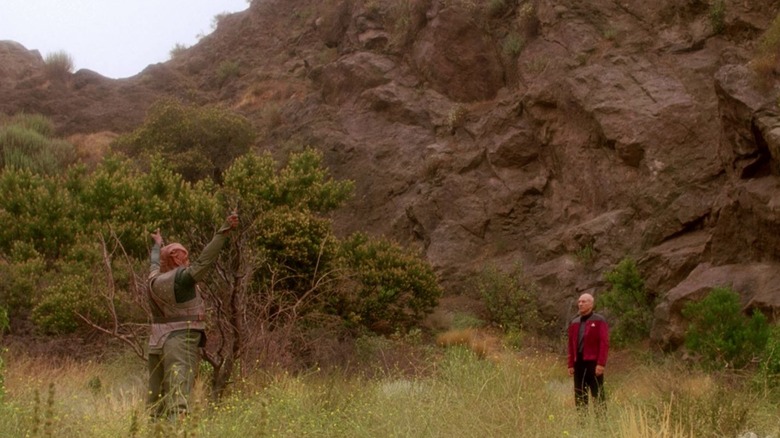
The fact that most "Star Trek" worlds are habitable by humans is, of course, a cost-saving measure. Actors don't necessarily want to wear spacesuit costumes (which wouldn't be practical), so the makers of "Star Trek" hastily write that this episode's planet has an Earth-like atmosphere and brush off their hands before moving to the next scene. Production frugality is also why most of the outdoor planets on "Star Trek" happen to look like Topanga Canyon or Vasquez Rocks in Southern California.
It wouldn't be until "Star Trek: The Animated Series" that "personal force fields" would enter "Trek" canon, allowing characters to walk around in a vacuum, on a water-coated planet, or on other worlds that were not well-suited for human lungs. Until then, the majority of worlds the crew encountered were M-Class planets.
An M-Class world is capable of supporting most humanoid life
Occasionally, it would be mentioned on "Star Trek" that a certain planet may be "Class M, type 4," implying that there is a vast network of planet types within "Star Trek." The M classification could be applied to planets, but also moons, planetoids, and even outsized asteroids that have their own atmospheres.
M-Class worlds don't just have Earth-like air and survivable temperatures, but also gravity similar to that of Earth's. It was rare that gravity was a problem for the human characters on "Star Trek"; they rarely floated away, nor were they crushed into chunky salsa. M-Class planets also, naturally, have clean water sources, although I imagine that careful scans would be made of the local water before it would be deemed potable.
In Geoffrey Mandel's valuable sourcebook "Star Trek Star Charts," it was made explicit that M-Class planets have an age of 3 billion to 10 billion years, and that they all have a diameter between 10,000 and 15,000 kilometers. For context, Earth is about 4.54 billion years old, and has a diameter of 12,756 kilometers. M-Class planets also, of course, mostly tend to exist in the "Goldilocks Zone" of a solar system (that is, they are just the right distance from their suns), ensuring they are capable of supporting life.
The term "M-Class" was mentioned as early as the original "Star Trek" pilot "The Cage" in 1966, but it wouldn't be until "Star Trek: Enterprise" in 2001 (specifically in the episode "Strange New World") that it would be explained that the "M" in "M-Class" actually stood for "Minshara," a classification invented by the Vulcans. Starfleet took up the classification, eventually shortened it to merely "M-Class," and a new planetary taxonomy was born. "Star Trek" wouldn't be "Star Trek" without complex, difficult-to-understand taxonomic nomenclature.
The other classes of worlds on Star Trek
It's worth noting that M-Class planets aren't the only ones capable of supporting human life. L-Class planets, for instance, can support human life and have some vegetation, but don't have any animals in their ecosystems. Other planet types, like K-Class worlds, aren't habitable, but could easily be made habitable via artificial biospheres.
Prior to the introduction of the Minshara-class terminology, other ancillary "Star Trek" texts, such as Shane Johnson's 1989 volume "The Worlds of the Federation," explained that there was a wide, near-complete set of planet classifications in "Star Trek." But there is a big problem with many of the (non-M-class) classifications from these sourcebooks, as they aren't consistent. Mandel's "Star Charts" and Johnson's "Worlds" give outwardly conflicting information.
For instance, in "Worlds," A-Class planets are gas giants like Jupiter. In "Star Charts," A-Class planets are molten, volcanic worlds. In "Worlds," J-Class planets are barren planets like Earth's moon. In "Star Charts," J-Class worlds are gas giants. "Worlds" stated that N-Class planets had breathable atmospheres, but that their surfaces were almost entirely oceans (like Argo in the "Star Trek: The Animated Series" episode "The Ambergris Element"). In "Star Charts," however, N-Class planets were high-temperature worlds with extremely dense, carbon dioxide-rich atmospheres; Venus would be an N-Class planet. "Worlds," meanwhile, classifies Venus as C-Class. One can see the two conflicting classification charts on the fan website Memory Beta. Trekkies who are purists for consistency will pull their hair out over such uneven information.
Why the changes? There is no in-universe reason. We're merely witnessing a standard push-and-pull between non-canonical sourcebooks. And, of course, both charts could be wholly negated by any new information announced out loud in new canonical scripts from the 2020s. It's very frustrating.
All we know is that M-Class planets have always been the habitable ones. That part, at the very least, hasn't changed.