

Star Trek Owed Its Success To Four Things, According To Isaac Asimov
We may receive a commission on purchases made from links.
The celebrated sci-fi author Isaac Asimov and "Star Trek" creator Gene Roddenberry were friends, and they wrote letters to each other often. Some of these letters can be read in the 1995 David Alexander book "Star Trek Creator: The Authorized Biography of Gene Roddenberry," wherein they discussed things like the popularity of Spock, played by Leonard Nimoy, and other various topics. Asimov was also a regular guest at early "Star Trek" conventions, so the two men ran in similar circles. Asimov never declared himself to be a Trekkie, as far as I have been able to determine, but he certainly watched "Star Trek," contributed ideas to it (in a general sort of way), and spent a lot of time among many Trekkies.
With such an inside track in the "Star Trek" world, Asimov had a lot of personal theories as to why the show was so popular among its fans. Recall that "Star Trek" wasn't a huge success when it was initially on TV from 1966 to 1969, but it became a phenomenon in reruns, eventually leading to the aforementioned "Star Trek" conventions in the early 1970s. Throughout, fans were drawn to the show's diverse cast and its utopian undercurrents, taking place in a world where the characters often spoke openly about ridding themselves of prejudice and where diplomacy was more important than military might.
Because Asimov was at "Star Trek" conventions, he got a close-up look at the fandom and got to know exactly what kind of people they were. In an issue of Cue Magazine, reprinted in the second issue of Starlog in 1976, Asimov laid out the four things that made "Star Trek" popular. In brief, the show was smart, it respected actual science, it was ethical and humane, and it featured sympathetic characters.
Asimov's Four Rules of Star Trek Popularity
Isaac Asimov must be fond of lists of rules, given that he invented the well-worn Laws of Robotics, a sci-fi trope about artificial intelligence that would be well-suited to real-world applications. When it came to Trekkies, Asimov laid it out clearly, saying that the "cult," as he called it, is based on four things:
"1) Young people of intelligence who are concerned with our world and with their own lives are naturally interested in science fiction, since this is the only form of fiction that deals with the future and with change — and it is in a changed future that youngsters will mature.
2) There was enough respect for science in the program to give it the support of the more sophisticated portion of the science fiction audience — who are the opinion-makers.
3) Many 'Star Trek' episodes dealt with ethical problems that were resolved in humane fashion. Even a 'monster' was viewed sympathetically when she turned out to be a mother protecting her child.
4) There were interesting, idiosyncratic, and sympathetic characters about whom one's feelings could crystallize."
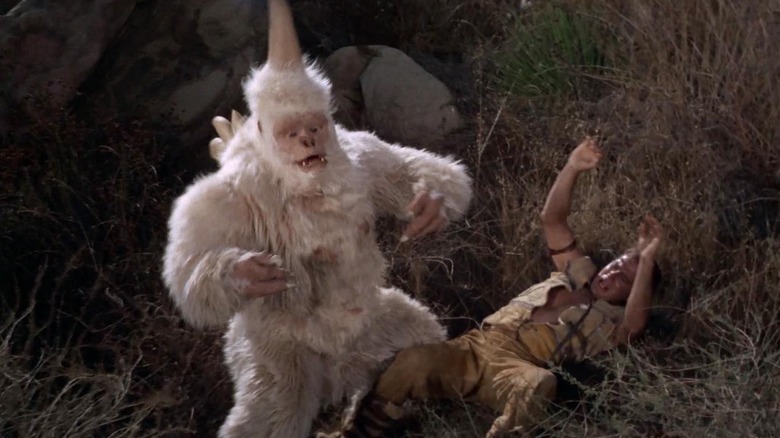
The "monster" that Asimov is referring to is likely the Horta, a rock creature from the episode "The Devil in the Dark" (which was difficult for William Shatner to finish). Initially, the Horta was seen as a B-movie beastie, melting human interlopers with its biological acids. It was later revealed that the creature was protecting a clutch of eggs from human miners that had invaded its domain. The episode ends with the humans and the Horta living in peace. That kind of thing was common on "Star Trek."
Overall, the show was smart, cerebral, attentive to detail, and featured great characters. Those are vital, I would say, for making any high-quality TV series.
Breaking down Asimov's rules
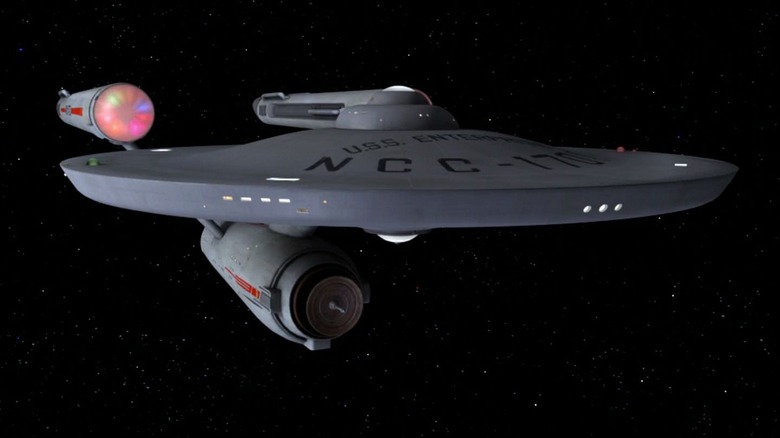
The four rules, as Isaac Asimov lists them, became some of the most common critical reactions to "Star Trek." Fans were indeed drawn to the show's optimistic view of the future. Things seemed pretty bleak in the mid-to-late 1960s, what with the Vietnam War, the assassination of Martin Luther King, and an increasing sense of hopelessness. "Star Trek" posited that not only would we live through all of that, but the future would be brighter, and humans would rid themselves of both war and prejudice. Fans also liked the show's attention to scientific detail. There were many scenes of engineers tinkering with engine parts and crawling into tubes to repair oblique parts of the USS Enterprise.
And, of course, it was a show that valued life. Not all space creatures were monsters to be exterminated, and not all alien foes were wholly evil. There was a lot of moral nuance to the series, and diplomatic solutions were generally found.
No doubt both Asimov and Gene Roddenberry heard these theories a lot from fans during their "Star Trek" convention speaking engagements throughout the 1970s, and Roddenberry perhaps internalized these comments deeply. When the time came to create "Star Trek: The Next Generation" in the mid-1980s (a time full of writers' room turmoil), Roddenberry decided to expand on each of them, making a rendition of "Star Trek" that was even more optimistic, even more scientifically rigorous, even more humane and diplomatic than the original.
Asimov didn't have a hand in creating "Next Generation," but it's possible that Roddenberry read the above rules, agreed with the assessment, and went whole hog the next time he had the chance. We might have Asimov — and a decade of closely-listened-to criticism — to thank for "Next Generation" being the way it is.