

5 Best Liminal Movies Of All Time, Ranked
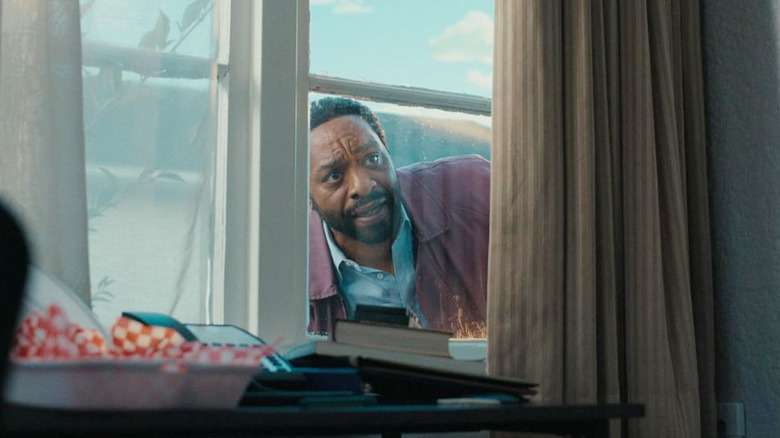
Some readers may be old enough to remember the furor kicked up over the phenomenon of subliminal messaging making its way into pop culture artifacts. There was a free-floating suspicion that subtle, unheard audio or backward masking was being used to insert demonic impulses into a media consumer, unregistered by their conscious mind. John Carpenter's 1989 film "They Live" is a very good example of subliminal horror at work.
Here in the 2020s, though, subliminal horror has given way to liminal horror; that is, horror images that take place within a "threshold" space. Liminal spaces are the places built to be unnoticed, the in-between spaces of a building. A hallway. A waiting room. A foyer. Liminal horror rests in those spaces, encouraging viewers to push them into their conscious mind. And when we look at a bleak, empty, in-between space, we begin to lose all sense of meaning. If there is nothing in a liminal space, the emptiness becomes terrifying.
The aesthetic exploded in popularity in the age of social media, wherein amateur photographers and animators could create liminal space images in vast quantities. Kane Pixels, aka. Kane Parsons, was one of the pioneers of the new wave of liminal horror images via his YouTube series "The Backrooms," which he has since adapted into the newly-released (and well-received) feature film "Backrooms."
Many horror movies have used this technique before, resting in eerie, in-between places, and letting a sense of dread creep into the viewer's head. Sometimes, a big empty lobby or a long empty hallway can be scarier than any slathering hellbeast or killer with an axe. The five titles below are among the best horror films to employ liminal imagery. Time to sit in the emptiness and enjoy.
5. Elephant (2003)
Gus Van Sant's 2003 film "Elephant" is a fictionalized retelling of the infamous Columbine High school shooting in 1999. Van Sant explores the home life and mindset of two high school students (Alex Frost and Eric Deulen) who plan and undertake a schoolwide massacre. They live in a world of quiet desperation and repression, seemingly unable to express themselves through any means other than violence.
Van Sant, however, doesn't construct a conventional narrative with "Elephant." Indeed, the movie seems to be a stripped-down analysis of the Columbine shootings, presented seemingly without commentary. The title comes from the old parable of several blind people encountering an elephant for the first time. They each, through touch, think the elephant is something different. None of them knows what the entire animal looks like. The same is being said of school shootings. We can all feel a piece, but none of us sees the whole picture.
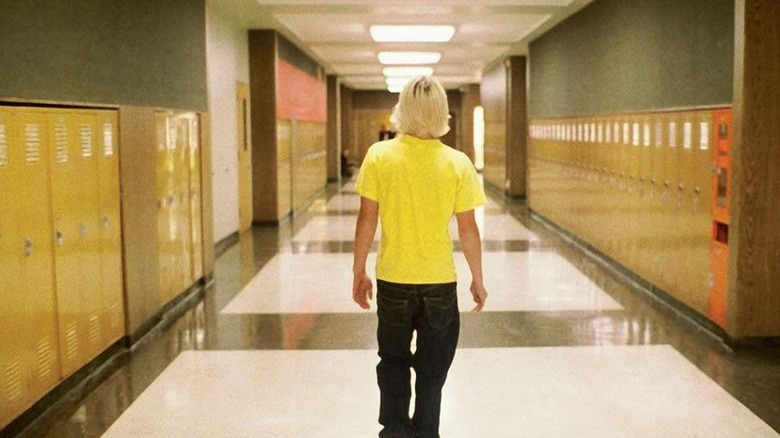
The vast bulk of the movie is extended shots of teenagers walking down long school hallways, the camera hovering just behind them. "Elephant" stresses how much time teenagers spend walking between classrooms, floating past hundreds of identical, institutionally colored lockers. Their friends may pass by them, but nothing seems to be happening. High school students, "Elephant" seems to be communicating, live in purgatory.
And while in that purgatorial space, the mind can wander. Resentments can grow. Hate can bubble up. It's not mockery or injustice that inspired the killers in "Elephant," but solitude. The bleak, blank hallways of their high school were the place where they could begin fomenting their darkest fantasies. And then, into that liminal space, they brought death, gunfire, and violence.
"Elephant" is a chilling film. It also, incidentally, influenced another noteworthy tale of horror and high school in the form of "Spontaneous."
4. The Shining (1980)
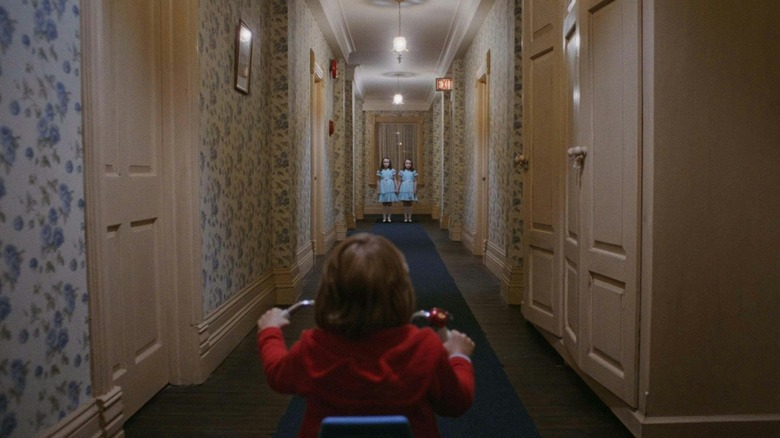
One of the great classics of liminal horror, Stanley Kubrick's "The Shining" is a film that hardly needs introduction. The movie has bled deeply into the pop consciousness, becoming one of the most recognized horror features of all time, and it's arguably one of the scariest. For many, "The Shining" introduced them to the very concept of liminal horror, giving everyone nightmares about long, empty hotel hallways in perpetuity. The scene wherein the young Danny (Danny Lloyd) rides his trike around a hotel hallway corner only to be faced with the Grady twins (Lisa and Louise Burns) at the end of the hall remains one of the film's most memorable.
Most of "The Shining" deals with a sense of eerie emptiness. It takes place in a large hotel with only Jack (Jack Nicholson), Danny, and Wendy (Shelly Duvall) Torrance taking care of the place in the winter. There are large lobbies, vast ballrooms, empty bathrooms, empty kitchens, empty everything. And in the emptiness, we begin to hear the whispers of the hotel's memory, the ghosts of its past drifting through the still air. "The Shining" introduced many to the idea that emptiness can, in itself, be a character, a presence that we cannot define. And that, of course, is the very spirit of liminal horror.
One might even say that Kubrick spent his career exploring liminal spaces. His long takes and meticulous interiors often invoke a sense of liminal dread. "A Clockwork Orange" takes place partly in liminal spaces, and "2001: A Space Odyssey" designed vast, futuristic interiors that are all sparsely populated. "The Shining" just happens to be the best example of Kubrick's skill in creating uncanny interiors, all the way down to its enigmatic ending.
3. We're All Going to the World's Fair (2022)
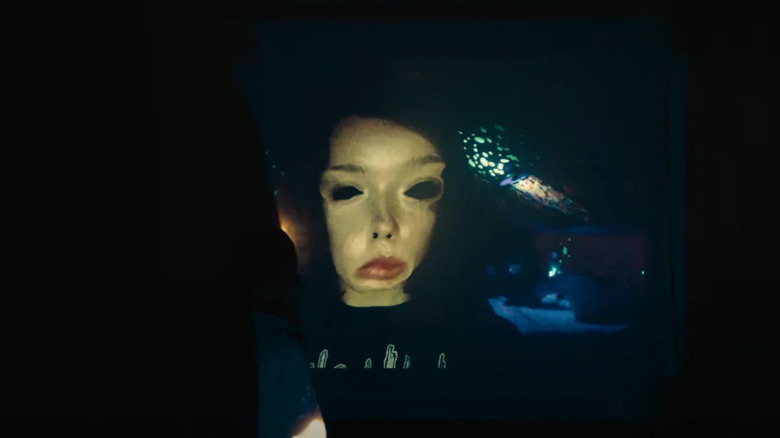
Jane Shoenbrun's debut feature "We're All Going to the World's Fair" was made for the generation of people who grew up lonely on the internet. It concerns the fate of Casey (Anna Cobb), a kid who, while living with her single dad, decides to take an online challenge called the World's Fair Challenge. It seems that if you repeat "I want to go to the World's Fair" three times and smear some blood on your computer, it will activate a vague curse, causing you to experience a psychotic break and even mutate physically.
Casey doesn't seem to have a world outside of her home. The universe is either in her bedroom, where she fondles her dad's shotgun, or online, where no one seems to have an identity. She lives in a liminal space she cannot leave. She screams in her sleep and rips apart her teddy bear. Is she breaking down mentally, is she play-acting, or is she legitimately cursed? In "We're All Going to the World's Fair," the liminal space becomes very abstract. It's set in an online world where one can sink deep into a horror movie-like headspace, and "play the game" 24/7. Bodies are mutable, and identities can be chosen. Shoenbrun, who is nonbinary and transfemme, was clearly exploring the value (and the adjacent horrors) these places have for early-2000s teens (Schoenbrun was born in 1987) who want to ponder who they are outside of their bodies.
In a way, social media and online living have placed everyone into a perpetual liminal state. Perhaps it was the rise of social media that made a whole generation sensitive to liminal imagery in the first place. "We're All Going to the World's Fair" is an intriguing peek into that.
2. Eraserhead (1977)
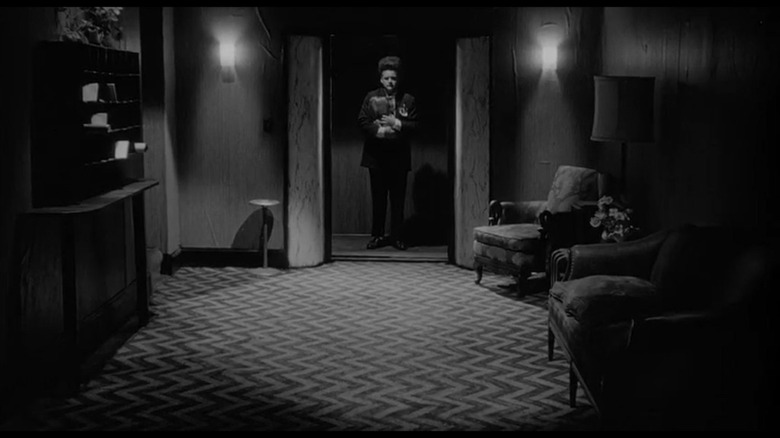
Like Stanley Kubrick, David Lynch spent a great deal of his career exploring liminal spaces, beginning with his first feature "Eraserhead" in 1977. "Eraserhead" takes place in a dusty, encrusted, near-dystopian cityscape where apartment rooms are small, chickens are mutants, and babies may not be babies. Lynch's use of light and shadow emphasizes the stage-like nature of the places that Henry Spencer (Jack Nance) occupies. We're sharply aware of how alone Henry is. The world has been drained of color, people, and all emotions. Well, not all emotions. Fear remains. Anxieties about fatherhood, mostly.
Henry, as a denizen of liminal spaces, has essentially abandoned his soul. He lives in grey, bricked-up misery. The city is groaning, smoky, and oppressive. The sun doesn't exist. Everything below the sky is a terrifying, depressing liminal space. "Eraserhead," we should pause to note, is one of the best movies of all time.
There is even a subliminal liminal space in "Eraserhead." When Henry dreams of escape, he stares into his dinky apartment's radiator and envisions a small stage with a proscenium and sees a woman with large cancerous cheeks (Laurel Near) dancing and singing about how everything is fine in Heaven. The wide, empty stage is a dream within a dream. A good hard look at the emptiness of a liminal space.
One can see Lynch returning to liminal spaces time and time again. The aesthetics of square, under-decorated rooms can be seen plentifully throughout his TV series "Twin Peaks," and they are also featured heavily in the opening scenes of his film "Lost Highway." Liminal horror requires a certain degree of spareness, and Lynch's aesthetic spareness — and the ineffable dread therein — defined his entire career. May his memory continue to be a blessing.
1. Skinamarink (2023)
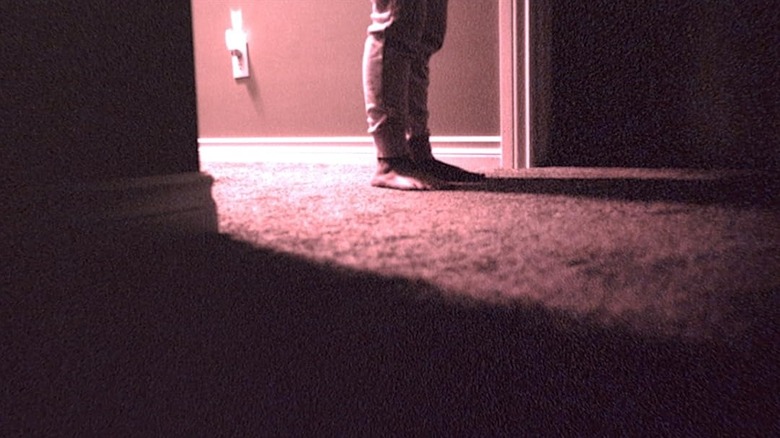
Made for only $15,000, Kyle Edward Ball's "Skinamrink," like "Backrooms," started as a YouTube phenomenon. Ball's channel was called Bitesized Nightmares, and he recreated viewers' actual nightmares as accurately as he could on camera. Nightmares, as we know, don't resemble the wild phantasmagoria seen in something like "A Nightmare on Elm Street." Instead, they tend to take place in familiar spaces that have been ... altered in some way.
"Skinamarink" takes place in a suburban home at night, and we hear the whispers of two children as they wander through the dark hallways and bedrooms playing with toys and watching old cartoons. The eerie part is that all the house's doors and windows start vanishing. There are sinister words about things that might be under the bed. There is a call to an adult who is concerned that one of the children might have hurt themselves. Is one of the parents missing? What was that about a young girl misbehaving and having her mouth removed? We see few human faces on camera, but Ball mostly focuses on portions of walls, rugs, toys scattered on the floor, or the ceiling. Like in a real nightmare, familiar spaces become terrifying when emptied. The movie is a whole liminal space.
And at the center of it is ... a presence. What's its name?
"Skinamarink" is also one of the scariest movies ever made, period. Ball plays with film grain, white noise, and nightmarish images to tell a story about ... well, there are theories, but the ending of "Skinamarink" may reveal that one of the characters had been in a coma. Or maybe it's just tapping into Jungian archetypes. Either way, it will stay with you forever.