

Japan Couldn't Afford To Play A Charlie Chaplin Classic, So They Staged Their Own Adaptation
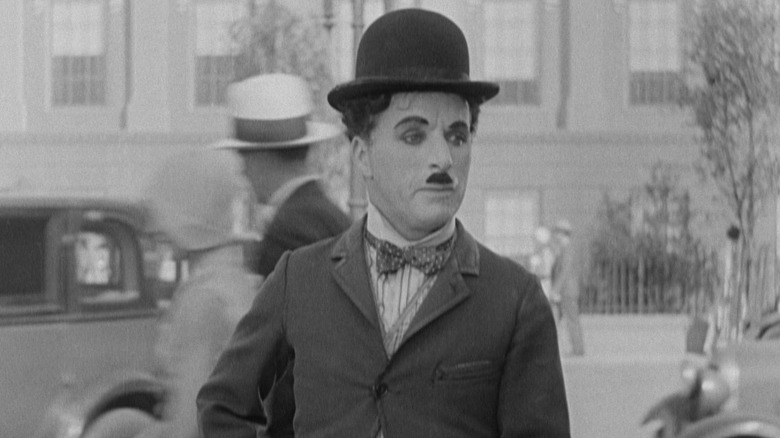
Charlie Chaplin is undoubtedly one of the most well-known movie actors of all time. As a silent film star, his movies transcended language barriers and made him one of the first truly worldwide icons of the screen. His legacy endures to this day; even now, his signature character, The Tramp, is as easily recognizable to modern audiences as Mickey Mouse, Superman, or Darth Vader.
Thus, at the height of his popularity, Chaplin's fandom was impassioned in every corner of the globe. That was part of why he resisted the move to making talking pictures, telling The New York Times in 1931 that he feared a move to talkies would risk "a universal means of expression" that would limit the field of films, holding them "down to the particular tongues of particular races." Around the time he began to make one of his great masterpieces, and what, in my humble opinion (and others), is the greatest romantic comedy of all time, "City Lights," he was even quoted as saying "moving pictures need sound as much as Beethoven needs lyrics."
(Rotten Tomatoes doesn't think "City Lights" is "perfect," but Rotten Tomatoes is wrong.)
"City Lights" debuted stateside in 1931 to much acclaim. However, as explained by Japanese Chaplin specialist Ono Hiroyuki in this video, Japanese exhibitors couldn't afford to cover the rental fees on prints of the movie after the post-World War I production bubble burst and the Great Kantō Earthquake led to a 1927 bank run on bonds in Japan. For those not aware, studios made their money back then by renting their film prints to theaters. Because of this, "City Lights" didn't get an official release in Japan until 1934.
... Although that didn't stop Japanese Chaplin fans from creatively adapting the movie into a Kabuki production in the meantime.
Chaplin's City Lights by way of Kabuki
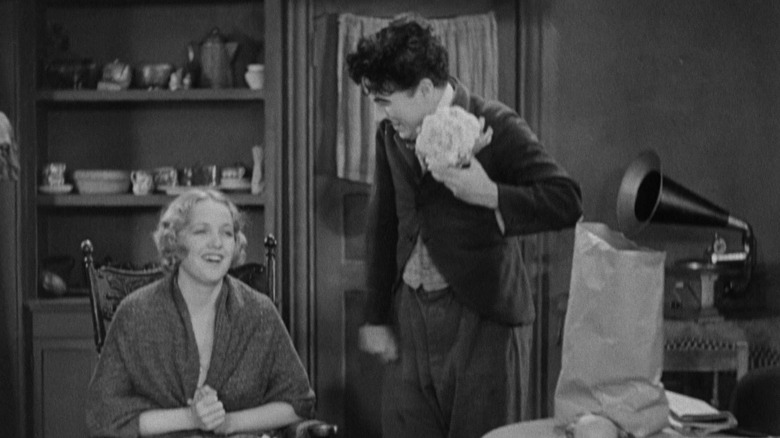
"City Lights" follows The Tramp (Charlie Chaplin) as he falls for a blind flower-seller (Virginia Cherrill) who mistakes him for a millionaire. When she's about to be tossed out of her apartment and unable to afford a surgery that will allow her to see, The Tramp promises to get her the money, no problem. He then endures a number of misadventures to do so (even going to jail at one point), culminating in one of the most beautiful and emotional endings in cinema history.
As mentioned, though, "City Lights" wasn't officially screened in Japan until 1934. But Japanese audiences were desperate for Chaplin's films, so they found as many workarounds as they could. At the time, Japan had no sense of copyright (especially for U.S. productions), so many adaptations in stage play and novel form were disseminated across the country — including one particularly notable one.
In 1931, a traveling Kabuki troupe visiting the United States screened "City Lights" during their trip. Then, when they returned home, they put on a colorful, traditional Kabuki version of the film called "Kômori no Yasu-san," written by Kinka Kimura. According to Ono Hiroyuki, the title translates to "Mr. Yasu with the tattoo of a bat on his cheek." Mr. Yasu, whose bat tattoo bore a striking resemblance to Chaplin's mustache, was a popular "tramp" character in a different, traditional Kabuki play, blending Chaplin's art with Japanese culture.
"Kômori no Yasu-san" bowed to great fanfare at Tokyo's Kabuki Theater in August 1931 (seven months after "City Lights" debuted stateside), and it localized elements of Chaplin's film. For example, it took place in a Tokyo suburb, while Mr. Yasu entered a sumo wrestling match rather than a boxing fight like The Tramp in "City Lights."
The enduring popularity of Charlie Chaplin's artistry
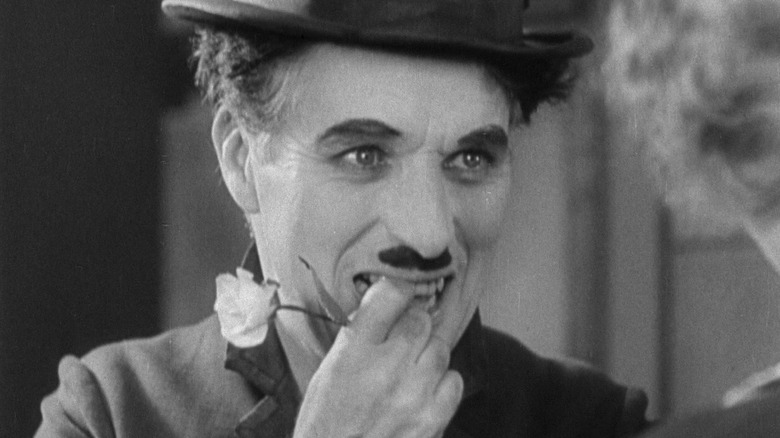
Charlie Chaplin remains an important filmmaker in the history of cinema at large. He made a string of masterpieces in the role of actor, director, writer, and composer from his time with Mack Sennett's Keystone Studios under the direction of Sennett, himself, and Mabel Normand, all the way through his talking features in his later career. He remains popular today.
In 2014, the Tokyo International Film Festival played "City Lights" to a delighted audience and put it on a double-bill with a short Kabuki play. As for "Kômori no Yasu-san," it was later revived in 2019 by the Japan Arts Council and the National Theater in Tokyo to commemorate the 130th anniversary of Chaplin's birth. There, Matsumoto Koshiro the 10th, the descendent of the actor who originally played the Tramp in the 1931 production of the play, took on the part this time. The revival played only for that month, but Chaplin's fifth child and fourth son, Eugene Chaplin, attended a performance at the theater and remarked that it was "living proof that [Charlie Chaplin's movies] can be transported to different cultures and still be funny."
Beyond that, the National Theater of Japan seems to have no shortage of love for "City Lights." It's even announced plans to stage a brand new ballet based on Chaplin's masterpiece in October 2026, as choreographed by English dancer Alastair Marriott, formerly of the Royal Ballet.
Circling back to Chaplin in real life, though: Have you ever heard about the time that Winston Churchill tried to get Chaplin to play Napoleon in a movie?