

Charlie Chaplin Almost Played Napoleon, With The Least Likely Screenwriter Imaginable
We may receive a commission on purchases made from links.
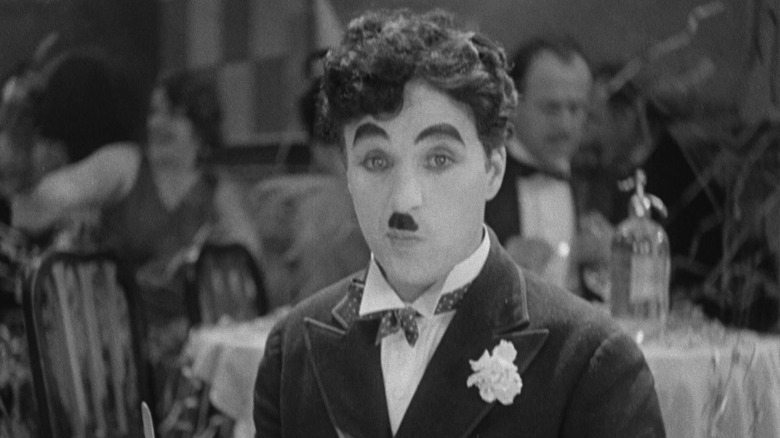
Of the great film comedians of the silent era, Charlie Chaplin was the most sentimental. His 1931 film "City Lights," often hailed as one of Chaplin's best (and one of the best films of the 1930s), is better remembered for its wistful love story and weepy smiles than for its physical comedy. More virtuosic slapstick could be found in the likes of Buster Keaton and Harold Lloyd. Chaplin wanted to hit you in the heart. While a comedian first and foremost, Chaplin was also an emotional and ambitious filmmaker.
Point to bring: Chaplin was in demand, and aspiring screenwriters likely all wanted to meet him. Indeed, in September of 1929, Chaplin, one of the Hollywood elite, invited one such aspiring screenwriter to a party in Santa Monica, California, being held in Chaplin's honor. This aspiring screenwriter — already about 55 years old — had done a stint in political office, but had just been voted out and had some free time on his hands. This screenwriter, from England and later in America, was also an ambitious biographer, and at the time was working on a book titled "Marlborough: His Life and Times." The book was a multi-volume biography of John Churchill, the Duke of Marlborough (a figure from the late 17th and early 18th centuries). One might intuit at this juncture that the ambitious screenwriter Charlie Chaplin spoke with was none other than Winston Churchill.
According to Andrew Roberts' 2018 biography "Churchill: Walking With Destiny," the meeting between Chaplin and Churchill at that fateful gala sparked a potential film collaboration between the two. It seems that Churchill, an avowed cineaste, had the idea of writing a biography of Napoleon, with Chaplin playing the famed French dictator. Of all the unmade movies in the world, this might have been the most fascinating.
Charlie Chaplin was going to star in a comedic Napoleon biopic penned by ... Winston Churchill?
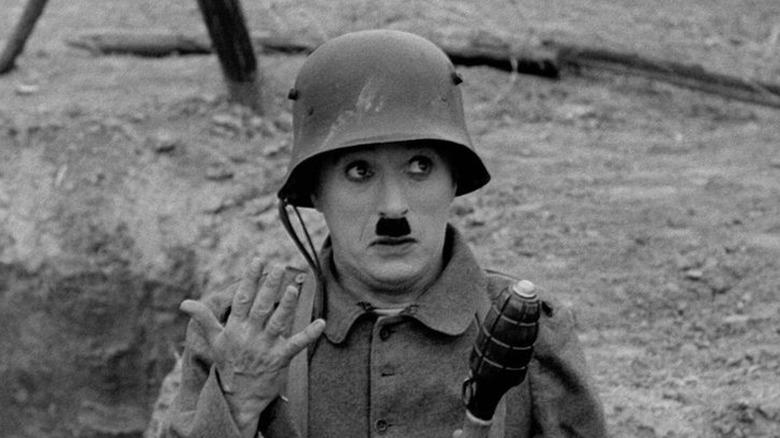
The story goes that Winston Churchill was happy to attend a gala party in Hollywood, even though the guest of honor, Charlie Chaplin, was a communist; Churchill couldn't stand communists. Regardless, Chaplin and Churchill got along swimmingly at the party, held at the home of well-regarded Hollywood starlet Marion Davies. Chaplin recalled that Churchill, as quoted in Andrew Roberts' book, stood apart from the main party crowd, "Napoleon-like, with his hand in his waistcoat, watching the dancing."
It seems that throughout the party and late into the night, Chaplin and Churchill would chat about movies. By 3 a.m., they were already making Big Plans. Churchill would write a Napoleon script, and Chaplin would star. It's not reported on, but one can easily imagine some potent cocktails being involved in the process. Churchill was quoted by Chaplin as saying:
"Think of the possibilities for humor. [...] Napoleon in his bathtub arguing with his imperirous brother who's all dressed up, bedecked in gold braid, and using this opportunity to place Napoleon in a position of inferiority. But Napoleon, in his rage, deliberately splashed water over his brother's fine uniform, and he has to exit ignominiously from him. This is not alone clever psychology. It is action and fun."
A fun pitch, I suppose, although a weird thing to focus on when thinking about a biography of Napoleon. Chaplin and Churchill, however, continued to communicate, and Chaplin even invited Churchill to look at early footage of "City Lights" as it was being filmed. Andrew Roberts' book noted that Churchill called Chaplin "a marvelous comedian, bolshy in politics and delightful in conversation." "Bolshy" being short for "Bolshevik," i.e. communist.
What happened to the Chaplin/Churchill Napoleon movie?
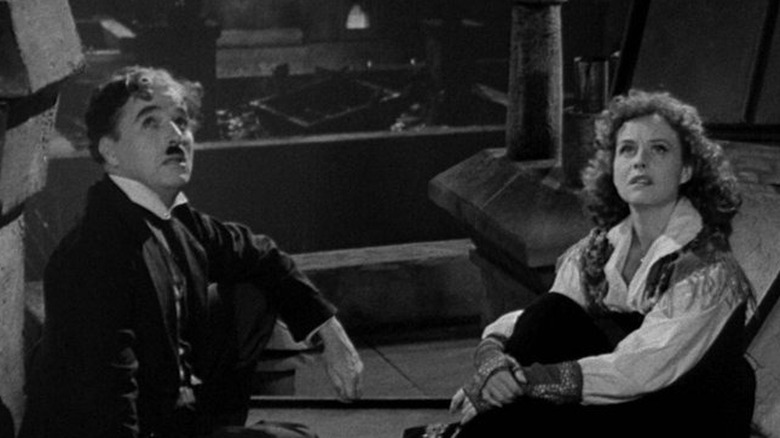
Andrew Roberts' book makes no further reference to the fate of the Chaplin/Churchill Napoleon movie. It's also unclear whether the film was meant to be an outright comedy or whether Churchill simply described it as having comedic potential. We can only speculate that Churchill's pitch to Chaplin led the filmmaker to hunker down and make "The Great Dictator" in 1940.
It should be noted that Winston Churchill was very well aware of cinema's power on the geopolitical stage. According to museum heads (as reported by the BBC), Churchill noted that the 1942 Best Picture winner "Mrs. Miniver" had more power in the Allied effort to win World War II than five battleships or 50 destroyers. Fun trivia: lead "Miniver" actress Greer Garson gave the longest Oscar acceptance speech in history.
It should also be noted that Churchill was also a prolific writer, who wrote history books, biographies, and even some fiction; Churchill wrote a novel called "Savrola: A Tale of the Revolution in Laurania." Churchill even penned a few screenplays. Naturally, none of them were ever made.
Mostly, one can easily find many, many books of Winston Churchill's speeches. And we can always content ourselves by reading any number of detailed biographies of Churchill. Or we can watch "Darkest Hour," a 2017 Churchill biopic starring Oscar winner Gary Oldman and directed by Joe Wright. Churchill and cinema were close chums. It's a pity, though, that the Napoleon comedy never came to light.