

The Only Clint Eastwood Movie To Earn One Star From Roger Ebert Was A Major Flop
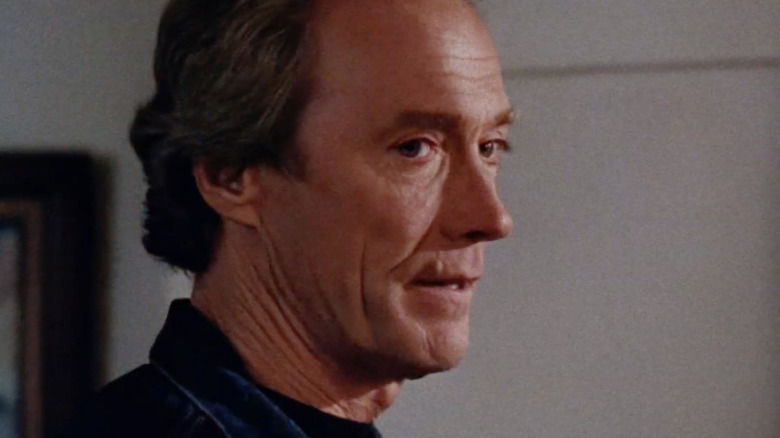
On the whole, Roger Ebert seemed to be a fan of Clint Eastwood as both an actor and director. The famed critic awarded the screen legend plenty of stars in his time, even handing out a perfect score to Eastwood and Matt Damon's "Hereafter." But there was one Eastwood movie that Roger Ebert simply couldn't bring himself to give more than a single star: "Pink Cadillac."
This 1989 action comedy was directed by Eastwood's longtime stunt double Buddy Van Horn, who graduated to directing with "Any Which Way You Can," the 1980 follow-up to the controversial 1978 Eastwood project "Every Which Way but Loose." Where that film was an unlikely hit that saw its star share the screen with a trained chimp named Manis, Van Horn's "Any Which Way You Can" was a decent enough sequel, even if the critical reaction wasn't quite as positive. Unfortunately, Eastwood's next collaboration with Van Horn, 1988's "The Dead Pool," wasn't quite so successful. That flick came in near the bottom of /Film's ranking of every "Dirty Harry" movie, and the next Van Horn x Eastwood collab might have been even worse.
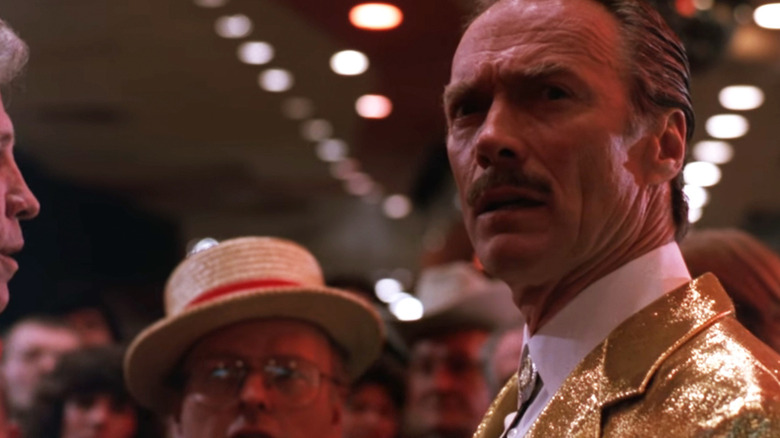
1989's "Pink Cadillac" debuted in a seminal year for movies, if only because this was the year Tim Burton's "Batman" bowed. The summer of '89 became the summer of "Bat-mania," which ultimately changed movie marketing forever, with fans flocking to their local multiplex to see Burton's innovative take on the Dark Knight. At the same time Eastwood was dressing like a sleazy nightclub promoter and delivering lines such as, "Too much raw dude for ya, huh babe? Well, I can dig it!" Ebert hated the film, which was unsurprisingly one of Eastwood's bigger flops.
Roger Ebert was perplexed at best by the racists in Pink Cadillac
"Pink Cadillac" didn't go over too well in general, but especially with Roger Ebert, who bestowed a single star on what is easily one of Clint Eastwood's worst movies. The critic decried the "idiotic behavior of most of the characters in the film" asking, "How can we take a thriller scene seriously when the characters don't?"
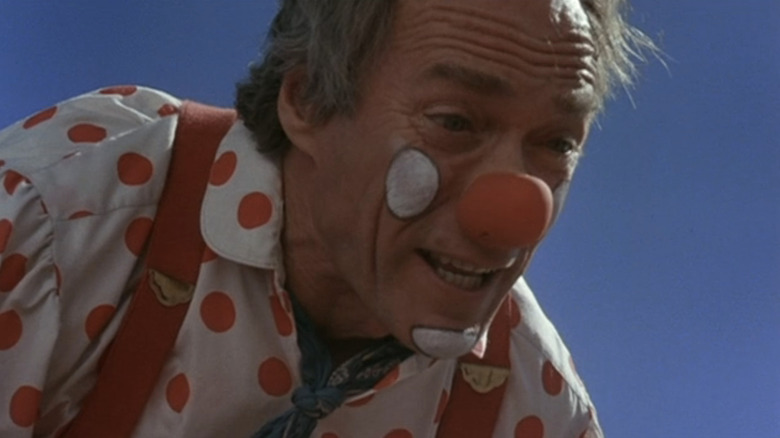
The comedy sees Eastwood play bounty hunter Tommy Nowak, who's tasked with tracking down Bernadette Peters's Lou Ann McGuinn, the wife of a white supremacist gang member. Sounds hilarious, doesn't it? As you might expect, the resulting film is a bit of a mess, with Eastwood adopting a variety of disguises to ensnare his marks, all of which might have been designed to showcase his lighter side but really just end up making him look ridiculous. As Nowak hones in on Bernadette, we learn that beneath the hood of her pink Cadillac sits $250,000. That money belongs to the white supremacists, who are also in hot pursuit, leading to a cat-and-mouse game between Nowak, Bernadette, and a dangerous gang of menacing racists.
This incongruous mix of elements is what seems to have bothered Ebert most about "Pink Cadillac." Commenting on Eastwood's outlandish disguises, the critic wrote, "This silliness might work in a movie like 'Every Which Way But Loose,' but 'Pink Cadillac' has a disturbing subplot about a secret army of white racists — and so the comedy seems out of place." Never mind that "Eastwood and Peters do not seem to feel, or express, a convincing bond" or that "there's little that's new in the material." No, the real issue for Ebert was that Buddy Van Horn and his star were being frivolous in their treatment of a disturbing real-world problem.
Roger Ebert was deeply uncomfortable watching Pink Cadillac
Warner Bros. must have known it was in trouble with "Pink Cadillac," seeing as the narrator of the film's theatrical trailer repeatedly refers to Clint Eastwood as "Clint" throughout his voiceover — as if to say "I know it looks awful, but it's your old buddy Clint!" For Roger Ebert, however, nothing was going to make up for the way in which "Pink Cadillac" attempted to mine the problem of racism for laughs.
"Nobody seems to have asked whether the emotional charge of blatant racism belongs in a lightweight story like this — even if the racists are the villains," he wrote in his review. As Ebert saw it, using an army of racists in an action comedy was "inappropriate," and the critic even admitted to feeling "uncomfortable" when the leader of this gang "ran down the usual litany of racist slurs." In summation, Ebert essentially urged Eastwood to be more considerate in his treatment of real socio-political issues. "In the times we live in," he wrote, "the offensiveness of such words should be observed, and they should not be used thoughtlessly."
There really is little to recommend with "Pink Cadillac," unless you like the idea of laughing at Eastwood struggling through one of his worst films. One of this forgotten 80s comedy's only highlights is when Eastwood and Jim Carrey briefly cross paths, with Dirty Harry throwing one of his best-ever scowls in the direction of early-career Carrey as he performs on a casino stage. Otherwise, the film is unintentionally hilarious, as Eastwood does his very best to commit to material that was always going to have audiences laughing at, rather than with, him. Or, in Ebert's case, feeling deeply uncomfortable.