

Drew Barrymore And Debi Mazar's Original Batman Forever Character Names Were Too Dirty
The Tim Burton "Batman" movies taught non comic readers how dark the Caped Crusader and Gotham City can get (even if Burton himself thinks they're tame next to newer Batman movies). Then, Burton's successor Joel Schumacher tried to overhaul the cinematic Batman back to the Adam West mold. "Batman Forever" introduced Robin (Chris O'Donnell), while both it and its sequel, "Batman & Robin," starred campy villains with ostentatious costumes, lairs, and death traps.
In West's "Batman," the male super-villains typically had molls. The first appearance of the Joker (Cesar Romero), in "The Joker Is Wild" & "Batman Is Riled," features a breathy-voiced blonde woman named Queenie (Nancy Kovack). I wouldn't be surprised if Paul Dini's childhood memories of those episodes (subconsciously) influenced the later creation of Harley Quinn. "Batman Forever" honored this tradition by giving the bifurcated baddie Two-Face (a hammy but unenthused Tommy Lee Jones) two henchwomen.
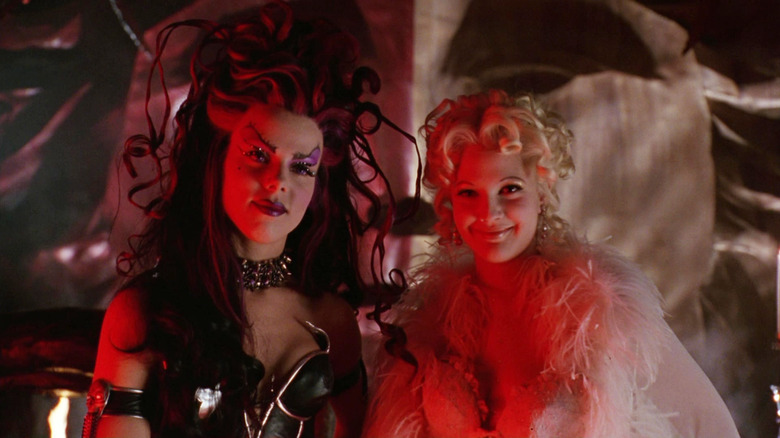
Two-Face is a villain all about the dichotomy of good and evil, so, of course, his choice in women reflects that — it's split between soft sweetheart Sugar (Drew Barrymore) and the devilish Spice (Debi Mazar). Their names are, naturally, an homage to the rhyme "What Are Little Boys Made Of?", which suggests girls are made of "sugar, spice, and everything nice." (That last part got left out of these two villainesses.) But originally, the duo's names were ... well, spicier.
As Schumacher, who cast Barrymore due to a pre-existing friendship and Mazar after she acted in "Goodfellas," told The Hollywood Reporter in 2015: "The original characters were called Leather and Lace. The studio felt that was a little — you know — so they became Sugar and Spice, the PG-13 version. They were great."
Rather than a nursery rhyme reference, "Lace" and "Leather" refers to the very different types of lingerie the pair wear.
How Sugar and Spice fit into Batman Forever's queerness
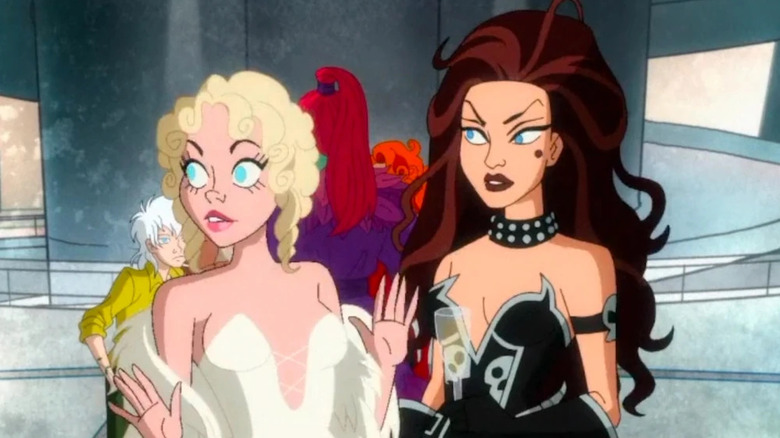
In "Batman Forever," Drew Barrymore's Sugar looks like Marilyn Monroe, i.e. the classical sexy but sweet gal, while Debi Mazar's Spice dresses like a dominatrix. They both wear strapless corsets, yet Sugar's is indeed lacy with stockings, and the white coloring suggests the wings of an angel. Spice's outfit, meanwhile, has skeletal patterning, fishnets, a spiked choker, and more obvious makeup. Similarly, where Sugar has big round eyes suggesting innocence (even though she isn't), Spice has Mazar's sharper stare. (When the pair made a cameo in the animated "Harley Quinn," their character models amplified this.)
Joel Schumacher was a gay man, and "Batman Forever" is a very queer film. So, how does two beautiful women parading around in corsets track with that? Are Sugar and Spice Schumacher's indulgence of the (straight) male gaze? They do fit into the tradition of femme fatale Batman villains with sexy gimmick outfits (see: Catwoman and Poison Ivy, the latter of whom Schumacher then used for "Batman & Robin"). Yet, they only highlight the queer themes of Batman.
"Batman is very, very gay. There's just no denying it. Obviously, as a fictional character, he's intended to be heterosexual, but the basis of the whole concept is utterly gay," to quote acclaimed comic writer Grant Morrison. Gotham City is filled with women in kinky costumes who throw themselves at Batman, but "he doesn't care — he's more interested in hanging out with the old guy and the kid," Morrison continued.
Schumacher's "Batman" movies, especially Sugar & Spice, support Morrison's point. Schumacher especially depicts Batman (Val Kilmer) and Robin not as surrogate father and son, but as two burgeoning life partners. No perfunctory romances or eye candy villainesses hide the core emotional relationship of the Schumacher "Batman" duology.