

One Of The Flash's Most Controversial Scenes Calls Back To An Award-Winning Banned DC Comic
We may receive a commission on purchases made from links.
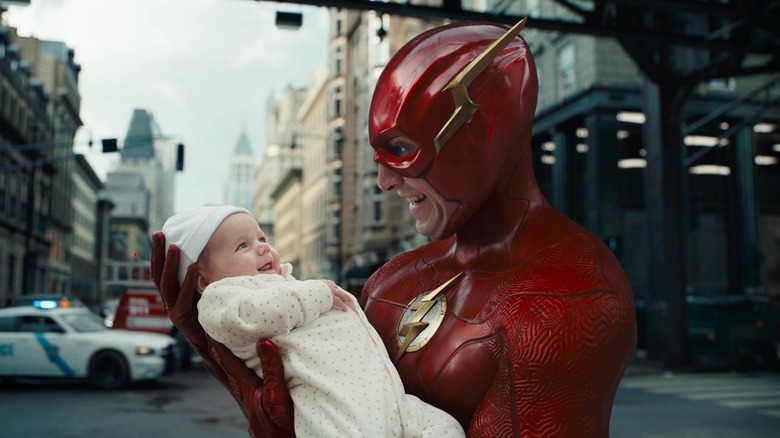
At the beginning of Andy Muschietti's 2023 superhero flick "The Flash," the title hero (Ezra Miller) rushes to a collapsing hospital to engage in some standard superpowered superheroism. The building shudders, and all the denizens of an infant nursery high above the street are thrown out of the window. Babies scatter through the air high above the Flash's head. Luckily, the hero can run so quickly, time appears to stop for him. The Flash, lightning-quick, runs up the side of the building, bounding across time-frozen pieces of detritus to catch the babies (and their nurse) midair. He then rushes them each back down to the ground below.
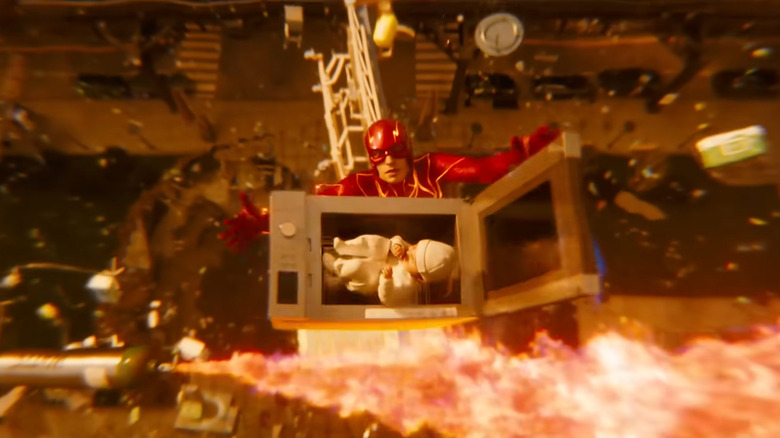
During the slow-motion fall, however, the Flash notices that many of the babies are in additional peril. One of them has sharp scalpels flying toward it, for instance. Another one is about to be incinerated in an explosion. The Flash is, while bounding across the frozen objects, able to block the scalpels and mitigate any harm.
Controversially (but amusingly to /Film), the Flash grabs a microwave oven, also included among the flying objects, and snaps it shut around the baby that's about to be incinerated. The baby is saved from the fire, although it's an absurd sight, seeing the Flash put a baby in a microwave. Once everyone is safe, the Flash extracts the baby from the microwave in relief. The baby's nurse screams in horror. It's a wacky scene in a chaotic movie.
Weirdly enough, this wasn't the first time that a DC Comics character courted controversy over a baby being placed in a microwave. Back in 1999, in a one-shot comic called "Elseworlds 80-Page Giant," a baby Superman ended up in a microwave while being watched by an irresponsible babysitter name Letitia Lerner.
It wasn't just The Flash: Baby Superman ended up in a microwave too!
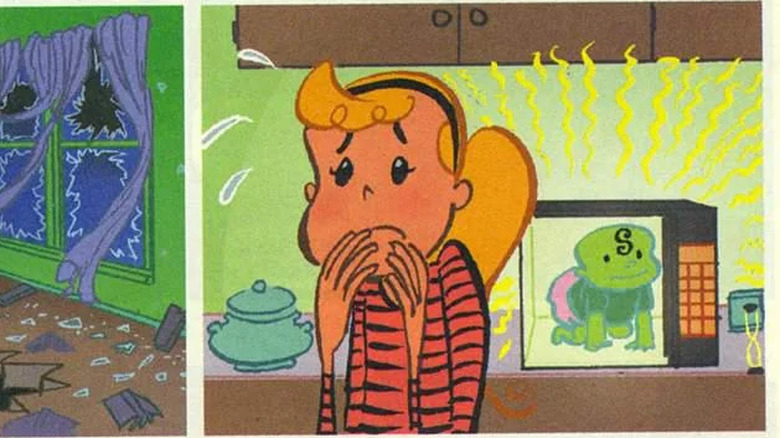
The "Elseworlds" story in question was called "Letitia Lerner, Superman's Babysitter," written by Kyle Baker and Liz Glass, and it imagined a night wherein an ordinary human was asked to babysit a months-old Clark Kent while his parents went out for the evening. Naturally, because the baby is superpowered, everything quickly descends into chaos. Letitia has to rescue baby Clark from the roof. At the end of the story, baby Clark, without Letitia noticing, climbs into a microwave oven and gets a dose of radiation. Ma and Pa Kent come home just as the infant is being cooked. Luckily, they are unfazed, noting that they'll pay double their promised rate, and can you come back this weekend?
It's a cute gag. Indeed, the idea of babysitting a superpowered infant was re-used in the 2005 Pixar short film "Jack-Jack Attack," a spinoff of "The Incredibles." Everything is funny because we know that the infant Superman can withstand being cooked in a microwave without any discomfort whatsoever.
The image, however, very much upset the editor and vice president of DC Comics, Paul Levitz. According to the website Recalled Comics, "Elseworlds" was not just recalled, but destroyed. The issue remains somewhat rare to this day because of the controversial microwave scene. Naturally, the recall only made "Elseworlds" a hot collector's item. The story, incidentally, won two Eisner Awards.
DC, however, seems to have rethought their decision, as they decided to reprint the story in 2001 in a compilation called "Bizarro Comics." "Elseworlds 80-Page Giant" was then reprinted in full in the late months of 2011. The microwave drawing was left intact, and there were no angry letters.
The offending comic was eventually reprinted, but the timing was very bad
The timing of the last reprinting was strange, though, as it coincided with a grim real-world event involving a baby in a microwave. In 2005, a woman named China Arnold was arrested in Ohio for actually murdering her own infant daughter by cooking her in a microwave. By May of 2011, she had undergone a third trial, and was found guilty of aggravated murder. She is currently serving life without parole. It was very odd that DC Comics should, later that same year, decide that it was finally a tactful time to reprint a baby in a microwave.
Of course, by 2023, everyone seems to have forgotten about the "Elseworlds" kerfuffle, and DC Studios actively elected to include a scene in their $220 million ultra-blockbuster wherein the hero — the hero! — puts a baby in a microwave. Sure, the microwave was unplugged, and it actually served as a means of protecting an infant from a blast of fire, but the image is still strange. Newsweek criticized the scene.
It's worth noting that "The Flash" was a gigantic bomb, making only $271.4 million at the box office. Its star, Ezra Miller, had already been ousted as a strange abuser who was always in trouble with the law, all prior to the release of the movie, so their reputation didn't help. Seeing Miller put a baby in a microwave was more unsavory than whimsical. "The Flash" was part of the decade-long film series called the DC Extended Universe, which crashed out at the end of 2023. One can point to the failure of "The Flash" as a decisive moment in the DECU's closure, although whether or not the microwave scene itself is to blame is a matter of debate.