

Steven Spielberg's Jaws Success Led To The Creation Of This Cult Classic '70s Horror Movie
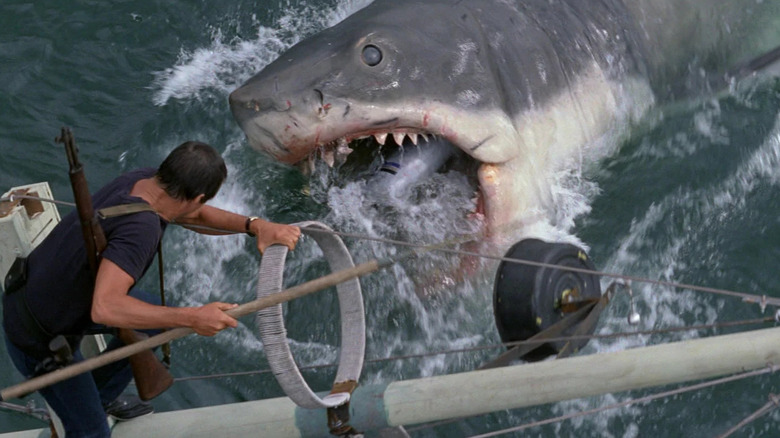
Director Steven Spielberg's 1975 film classic "Jaws," as you're most likely aware, centers on a great white shark that's stalking the beaches of a New England resort town. However, the town makes a whole lot of money from its tourism trade, so its mayor refuses to close its beaches. Spoiler: This gamble doesn't work out, so the movie then climaxes with its heroes setting off to kill the big fish. Although simple enough plot-wise, "Jaws" changed the box office forever and the greater cinematic landscape with it.
Naturally, Spielberg's film spawned a whole lot of imitators as well, and while none of them enjoyed the same popularity, the likes of "Piranha," "Orca," and "Mako: The Jaws of Death" gave rise to a fun, whimsical genre unto itself. (Heck, we here at /Film previously ranked the best "Jaws" knock-offs.) Even to this day, shark movies are still being produced thanks to "Jaws," with 2026's "Thrash" being a recent example.
Weirdly enough, even Nobuhiko Obayashi's 1977 cult classic "House" was meant to be a "Jaws" knock-off starting out. As it now exists, "House" is a surrealist masterpiece packed with bizarre, bloody images and twisted horror conceits that escaped unaltered from the cat-infested brain of an out-of-control TV commercial director. It does not, however, have any sharks in it, nor does it take place on a beach or involve attacking animals.
So, how is it connected to "Jaws" then? Per the British Film Institute, "House" backer Toho had asked Obayashi to make a film in the same vein as Spielberg's blockbuster. That he instead turned in "House" serves as a glorious miracle of misunderstanding the assignment.
You would never guess that House began as a Jaws knock-off
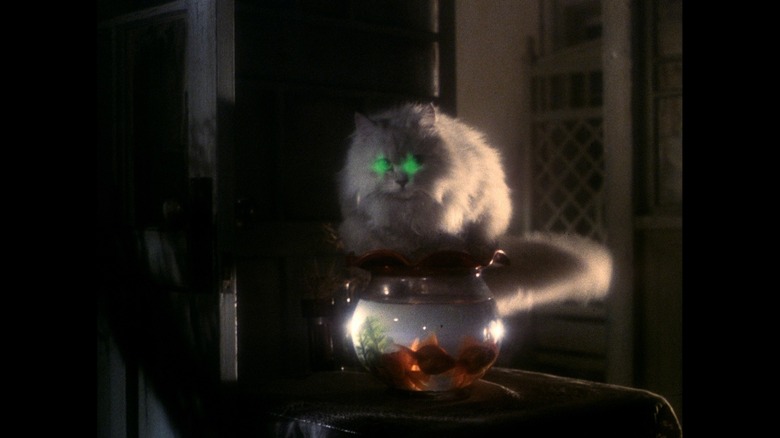
"House" was Nobuhiko Obayashi's first feature film, with the director having previously worked in the world of TV commercials. He wasn't really sure how to appeal to a mass film audience, however, so he grilled his young daughter, Chigumi, on the kinds of things that might scare her if she saw them in a horror movie (per the BFI). She came up with the idea of "a house that eats girls" and suggested a few horror scenes that made their way into the final film. For example, she thought of someone dropping a watermelon into a well, only to retrieve a severed head instead.
The film also features a piano that eats teenage girls, a bizarre mirror, and a martial artist getting partly sucked into a ghostly dimension, her legs still dangling around in ours. Weirder still, there's a dancing skeleton as well, along with several girls being offed and/or terrified by a ghost who might actually be a cat (... or something) and a bear preparing sushi. Elsewhere, at one point, a young man is shown driving to the titular house in a dune buggy, implying that he may rescue the heroines. What happens to him is flabbergasting.
In the documentary film "Constructing a House," itself included in the "House" Criterion edition, it's explained that the movie's score was completed before shooting began. Asei Kobayashi played piano pieces for the soundtrack, and the rock band Godeigo wrote a few songs. Obayashi later played the film's soundtrack (an odd mix of pop, fairy tale music box melodies, and big musical stings) on set to get his actors in the right frame of mind.
It's all so wonderfully incongruous. One would never guess this film began as a "Jaws" knock-off.
House isn't a proper Jaws knock-off, but it has become a hit
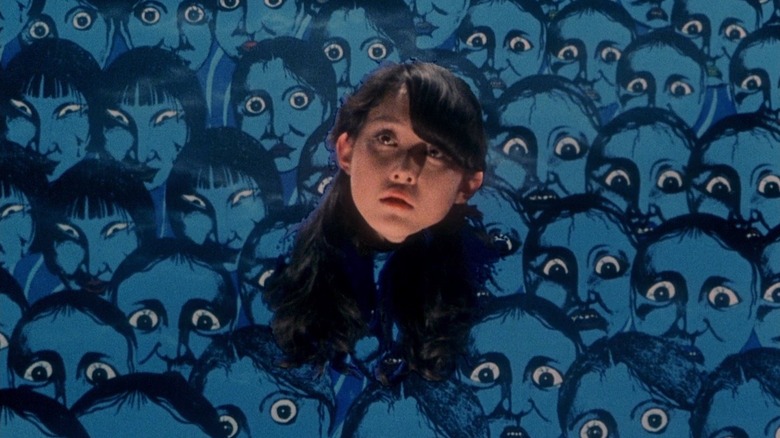
An insightful essay by Chuck Stephens on the Criterion website examines how "House" could have come into being, especially if the mandate was for Nobuhiko Obayashi to make a "Jaws" knock-off. The late 1970s was, the essay observes, a weird time for Japanese cinema. The Japanese New Wave of the late 1960s was still rolling high, and directors like Nagisa Ōshima, Shōhei Imamura, and Seijun Suzuki ("Branded to Kill") still occasionally making striking movies. Japan was also still getting yakuza films from the likes of Kinji Fukasaku (the eventual director of "Battle Royale"), but they were falling out of fashion.
Strangely, though, 1977 was a sudden dead zone for the movement (as Stephen notes). Imamura and Ōshima didn't release any movies that year, while cinematic elder statesman Akira Kurosawa had only just revived his career with 1975's "Dersu Uzala." Instead, the big hits of the day were high-end adult dramas. Thus, Obayasho pushed "House" into this miniature dead zone, finding the only crack it could slip through. The world now had to contend with this bizarro thing based partly on the nightmares of its director's daughter.
The film remained obscure in the U.S. for decades before coming to cult movie fans' attention in 2010, when it got a proper wide release. (The Criterion Collection churned out a Blu-ray later that same year.) According to the "Constructing a House" documentary, "House" became a hit stateside, especially among teenagers. Obayashi might not have been able to create a proper "Jaws" knock-off, but he gave Toho its money's worth anyway.
"Jaws" is a fine enough movie, but as someone who loves truly gonzo cinema? Give me "House" any day of the week.