

Why Stan Lee Lied About His Role In Killing Spider-Man's Girlfriend Gwen Stacy
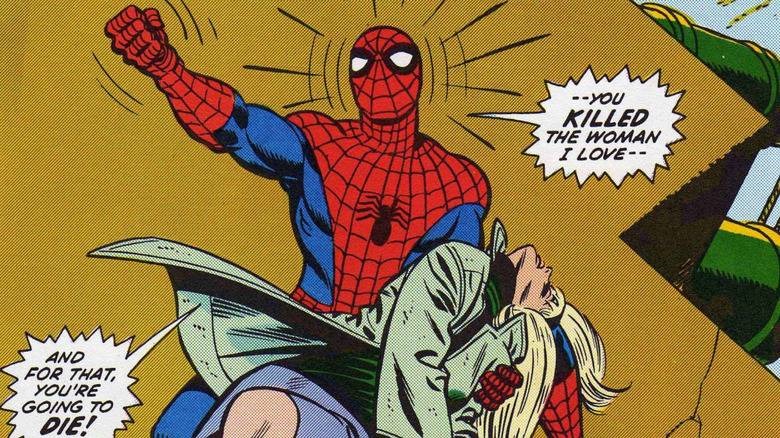
The two-issue story arc known as "The Night Gwen Stacy Died" appeared in issues #121 and #122 of "The Amazing Spider-Man," published in June and July of 1973. Almost every single Marvel Comics fan knows about this story, as it might be one of the most important in Spider-Man's history. Gwen Stacy, of course, was Peter Parker's girlfriend at the time, and she was a major part of the comics. It was practically unthinkable to kill her off.
During the story, one of Spider-Man's nemeses, the Green Goblin, abducted Gwen Stacy and used her to lure Spider-Man to the top of a bridge. During the ensuing fight, the Green Goblin threw Gwen off the bridge, forcing Spider-Man to catch her with one of his trademark web strands. Sadly, when Spider-Man hoisted Gwen back to safety, he found that she was already dead. It's widely accepted among Spider-Fans that Gwen's death was caused by the sudden jolt of being halted midair by Spider-Man's web. He accidentally killed his girlfriend while trying to rescue her. It's one of the saddest moments in Spider-Man history, and one of the most significant in the history of the medium.
"The Night Gwen Stacy Died" was written by the late, great Gerry Conway. Stan Lee, the head honcho of Marvel, long maintained that killing Gwen was Conway's idea, and that Lee had little to do with it, which was a convenient stance to have in the wake of all the fan backlash. At a 2013 convention, though (transcribed by Popverse), Conway maintained that Stan Lee signed off on the idea, and only changed his tune when it looked like the fans were getting angry. When Stan Lee disowned "Gwen Stacy Died," he was lying.
Stan Lee lied about Gwen Stacy when he saw the fans were getting angry
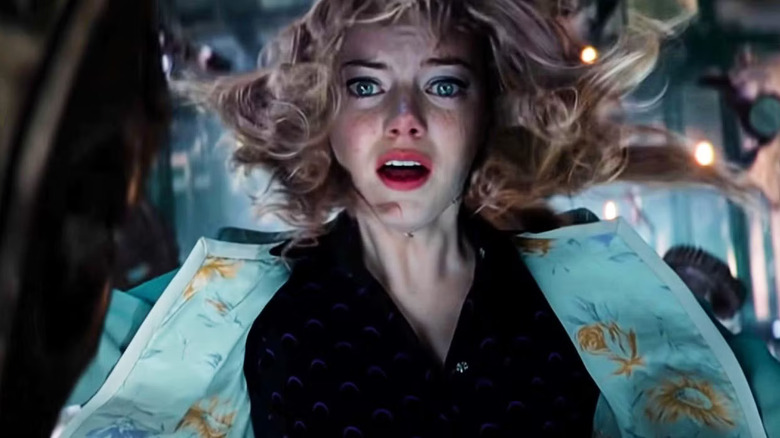
Essays have been written about how the death of Gwen Stacy was the moment that superhero comics "grew up," moving the industry from its Silver Age to its Bronze Age. /Film has also analyzed the death of Gwen Stacy and why it was so important in the annals of Marvel Comics.
But the fans were incensed. Indeed, fans were so angry that a major Spider-Man character was killed, they flooded the Marvel offices with angry letters, expressing their disgust. According to Popverse, Stan Lee disavowed any knowledge of the story, claiming that it had been published without his oversight.
Gerry Conway, however, knows the score. In 2013, he recalled very well the conversation he had with Stan Lee, and that Lee had given his full permission for Conway to kill Gwen. In his words:
"Stan did not say no to this. [...] I mean, Stan was fine with it. He was like, 'Yeah, okay. Go kill her.' But Stan did get a lot of heat at conventions and at college campuses, and as a result of that, started claiming that it happened when he had been out of the office and didn't know."
At those same gatherings, Lee placed the blame for Gwen's death right on Conway's shoulders. Conway, meanwhile, was a little blindsided by all the sudden negative attention. It's worth noting that Conway was born in 1952, meaning he was quite young, only in his early 20s, when this all went down. Stan Lee, the head honcho, essentially threw one of the Marvel kids under the bus, and the kid wasn't ready for it.
Gwen was resurrected after the backlash
Gerry Conway was plain-spoken about what happened, the fear it instilled in him, and just how young he was. He said:
"Yes, Stan did blame me. That was, I think, a defensive move on his part, because he didn't really know that things were going to explode. None of us did. I felt very traumatized because I was a kid. I was like 19 years old or 20 when this happened. For many years, I didn't go to conventions, I didn't read letters from fans because they were just filled with rancor and hate."
This is not the sort of experience one wants to have when they're a young kid trying to make a name for themselves at a new gig in the comics industry. The backlash, and Stan Lee blaming him for it, left an impression on Conway, but luckily, he stayed with Marvel and continued to write for decades. But about that time in the 1970s, he said:
"You get kind of impressionable about that kind of stuff. Stan did sort of shift the blame off onto me and onto [then-editor-in-chief Roy Thomas] and the other people at the office, and that's why he asked us to bring Gwen back."
Gwen was eventually brought back ... as a clone. But that wasn't really the satisfying return fans wanted, and led to the Clone Saga, an extended 1990s Spider-Man arc that no one is particularly fond of.
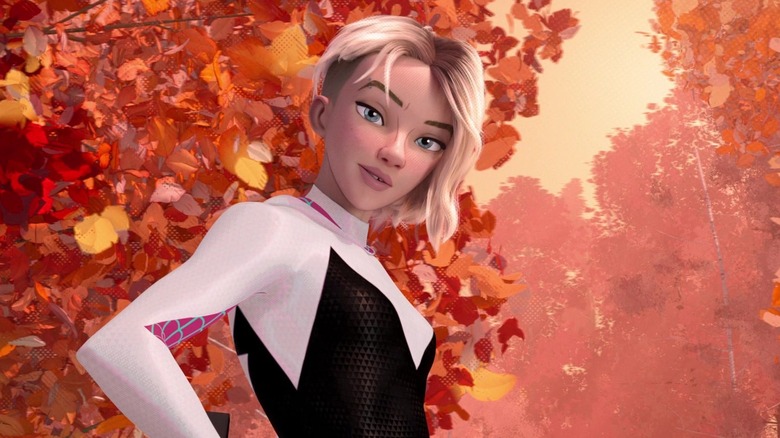
Thanks to parallel universe shenanigans, however, Gwen Stacy has been brought back in multiple ways ... and is even a superheroine in her own right, called Spider-Gwen, a.k.a. Ghost-Spider. Spider-Gwen has appeared in the two "Spider-Verse" movies to date, so it seems Gwen has been rescued after all.