

50 Years Later, Robert Redford's Intense Thriller Is Worth Revisiting On HBO Max
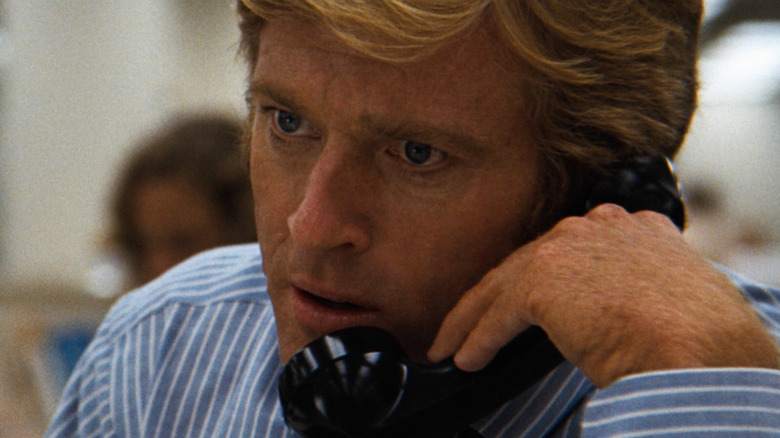
Director Alan J. Pakula's 1976 thriller "All the President's Men" was immediate and timely upon its release. It stars Robert Redford as Bob Woodward and Dustin Hoffman as Carl Bernstein, the two now-famous Washington Post reporters who blew the lid off the Watergate scandal back in 1972. This was the incident where people linked to Richard Nixon's presidential re-election campaign were caught breaking into the Watergate Hotel to steal files belonging to the Democratic National Convention and plant listening devices to illegally spy on their political rivals. Many cite the Watergate scandal as the main thing that brought down the Nixon administration, with Nixon himself resigning from office after being re-elected.
This was considered one of the biggest political scandals in U.S. history, at least at the time, and the word "Watergate" — or, more accurately, the suffix "-gate" — has since become shorthand for scandal. "All the President's Men" is presented as a matter-of-fact investigative procedural, delving into the machinations of the scandal, as well as how Woodward and Bernstein were able to uncover as much as they did. They were told to "follow the money," which is wise advice in any investigation; someone gets rich from every scandal. It certainly helped that they had a secret informant who called himself Deep Throat, after the noted adult feature that was playing in theaters at the time.
Of course, 50 years later, during the scandal-pocked, fascism-flavored Donald Trump administration, "All the President's Men" feels less like a searing indictment of corruption in American politics and more like competency porn. It's arguably the best conspiracy thriller film that was made in the '70s, and it's currently streaming on HBO Max. One might wonder if people are watching the movie now to see a time when politicians suffered consequences for malfeasance.
All the President's Men was an Oscar-winning hit
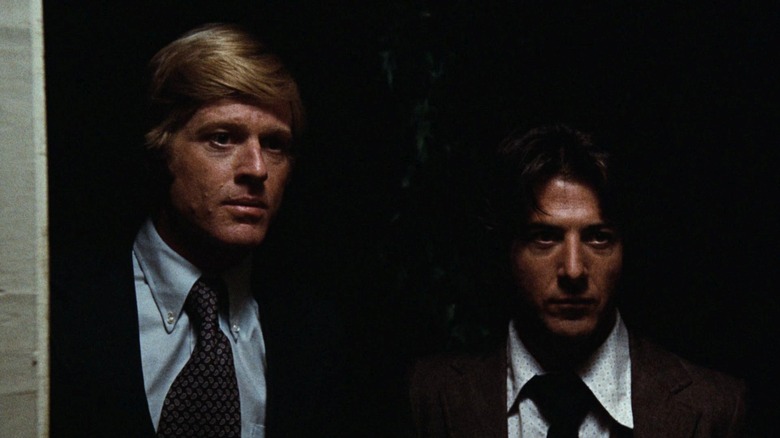
The release timeline of "All the President's Men" is quite brisk. The actual Watergate scandal took place a year after the publication of the Pentagon Papers, which exposed the truth about the U.S.'s political and military involvement in Vietnam. 2017's "The Post," an excellent picture that Steven Spielberg directed in a hurry himself, covers this event quite nicely.
Despite the scandal, Richard Nixon was re-elected President, and he charged into an administration plagued by chaos. Then, in June 1974, Bob Woodward and Carl Bernstein published their exposé book "All the President's Men," with Nixon resigning the following August. In what many consider to be a grievous miscarriage of justice, Nixon's successor, Gerald Ford, granted him a full pardon soon after.
Robert Redford also bought the film rights to Woodward and Bernstein's book in 1974, with shooting on the screen adaptation getting underway in 1975. The finished movie, with a screenplay by William Goldman, reached theaters in April 1976. Nixon was barely out of office, a figure of shame, and "All the President's Men" was a chance for U.S. audiences to look really hard at the haven for criminality that the White House had become.
"All the President's Men" soon became both a huge box office hit and a massive awards darling that landed eight Oscar nods, including ones for Best Picture, Best Director, and Best Editing. It ended up winning four Academy Awards in total, including for Goldman's screenplay (although Redford debated his participation), and for Jason Robards's supporting performance as the Post's managing editor, Ben Bradlee. Best Picture, however, ultimately went to "Rocky."
All the President's Men is quaint compared to the world of politics in 2026
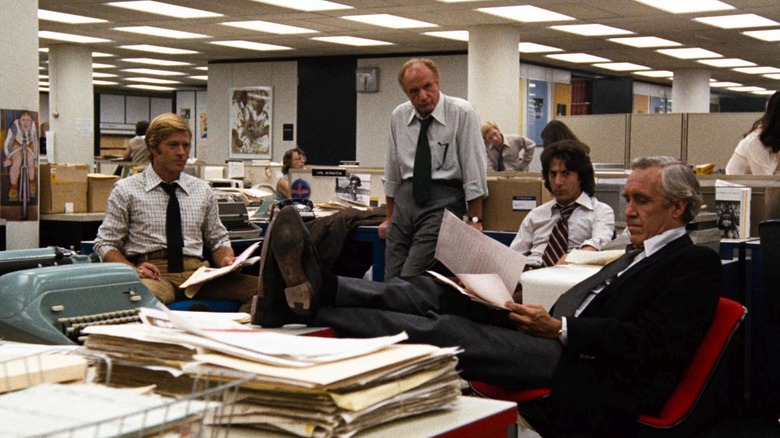
One can watch "All the President's Men" and just enjoy its taut filmmaking, amazing script, and great performances. Robert Redford, Dustin Hoffman, Jason Robards, and Jack Warden, who played Harry Rosenfeld, are all great in the movie. One can also lose themselves in the righteous soul of the film, which stands up for the tenets of journalistic integrity, the truth, and the dangers of speaking truth to power. It might even serve as a valuable history lesson for those who weren't alive during the Nixon administration. It's going to be an exhilarating experience regardless.
But at the same time, "All the President's Men" feels quaint in 2026. Richard Nixon was scandalized by the revelation of his crimes and resigned in disgrace largely as a direct result of what the Post brought to light. During the two Donald Trump administrations, however, the president has been openly corrupt, flouted the law repeatedly, and — thanks to a complicit political party behind him and the support of an online/TV right-wing media onslaught — never faced even the smallest bit of consequences. Reporters can uncover many scandals and crimes in Trump's past and see what he's doing in the present to fire and intimidate opponents, and we tend to throw each scandal on the pile with all the other ones. And he experiences no remorse. Trump, apparently, never developed his shame gland.
It's weird, then, to consider that "All the President's Men" is now a comfort watch. It presents a reassuring vision where everyone is good at their jobs, journalism is the last noble vanguard against wicked, corrupt leaders, and scandal-ridden presidents actually appear to experience shame when ousted. No wonder it still feels so timely.