

Star Trek Creator Gene Roddenberry Had A Scientific Explanation For Spock's Green Blood

We may receive a commission on purchases made from links.
In the "Star Trek: The Original Series" episode "The Naked Time," it was established that Vulcans had copper-based blood, which was what caused it to turn bright green when it was exposed to air. Throughout "Star Trek," Dr. McCoy (DeForest Kelley) often made bigoted comments about Spock (Leonard Nimoy) and his unusual, green Vulcan blood. Spock's green blood didn't appear on camera in the original series, but in later iterations of "Star Trek," Trekkies would see Vulcans bleeding green.
The idea that Vulcans should have green blood was born of the makeup given to Leonard Nimoy. Nimoy was made up to be slightly yellow in hue for early episodes of "Star Trek," likely meant to highlight his alien-ness alongside his angled eyebrows and his outsize, pointed, Mephistophelean ears. According to the book "Captain's Logs: The Unauthorized Complete Trek Voyages," the idea of giving Spock green blood belonged to regular series director Marc Daniels. He was quoted as saying that "The green blood was my idea, because if Spock was going to have a yellow complexion, he ought to have green blood." Daniels recalled series creator Gene Roddenberry objecting to the idea of Spock having green blood, at least at first, but he ended up parlaying the fact into future episodes and it became canon.
Meanwhile, in David Alexander's book "Star Trek Creator: The Authorized Biography of Gene Roddenberry," it was noted that Roddenberry would often answer fan letters, addressing their concerns about details on the series. When a fan wrote in asking about Spock's blood, Roddenberry had a full-on scientific answer, describing the mineral content of Spock's blood, a Vulcan's heart rate, and other sci-fi facts about an alien circulatory system. Roddenberry had very much come around to Marc Daniels' way of thinking.
Gene Roddenberry said that there were unusual minerals in a Vulcan's blood

Transcribed in David Alexander's book was a letter from Gene Roddenberry that outlined Vulcan physiology quite clearly. And because Roddenberry wrote it, it's safe for all Trekkies to consider this canonical. It also, in true Roddenberry fashion, addressed the notion of inter-species sex (one doesn't need to watch too many episodes of "Star Trek" to know that Roddenberry was notoriously horny). The letter read:
"Spock's blood is green because of traces of nickel and other metals, which our blood does not have. However, the difference is minor, and it is compatible with Terra blood when the conception and pregnancy is properly planned and controlled by techniques of the highly advanced Vulcan school of medicine — just as our own present Earth school of medicine is learning to beat the RH factor. There is actually no inconsistency in having a pulse rate of 242 beats per minute and practically no blood pressure by our standards."
Roddenberry explained that this is due to Vulcan arterial diameters, continuing:
"The average diameter of [Spock's] arteries is larger than Terrna, more efficient, and the faster, lower pressued hydraulic action of his 'slightly different heart' results in about the same volume delivered as our slower, higher-pressured system."
One can only speculate if Roddenberry consulted any medical professionals on this matter, if he had some kind of cursory knowledge of blood pressure dynamics, or if he was just B.S.ing a correct-sounding theory to a concerned Trekkie. Regardless, Roddenberry took the time to address a fan's concerns in a technical fashion, which all Trekkies appreciate. We love a good, thick block of dense, scientifically plausible techno-jargon. Roddenberry was either a detail-oriented nerd, or he merely understood that "Star Trek" appealed to detail-oriented nerds.
Gene Roddenberry even had a scientific explanation for why all aliens on Star Trek are humanoid
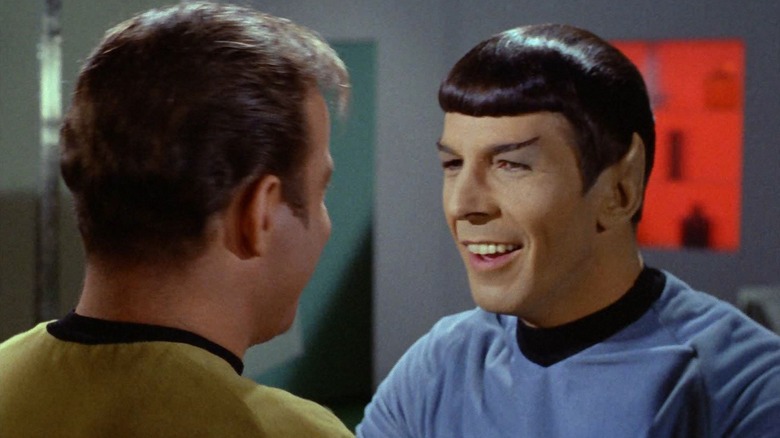
Gene Roddenberry also went on a tangent about alien physiology in general. Notably, he explained why most of the alien species in "Star Trek" seem to resemble humans so closely. The practical reason, of course, is that human actors had to play them on camera, but Roddenberry pointed out an in-canon reason as well, saying that it was all based on real science. He wrote:
"We depict humanoid aliens because we (along with Cal Tech studies and others) do believe that parallel evolution is a distinct possibility. Natural laws govern life development just as other natural laws govern time, space, and atoms. There are no 'accidents' in nature, probably not even social development."
Cal Tech is, of course, the California Institute of Technology, although I was unable to find the Cal Tech studies pertaining to parallel alien evolution. Regardless, Roddenberry felt that it was completely in the realm of possibility that aliens would evolve to look and behave like humans. That, of course, is a handy theory when you only have human actors to work with, and when the special effects of the mid-1960s didn't allow writers to visualize too many non-humanoid aliens.
This letter, of course, was written before the "Star Trek: The Next Generation" episode "The Chase," which indicated that all "Star Trek" humanoids evolved as a direct result of an ancient, ancient humanoid alien species seeding thousands and thousands of worlds with their own DNA. That, too explains why so many "Star Trek" aliens look like humans, are sometimes medically compatible for transplants, and — and Roddenberry would like this best of all — could have sex.