

60 Years Later, This Jack Nicholson Western Is Still A Gem That Deserves More Love
Outside of flogging a dying horse for diminishing commercial returns, what was the point of making a Western in the 1960s? If your name wasn't John Ford, Howard Hawks, or Budd Boetticher, what could you possibly add to the genre in terms of form and content that would interest an audience overly familiar with the sight of people working up a rotten case of saddle sores? And shootouts? And the near total eradication of an indigenous population?
The next generation of directors, who grew up loving the films of Ford, Hawks, and Boetticher, found a way. They made them bloodier and bolder. They amplified the viciousness of people traversing a lawless terrain and corrupting the granite grandeur of the land they trampled. These newfangled Westerns could be operatic (via the widescreen lenses of Italian filmmakers like Sergio Leone and Sergio Corbucci), but they could also be made on the cheap and generate a massive profit. Leone's first Spaghetti Western, "A Fistful of Dollars," cost roughly $200,000 in 1964 and grossed that total many times over. Five years later, Dennis Hopper put a couple of cocaine-slinging cowboys on motorcycles, and "Easy Rider" became a sensation that kept Jack Nicholson in the acting game.
The Western had been reconfigured to speak to moviegoers who were of draft age and furious with their parents for committing them to a pointless war in Vietnam. And this was great business for Hollywood, even though the old men running the studios found this radical tonal shift morally repugnant. Hollywood's Schlockmaster General Roger Corman didn't care. So, when director Monte Hellman and his producing partner Nicholson pitched him on a cheap Western, Corman greenlit it on one condition: make two. Both movies, "The Shooting" and "Ride in the Whirlwind," received critical acclaim, but the latter remains undervalued.
Monte Hellman and Jack Nicholson created the Acid Western in 1966
The American Western had fully entered its "revisionist" era with the dual release of John Ford's "The Man Who Shot Liberty Valance" and Sam Peckinpah's "Ride the High Country" in 1962. Randolph Scott hung up his saddle for good, while Joel McCrea should've. John Wayne persisted, but the genre now belonged to Clint Eastwood (much to Wayne's chagrin). Youth would be served.
While young moviegoers were queuing up for Spaghetti Westerns, a moody offshoot shuffled into view that would eventually be dubbed the Acid Western. Hellman's "The Shooting" kicked off this subgenre by embracing the emotional and spiritual disillusionment that had gripped the 1960s counterculture. It's an existential tale that finds Warren Oates and Will Hutchins leading Millie Perkins (seven years after starring in "The Diary of Anne Frank") to a mysterious destination, no questions asked. Along the way, they're menaced by Jack Nicholson, who's cast perfectly as a nefarious gunslinger.
Carole Eastman wrote the film's exhilaratingly unpredictable screenplay, which blasts away at set-in-stone Western conventions with gleeful aplomb. You never know where "The Shooting" is headed, but you're disconcertingly aware at every second that nothing is going to work out. "Ride in the Whirlwind" comes on with the same energy, but it doesn't rub your nose in the mess in the same way.
Ride in the Whirlwind was neither Leone nor Peckinpah
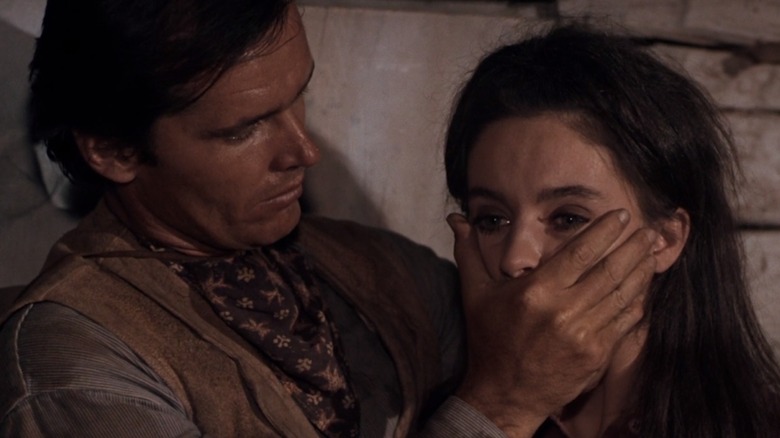
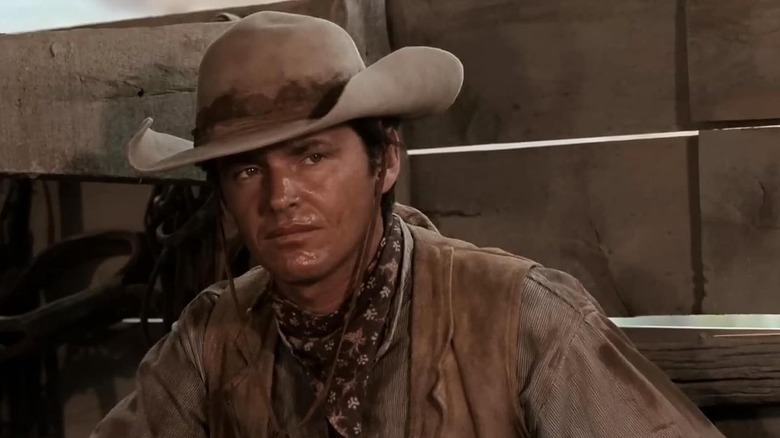
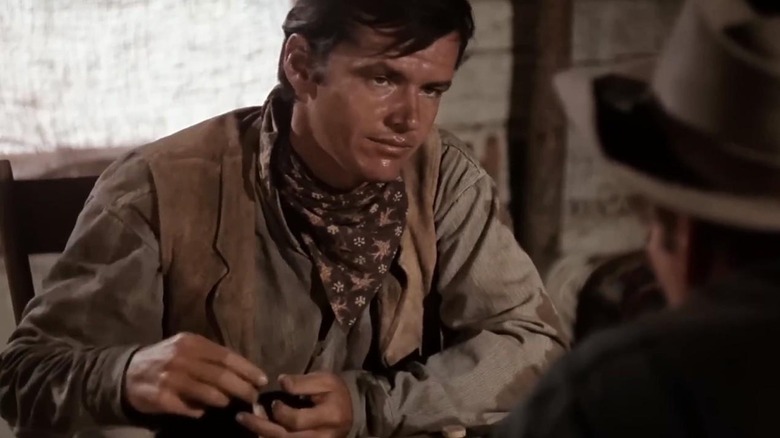
"Ride in the Whirlwind" comes out throwing curveballs, but if you know Westerns well, these are hittable pitches. Jack Nicholson shares the top of the marquee with Cameron Mitchell as a couple of cowboys who find themselves on the run from a pack of vigilantes. Though the men are innocent, they made the mistake of camping with some bad hombres (including Harry Dean Stanton as an outlaw named Blind Dick). Given that this posse is interested solely in the price on their head, Nicholson and Mitchell will be forced to take desperate, lawless actions that tragically reinforce the perception of their guilt. They wind up hiding out in a farmhouse against the will of its occupants, which builds to a violent conclusion that backs away from the bleakness of "The Shooting."
Monte Hellman makes the most of distinctive (now non-existent) Utah locations and flaunts uncommon craftsmanship that would eventually make him a cult favorite filmmaker. But despite earning plaudits at film festivals in 1966 and 1967, these movies marked the end of Hellman and Nicholson's partnership. Five years after the releases of "The Shooting" and "Ride in the Whirlwind," Hellman returned with the existential road racing masterpiece "Two-Lane Blacktop." Even with the buzzy presence of James Taylor, Warren Oates, Laurie Bird, and Dennis Wilson, the film didn't find its audience until years after its debut. Hellman's career continued despite him being an out-of-his-time auteur. I don't know how it could've gone any better for him.
I do, however, have an inkling as to why it worked out so splendidly well for Jack Nicholson.