

Star Trek Nearly Recruited A Legendary Artist To Revamp The Franchise's Scariest Villains
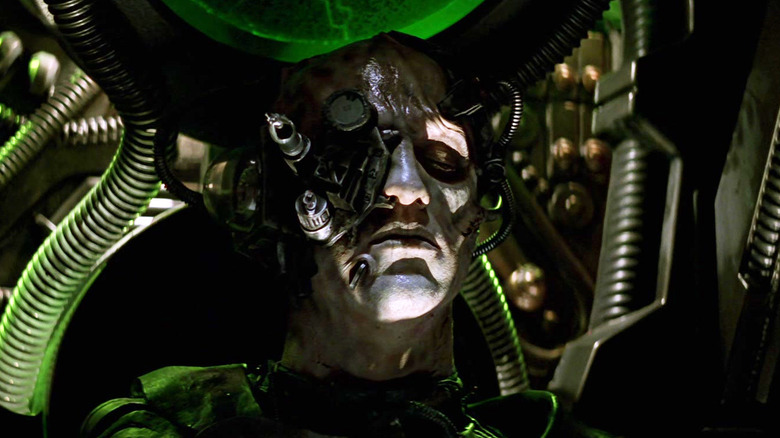
At this particular epoch in pop culture history, most anyone, not just Trekkies, could tell you all about the Borg. The Borg, of course, are a race of soulless cyborgs, possessed of a single machine consciousness, that traverses the galaxy in outsize cubic ships, kidnapping people and stealing technology for assimilation into their collective. They bear no malice; they merely take and use whatever they want, being too powerful to resist. As they tell every ship they encounter, "Resistance is futile." They were the "Star Trek" franchise's best villains ... until they weren't.
The Borg were introduced in the 1989 "Star Trek: The Next Generation" episode "Q Who" and were shown to the crew of the USS Enterprise-D as an example of a deep space threat that Starfleet is not yet prepared to face. The Borg don't have individuals. Most insidiously, they can adapt to any attack. If you kill one drone with a phaser, the next one will be resistant to phasers. The drones themselves behave like mechanical zombies. They have pale, pigment-free skin, and their bodies are covered with metal paneling or worm-like tubes. Often their eyes, ears, or mouths are stopped up with mechanical implants.
There's an eerie, biomechanical look to the Borg that was clearly inspired by the artwork of H.R. Giger, the Swiss surrealist who, of course, is best known for designing the titular creature in Ridley Scott's 1979 film "Alien." Many folks, however, are additionally familiar with the bleak, apocalyptic aesthetic of his other art, wherein human bodies merge disturbingly with industrial equipment. Fittingly, Cinefantastique Magazine reported in 1996 that Giger was once approached about revamping the Borg's design for that year's "Star Trek: First Contact." Sadly, though, he didn't end up contributing to the movie.
H.R. Giger was consulted about revamping the Borg's design for Star Trek: First Contact
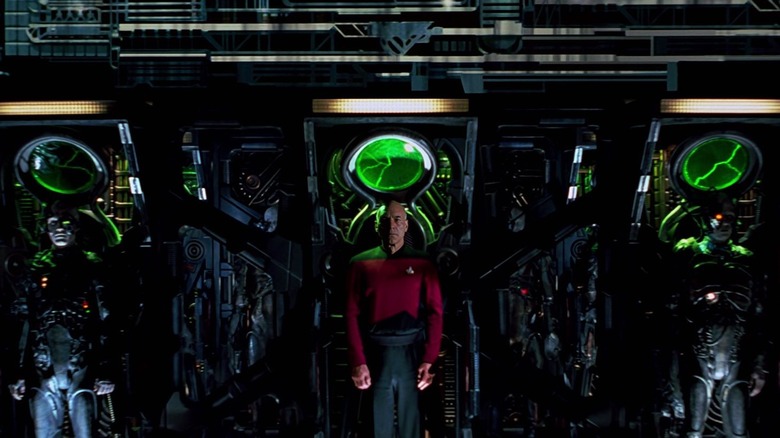
In "Star Trek: First Contact," the Borg's metal panels are more form-fitting and resemble custom suits of armor. The facial implants on Borg drones are still present, and they're still encrusted with tubes, but they have a more organic look to them. Their all-white skin is now blotchy and rash-y, and they seem to sweat, making them more animalistic and malevolent. Whether or not this is an improvement can be debated.
Longtime "Star Trek" makeup designer Michael Westmore designed the facial makeup, while the body costumes were designed by Deborah Everton. Cinefantastique Magazine mentioned, only in passing, that H.R. Giger was consulted about "First Contact," but the outlet noted that he passed on the film. One can only speculate as to why. Maybe it was because the creatives behind "Star Trek: The Next Generation" had already borrowed from him so heavily.
At the time, Giger had recently completed his work on the sci-fi horror film "Species" and was serving as a creative consultant and set designer for the 1996 German horror/comedy "Killer Condom." It's perhaps telling that Giger would rather have worked on a movie titled "Killer Condom" than be involved with a well-moneyed studio picture like a "Star Trek" sequel.
Giger was notoriously weird (the "Alien" crew referred to him as Count Dracula on the film's set), and one can perhaps imagine that he wouldn't want to sign on to a movie wherein he would be subjected to studio notes and the whims of executive producers. The "Star Trek" franchise was, at the time, closely overseen by executive producer Rick Berman, and he was stringently protective of Gene Roddenberry's creation. A wild artist like Giger would not have gotten along with Berman.
Star Trek: First Contact ultimately went with a different Borg design
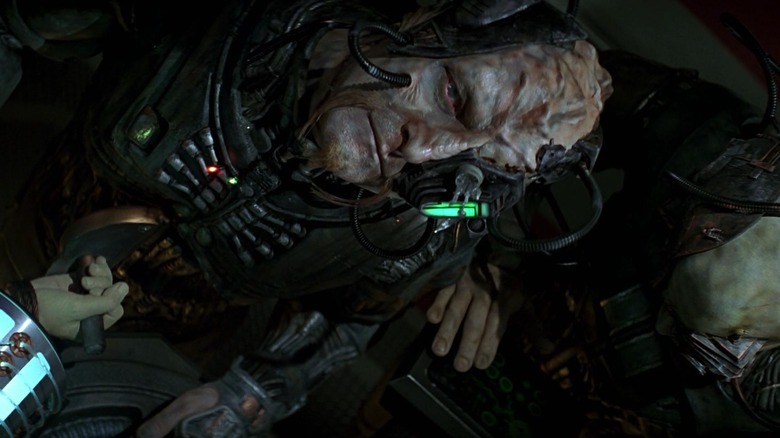
It should be noted that, for "Star Trek: First Contact," the Borg weren't merely redesigned; their entire dynamic was changed. On "Star Trek: The Next Generation," they were said to have a singular consciousness. In "First Contact," they became more like a beehive, with drones, workers, and even a queen (played by Alice Krige). The Borg queen was also a free-thinking and passionate figure, making decisions on her own and motivated by emotions. It was a dramatic shift. Rick Berman was quoted as saying the following about the Borg's revamped design:
"We wanted to develop the Borg in a way that [was] unique. We wanted to be able to put [in] the research and development time, and the cost of developing the costumes and the makeup prostheses that we could never afford to do in television, because of the money involved and the time involved. We were like kids in a candy store, being able to develop the Borg and to design them, and have them turn out the way they did. It was wonderful."
"Star Trek: First Contact" went on to become a sizable critical and box office hit upon its theatrical release in 1996, and it's still frequently ranked as one of the best "Star Trek" movies ever made. One can only speculate if H.R. Giger's designs would have helped the film. Personally, I think they might have hindered it. Giger's work is so surreal, sexual, and off-putting that a mainstream audience might have rejected his version of the Borg. If Berman had possessed the chutzpah to actually make an R-rated "Star Trek" movie, then maybe it would have worked as a great sci-fi horror flick.