

American Psycho's Filmmakers Had Two Rules For The Movie - And Broke One Of Them
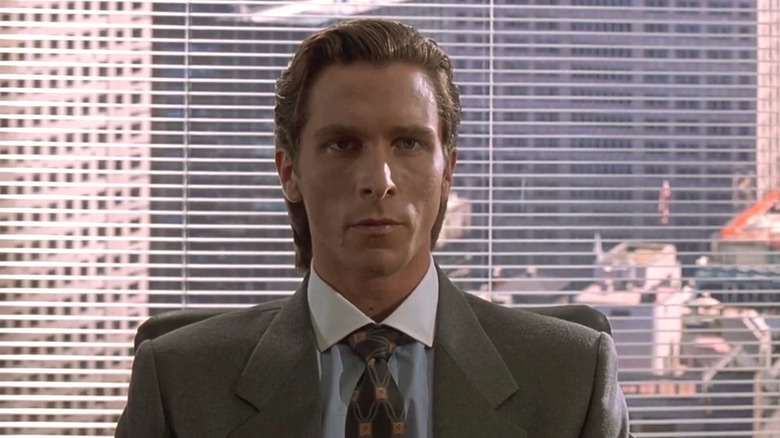
The hyper-popular meme culture circling Mary Harron's "American Psycho" might've died down in recent years, but the satirical horror will forever be relevant. Harron's "American Psycho" had split audiences on release, contributing to the misunderstood perception of its serial killer protagonist, Patrick Bateman (Christian Bale), whose identity fixation dictates the themes of the film.
The seeds for Bateman's repulsive obsession with consumerism were sown by "American Psycho" author Bret Easton Ellis himself, but Harron's sharp caricature of Bateman might've been too nuanced for its own good. Unfortunately, Bateman is unironically revered (and misinterpreted) in certain online circles even though Bale and Harron never intended to make this spineless Wall Street banker cool.
That said, how did Harron and screenwriter Guinevere Turner approach such a controversial source material? Turner spoke to Yahoo!News about two ground rules that were put in place while fleshing out Bateman. The first was that Bateman, who is a finance bro, would never be seen working (lending to an amusing gag throughout the film). Secondly, the graphic violence would never be shown, but implied in order to avoid unintentional glorification. However, per Turner, this second rule got broken for a good reason:
"There's a really interesting thing that you do when you make the audience imagine what happened, which is that all of a sudden they're sort of complicit – like, they're thinking something grosser than what we actually think happened. We thought, we should do one just [violent scene] to prove we're not afraid to do this. And it's sort of an homage to what this movie could have been."
The scene in question is the one in which a blood-soaked Bateman chases a frightened woman with a chainsaw. In Harron's capable hands, such an unsubtle sequence adds complex layers to Bateman's characterization.
American Psycho would've been a very different movie without Mary Harron
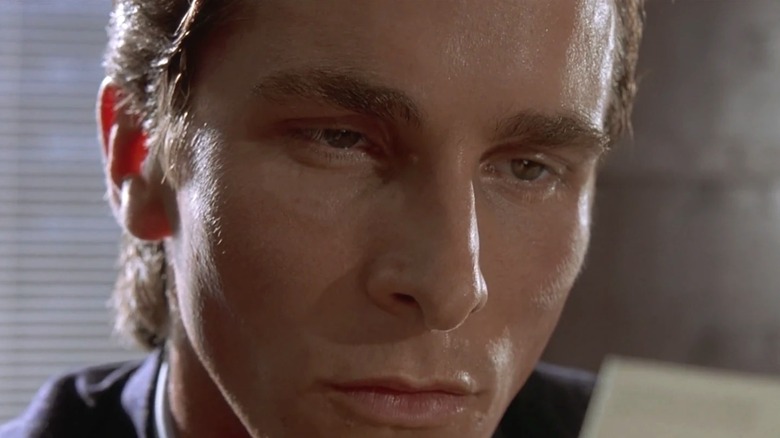
Turner's comment about what "American Psycho" could've been should be contextualized against the making of the film. There was a time when Harron was briefly fired from her directorial duties because she was opposed to Lionsgate's decision to cast Leonardo DiCaprio as Bateman. Oliver Stone ("Wall Street," "Platoon") was brought in as Harron's replacement, but this stint was brief.
Amid disagreements cropping up about the film's creative direction, DiCaprio (who was a Hollywood heartthrob at the time) left to work on Danny Boyle's "The Beach." With their popular A-lister gone, Lionsgate decided to bring Harron back, who took a firm stand about casting Bale as Bateman. The studio eventually gave in, and the rest is history.
Bale is brilliant as Bateman. He injects the character with the perfect mix of pathetic hedonism that gives way to violent outbursts. Bale's performance in the chainsaw sequence adds a surreal undertone to it, where the film questions whether Bateman's crimes are real at all or an extension of his ego-induced psychosis. When Bateman discovers the bodies of his victims, the film morphs into a slasher for a while, framing him as a horrific murderer. But Harron and Turner slip back into playful satire when Bateman's paranoia fuels a ludicrous string of events towards the end.
Without Harron, "American Psycho" wouldn't be the influential horror-satire that it is today. A remake with Luca Guadagnino at the helm is currently in the works, which could be a worthy reinterpretation of Ellis' brilliant novel and the elusive Bateman at the center of it. Although Guadagnino has his work cut out for him, he's an ideal choice for a fresh take on a certified classic.