

Why Lee Cronin's The Mummy Has All Those Split Diopter Shots, As Explained By The Director [Exclusive]
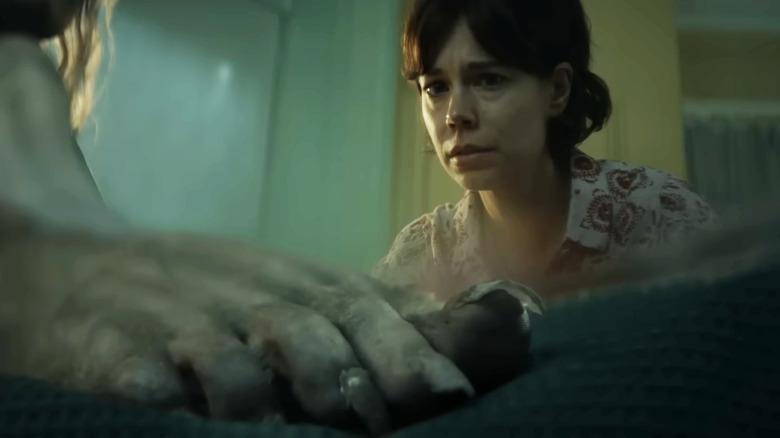
If you've seen "Lee Cronin's The Mummy" or "Evil Dead Rise," you already know that director Lee Cronin loves a split diopter shot. The majority of focused frames in a film either use a deep depth of field, where everything in the frame is in focus, or a shallow depth of field, where one aspect — foreground, middle ground, or background — is in focus while the rest of the frame is out of focus. But by utilizing the half-circle lens, filmmakers could "split" the difference, allowing for two distinct focal planes within a single shot, with the "split" being the only aspect that's out of focus. The technique blew Cate Blanchett's mind when it was used on "The Lord of the Rings," and when director Brian De Palma used it with such aplomb, it became the signature shot of his best films.
Split diopter shots are an extremely effective way to emphasize duality, draw the audience's eye to multiple simultaneous situations, or simply provide a visually interesting frame to look at, but Cronin's love of the shot is so prominent in "Lee Cronin's The Mummy" that when I interviewed him the day of the film's theatrical release, I had to know why he felt the need to come for King De Palma's split diopter crown. "It was never an intent," he tells me through a smile. There was never a conscious decision to sprinkle the shots throughout "Evil Dead Rise," but he loved unleashing them so much that he wanted to do the same for his "Mummy" movie.
Unsurprisingly, Cronin has a fascinating methodology for why he finds the shots so useful in horror, and he gave me three reasons why "Lee Cronin's The Mummy" has so many split diopter shots: psychological power, his dislike of inserts, and optical ghosting.
Lee Cronin's reasons for loving split diopter shots
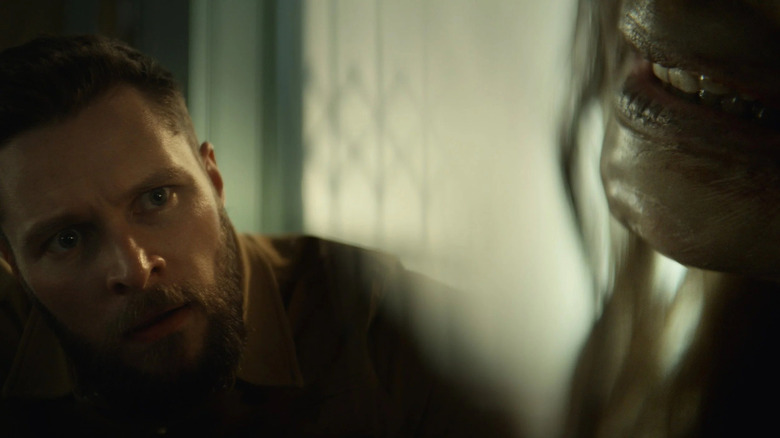
The first reason Lee Cronin loves a split diopter shot lies in the psychological power it has over the audience. "I'm less likely to use them for that classic kind of dialogue scene," he explains. "It's usually more about putting you inside the head of a character." Cronin cites a moment (see above) where Jack Reynor's Charlie is looking at the condition of his daughter, the mummified Katie (Natalie Grace), and the frame shows his reaction in addition to Katie's decayed state. "Rather than cutting to him and cutting to what he's looking at and having to edit in that moment, I'm giving you the full psychological spectrum in one frame, and I love the immediacy of that," Cronin tells me.
This decision leans into his second reasoning for loving the shot, which is that he's "not an enormous fan of inserts," and that he avoids them when he can. "There are a few insert shots in this movie, and in all movies, but I much prefer putting the object and the person together," he says. "And that's sometimes where people won't even realize I'm using split field, necessarily." Cronin tells me that there are many subtle split diopter shots in "Evil Dead Rise" that most viewers don't even recognize as such, often when someone is picking up a weapon. "I don't want to have to cut to the thing and cut back to them," he says. "I love the immediacy. It allows me to get even more ideas across."
It is jarringly efficacious. Seeing Jack Reynor's eyes practically bugging out of his head, next to the decaying face of a little girl, certainly gets the point across.
Split diopter shots provide optical ghosting
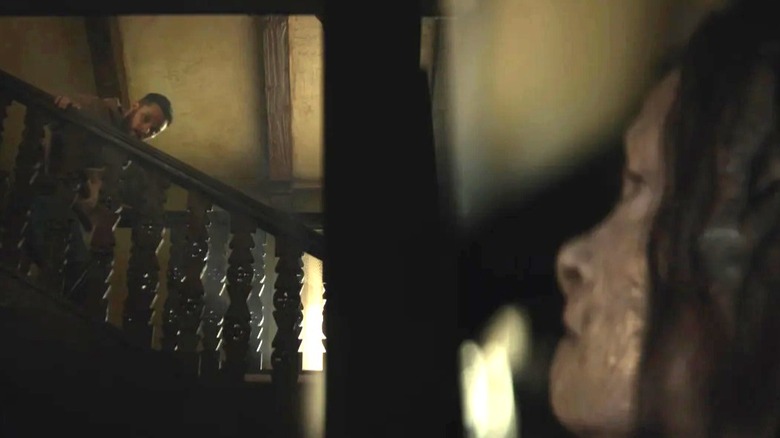
Lee Cronin's third reason for loving split diopter shots concerns how the cinematography plays tricks on the audience's sensibilities. "I really, really adore the optical ghosting and inaccuracies and atmosphere that comes with it," Cronin explains. In working with his director of photography, Dave Garbett, they, of course, get the technical aspects of a split diopter shot correct, but they're more than willing to lean into the weirdness that comes from the splitting of the field. "We don't want to see the line of the split, but we don't mind all of the affectations that it gives off, like ghosting and repeating images," he says.
In one example, he notes that if someone is walking through the frame, there might be a ghostly outline of their shoes, tricking the audience into seeing a foot left behind them. "I actually love the atmosphere that it brings, and sometimes I've used them just for the atmospherics as well," Cronin reveals. "And I'll continue to do so."
"Lee Cronin's The Mummy" is full of gruesome, grotesque, and gory moments, and the film revels in every disgusting moment. This was the result of filming these scenes with probe lenses, which allowed them to get as close as humanly possible to revolting shots of eyes, teeth, and skin. Cronin says that, in addition to the split diopter shots, the probe lens close-ups on gore will be another tool in the arsenal he'll continue to explore on future films. It's only going to get gnarlier from here.
"Lee Cronin's The Mummy" is playing in theaters everywhere.