

How Arrival Author Ted Chiang Feels About Denis Villeneuve's Movie Adaptation
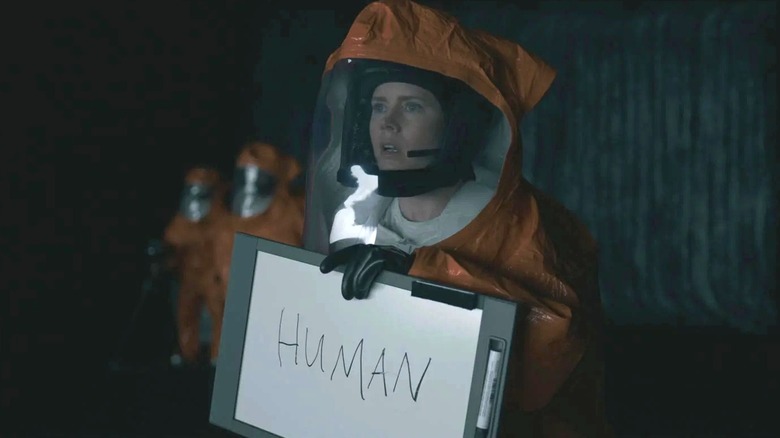
In this writer's opinion, Denis Villenueve's 2016 sci-fi film was one of the best movies of its year. On the surface, it was an intriguing sci-fi yarn about first contact with an alien species. It was very reminiscent of Robert Wise's 1951 classic "The Day the Earth Stood Still," in that human governments would react to an alien visitation not with awe or wonder or respect, but with suspicion. The thrills came from the struggles of linguist Louise Banks (Amy Adams) trying to decipher and translate the language of the alien heptopods. For instance, when the aliens say they are on Earth to "offer weapon," what does that mean?
"Arrival" is a very intelligent film that acknowledges just how difficult it is to communicate when languages have different base syntax. Some think that "offer weapon" means "give a weapon to you," while others think it means "use a weapon against you." Louise eventually figures out that what she thought was "weapon" was a more general term for a "tool." Even then, what kind of tool do they mean?
More deeply, though, "Arrival" reveals that language can define and alter our perceptions of reality. Some linguists have pondered why many ancient languages don't have a word for "blue," for instance. Did human eyes not see the color blue back then? Was blue only perceived once we had a word for it?
"Arrival" was based on the novella "The Story of Your Life" by Ted Chiang, and while the central linguistic premise was retained from the story, a lot of the film's "thriller" elements were invented. When asked how he felt about the movie on the Ink to Film podcast, Chiang noted that he was happy with the movie, despite the changes.
Ted Chiang was pleased with Arrival as an adaptation
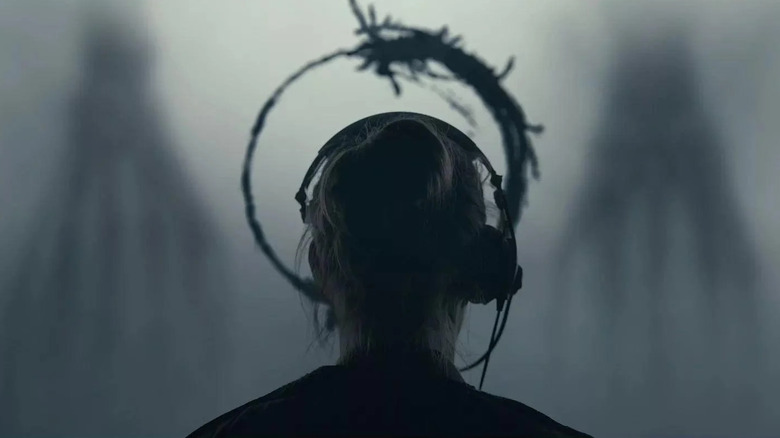
Ted Chiang's original story was also about a linguist named Louise Banks tasked with translating the alien language of a species of heptapod aliens who have arrived on Earth for mysterious reasons. In the story, the heptapods don't land on Earth, but remain in orbit, only communicating through massive shiny relay stations sent to the surface below.
Louise's attempts to communicate are fascinating, and she finds that their writing is based on entire clauses appearing at once. She introduced physics concepts to them, and the heptapods were able to understand Fermat's Principle of Least Time very well. Delving into the meaning of Fermat's Principle, Louise finds that the heptapods know how their sentences will conclude before they write them. This isn't just a matter of thinking ahead, but a matter of perception. The heptapods experience time all at once, and not as a sequence of events. And if one can learn the heptapod language, will they, too, also begin experiencing time differently?
All of this is in the movie, and Chiang was very happy with that. He felt that the film's screenwriter, Eric Heisserer, retained the ideas, but also altered them in ways that made Chiang's ideas more cinematic. As Chiang said:
"I am very happy with the way the movie turned out. It is both a good movie in its own right and a good adaptation. And I think it is faithful to the spirit of the story, which I think is more important than being faithful to the letter of the original. I kind of think if it were more faithful to the letter of my original story, it probably would not work as well as a film."
Heisserer, it should be noted, was nominated for an Oscar for his screenplay.
The conflict of different mediums
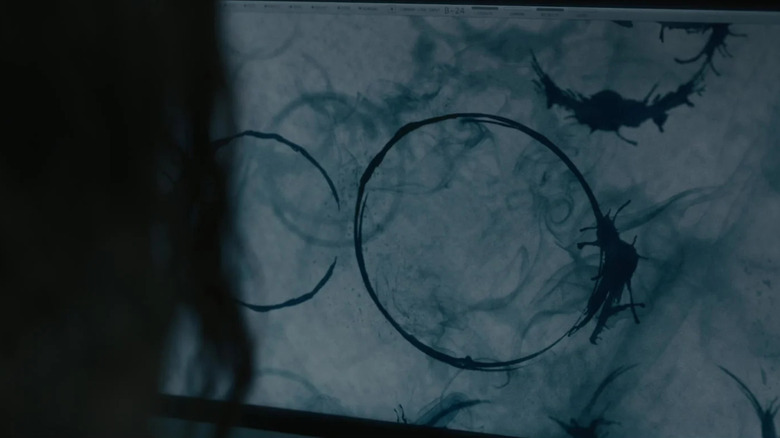
The interviewer pointed out to Ted Chiang that his novella, "Story of Your Life," was better suited to communicating its ideas, as it was presented in the written medium. If one is reading words on a page, then they're already contemplating the structure of language and the way words alter our perceptions. By contrast, film is a visual medium, communicating its ideas through images and sounds. Ted Chiang explained that he once felt the same way as the interviewer, seeing "Story of Your Life" as incredibly ill-suited for film adaptation. It wasn't until he saw the film that he found that it could be done. Not only that, but it was done incredibly well. Chiang said:
"I would have said this was unfilmable. Most of the action is taking place inside the protagonist's head. Eric deserves so much credit for seeing a way to make it a visual story. I really don't know if anyone else would have ever thought of that. Because it seems like such an unlikely candidate for adaptation."
The ending was also altered, but we've written before about how that was the right decision.
"Arrival" was not just nominated for Best Adapted Screenplay at the Oscars that year, but also Best Picture, Best Director, Best Cinematography, and several others. It ended up winning for Best Sound Editing. It lost Best Picture to "La La Land" "Moonlight."
Denis Villeneuve, having proven his sci-fi chops, would move on to high-profile, big-budget sci-fi adaptations like the somnambulistic "Blade Runner 2049" and the ambitious and complex "Dune" movies. For my money, "Arrival" is the best of those films.