

Maul: Shadow Lord Makes Dave Filoni's Most Disappointing Star Wars Show All The More Baffling
Warning: This article contains minor spoilers up to episode 3, "Whispers in the Unknown," of "Star Wars: Maul — Shadow Lord."
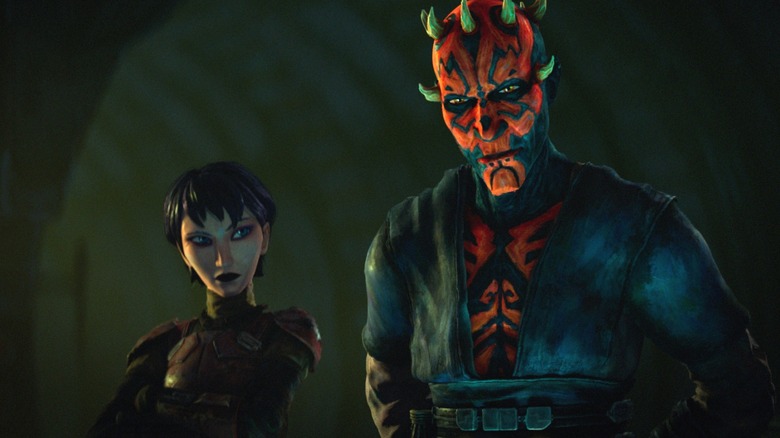
"Star Wars" is officially back in all its animated goodness, and it feels so bad (complimentary). The premiere of "Maul — Shadow Lord" not only brings back one of the best expansions to the canon in Sam Witwer's seemingly un-killable Maul, but it's also a welcome reminder that the franchise reached some of its greatest heights in another medium altogether. It's probably too early to say whether this latest series rivals either "The Clone Wars" or "Rebels," but it's certainly not out of the question. That speaks to creator and newly-crowned Lucasfilm President/Chief Creative Officer Dave Filoni's incredible success in building out this corner of the "Star Wars" universe ... but it raises some serious questions about his most disappointing live-action work, too.
Because the more I watch "Maul" and revel in its incredible sense of style, eye-popping colors, and imaginative action, the more I wonder why the same simply can't be said for Filoni's "Ahsoka." I've previously written at length about my gripes with turning the fan-favorite animated Ahsoka Tano into a live-action shell of herself, so I won't rehash those arguments all over again. In fact, I don't even need to: "Shadow Lord" makes all those points for me, conveniently enough.
Through three episodes, "Maul" already feels like the worthiest "Star Wars" addition since "Andor," and that's precisely because it isn't self-conscious about embracing its strengths. Despite originating in George Lucas' 1999 blockbuster "The Phantom Menace," isn't a character like Maul arguably more at home in animation anyway? Given all the creative freedom this allows, we wouldn't have it any other way. And, yes, "Ahsoka" could've learned a thing or two from this show.
Maul - Shadow Lord proves that, when it comes to animation, this is the way
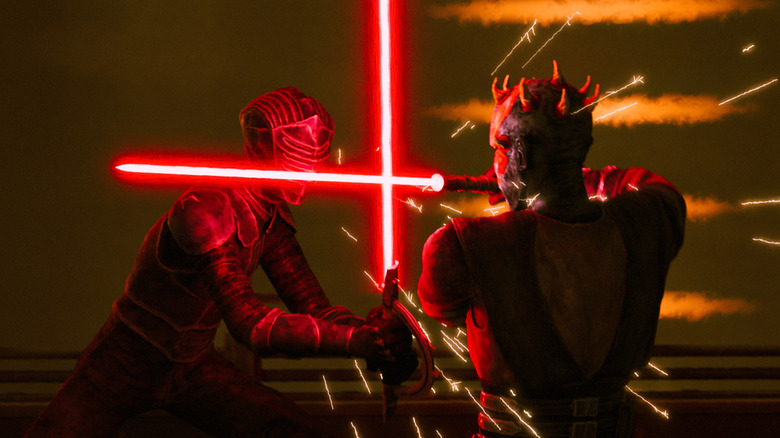
If anyone doubts that animation was the ideal approach to "Maul — Shadow Lord," look no further than Maul's post-"Phantom Menace" arc up to this point. After "The Clone Wars" did the impossible and turned the admittedly one-dimensional cutout into an actual character, "Rebels" famously took it even further and gave him an emotional gut-punch of an ending. But when Darth Maul actor Ray Park came out of nowhere for that cameo in "Solo: A Star Wars Story," the response from casual audiences was one of mass confusion ... and who could blame them? For those excited about "Solo," it shouldn't have been a requirement to do their homework and follow Maul's continuing journey unfolding across two different animated shows. Now, imagine how that would've been compounded if its creative team had randomly decided to turn "Maul — Shadow Lord" into a live-action series instead.
See where I'm going with this? As much as diehard fans couldn't wait to see a popular fan-cast like Rosario Dawson officially bring Ahsoka Tano to life, the choice to produce a live-action sequel series to the events of "Rebels" never made much creative sense. The best part of animated "Star Wars" shows like "Rebels" and "The Clone Wars" (and "The Bad Batch," for that matter) came from their ability to do what the live-action "Star Wars" movies never could: showcase the sheer imagination and epic scope/scale of a galactic space opera without breaking the bank. And, as far as its kid-friendly demographic was concerned, the added bonus of populating these stories with sillier, more expressive, and downright alien faces helped redefine what "Star Wars" could truly look like.
Unlike "Maul," though, "Ahsoka" neglected to play to its strengths.
Ahsoka is the rare Star Wars show to miss what makes its characters so special
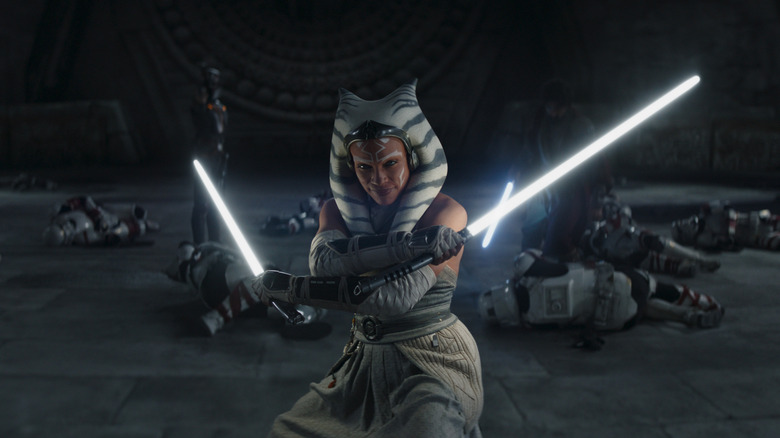
Now, none of this is to say that animation suits all "Star Wars" stories. "Andor" might well be the perfect example of a narrative that takes full advantage of its chosen medium. By leaning heavily on the show's hard-edged interests, creator Tony Gilroy delivered what feels destined to go down as one of the best live-action "Star Wars" experiments ever. And, to defend Dave Filoni's intentions with "Ahsoka," "Maul" itself proves that there's a precedent for taking characters established in one medium and fully translating them to another. Context matters, however, and "Shadow Lord" best exemplifies the approach that "Ahsoka" could've (and should've) taken instead.
Seriously, just glance at literally any given frame of "Maul," each so full of life and energy in a way that brings the spectacular "Spider-Verse" movies to mind, and tell me you wouldn't give anything to see that recreated in "Ahsoka." Can anyone honestly say that watching such dull and inert action, drab blocking and staging, and colorless visuals are an improvement over the boundless creativity on display in "The Clone Wars" and "Rebels"? Fan-favorites like Ahsoka, Sabine Wren, Ezra Bridger, and even Grand Admiral Thrawn were made to come to life in animation, all but jumping off the screen with their larger-than-life personalities (and heroic feats to match). Watching their live-action counterparts stumble through a low-energy "reunion" pales in comparison.
Season 2 of "Ahsoka" threatens promises to arrive soon, but at least we'll have "Maul — Shadow Lord" in the meantime — a show that's refreshingly unafraid to let its animated flag fly. Both series represent a bit of an inflection point for "Star Wars." Something tells us we know which one will prove worthwhile in the long run.