

Project Hail Mary's Author Has An Interesting Take On Star Trek: The Next Generation's Borg
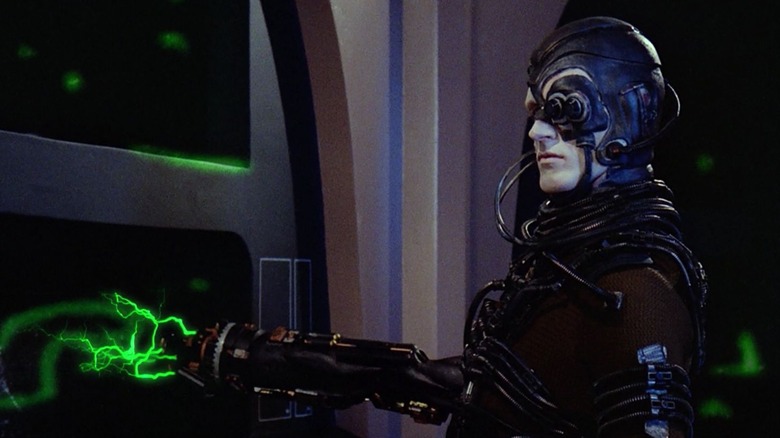
Andy Weir has a rather controversial take on the Borg.
All Trekkies know about the Borg, the malevolent race of soulless cyborgs that traverse the galaxy, absorbing ships and people into its machine-driven, hive-mind collective. Even non-Trekkies likely know about the devastating time Captain Picard (Patrick Stewart) was assimilated by the Borg. Clearly inspired by the artwork of H.R. Giger, the Borg became one of the most utilized villains in "Star Trek" history, first appearing in "Star Trek: The Next Generation," and playing a major role on "Star Trek: Voyager"; one of that show's lead characters was a reformed Borg drone. Eventually the Borg reached the point of overuse; they were Trek's best villains, until they weren't anymore.
The concept of the Borg is well known even outside of "Star Trek" circles, and the phrase "you will be assimilated" rests on the lips of many consumers of popular culture. The Borg are scary. The thought of having your mind and body usurped by a logical, passionless machine intelligence — of being robbed of your individuality — is presented as the ultimate death, something even worse than dying. But then, as the Borg would say, death is irrelevant. Resistance is futile. You must comply.
Andy Weir, the author of "The Martian" and "Project Hail Mary" — both adapted into excellent feature films — recently spoke with CNET, and he argued, perhaps bafflingly, that the Borg may not be as villainous as all that. Indeed, he argued that the Borg, at least by their own logic, are compassionate. Weir argued that the Borg, when they assimilate sentient beings into their collective, are actually creating a massive network of beings that, by their very construct, care about each other.
Andy Weir sees the Borg as compassionate figures

The design and presentation of the Borg, it should be noted, are the opposite of compassionate. Borg drones don't speak, have no facial expressions, and their bodies are encrusted with tubes and machinery. Their ships are not elegant or aesthetic, but giant cubes made of plumbing and motorcycle parts. Even if one doesn't want to see the Borg as villainous, one still has to accept that they are, as Q (John de Lancie) describes them, the ultimate users. They merely take and absorb what they need from the galaxy and kill the rest.
Andy Weir's notions of the Borg as a compassionate tribe are a little baffling in that light. But he does come to conclusions logically. When conceiving the alien, Rocky, for "Project Hail Mary," voiced by James Ortiz, Weir said he compiled a list of things that any alien species might need in order to develop deep space travel. For one, he said that an alien species needed some means of developing a transfer of information, or language. That would, in turn, inspire an alien species to live as a tribe, wherein communities would work to protect one another. He said:
"You have compassion and concern for other members of your tribe. You're like, 'I care about that guy even though, if he dies, it doesn't affect me directly.' That evolves so that the tribe as a whole cares about each other. So it's almost like a single multifamily entity, right?"
So nothing like the Borg, right? The opposite of a machine intelligence that disposes of its drones if they outlive their usefulness, right? Wrong. Weir thinks that the Borg are actually enhancing that sense of tribe by assimilating people.
Andy Weir thinks that the Borg's collective is a positive thing
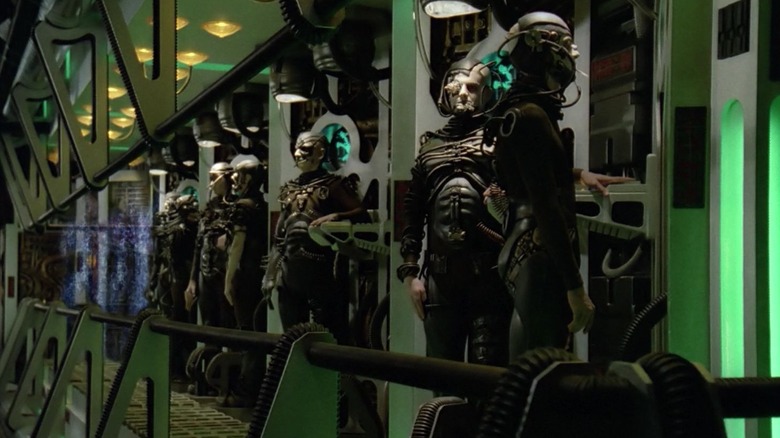
Weir noted in the CNET interview:
"The most compassionate thing the Borg can do is assimilate people. Because then they're part of the Borg, which is the best thing you can be like."
You don't just have a tribe with the Borg. Your mind is linked into a single consciousness. On paper, that is the most connected a person can be to their community. See also: "Pluribus."
And, to be fair, Weir's notion of the Borg as something well-organized is explored a lot on "Star Trek: Voyager." The character of Seven of Nine (Jeri Ryan) is a former Borg that was removed from the collective, but who still had many of her Borg implants and philosophies. Seven would eventually reveal that the Borg assimilated people in an unending quest for perfection. They wanted to find the best elements of all peoples and all technologies, and essentially bring them all under one cybernetic roof. They weren't compassionate, but they were, in their own computerized way, trying to build a better galactic community.
Weir feels that the Borg's perfect community was vital for a species to band together to make a starship. In his words:
"In order to get to the point where you're making a spaceship, your species must have the concept of compassion and concern for each other. [...] You would never have made a spaceship if you didn't have that."
I would still argue that the Borg don't "care" about each other in the human sense of the word. They certainly don't care about the lives and consciousnesses of the beings they assimilate. But Weir is right in that they are all working together, seamlessly, toward a common goal.