

Isaac Asimov Inspired (But Didn't Write) A Major Sean Connery Sci-Fi Box Office Bomb
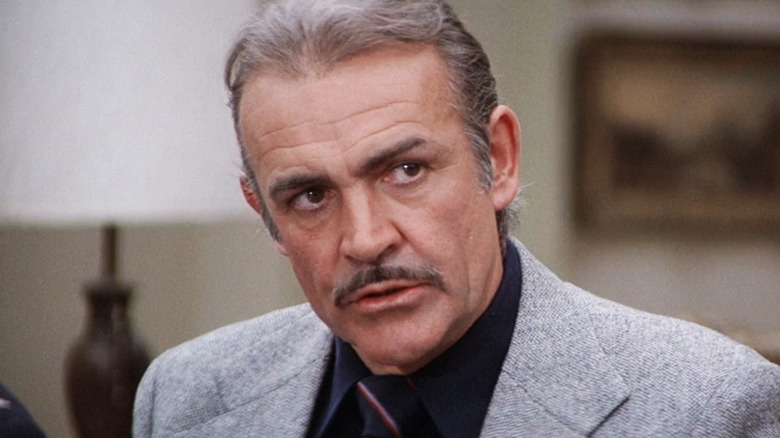
When it comes to sci-fi, Sean Connery has a dodgy record. In 1974 he starred in "Zardoz," a terrible sci-fi movie that Connery thought would help him escape his James Bond legacy. Five years later he had another go with "Meteor," an infamous box office bomb that somehow managed to make the destruction of Earth a tiresome affair. Considering it was inspired by a story from sci-fi luminary Isaac Asimov, it probably should have been better than it was. But then, Asimov didn't really have any input beyond sparking the initial concept.
The famed writer is responsible for so many sci-fi highs. His "Foundation" series formed the basis for the supposedly "unfilmable" Apple TV show of the same name, which gave the story new life and effortlessly proved the naysayers wrong. Elsewhere, Asimov's 1950 short-story collection "I, Robot" was hugely influential, even if it did result in a kind of okay Will Smith movie. As such, the prolific writer surely wasn't too thrilled to have "Meteor" associated with his legacy.
As noted by the American Film Institute two contemporaneous Los Angeles Times articles detailed how producer Theodore Parvin was inspired by an article in Saturday Review magazine. The piece was written by Asimov and explored a scenario whereby meteorites descended and destroyed a major city. This, it seems, was the seed of the idea for what became "Meteor," though Asimov would likely be pleased to know his influence didn't extend much beyond that.
Meteor had a lot working in its favor
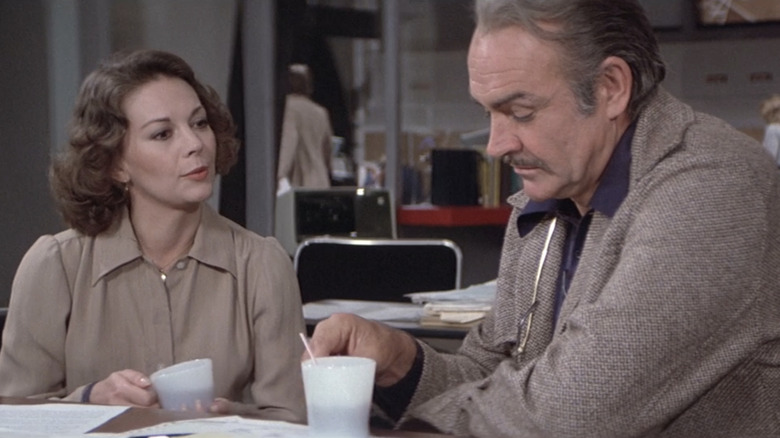
Some might argue that "Meteor" is an underrated disaster movie that deserves a watch. Others, like the New York Times' Janet Maslin, would say that "the suspense is sludgy and the character development nil; even the inadvertent comedy is spotty." Where you fall between those two poles probably won't depend on whether you're an Isaac Asimov fan, only because the writer did little more than inadvertently provide the basic concept.
As detailed by AFI, after reading Asimov's Saturday Review piece, Theodore Parvin drafted a 20-page outline. He then brought in Edmund H. North to write the full screenplay. It wasn't North's first time turning literary sci-fi ideas into movies. The seasoned scenarist had previously written 1951's "The Day the Earth Stood Still," which was based on Harry Bates' 1940 science fiction short story "Farewell to the Master." By 1979, North had earned himself an Oscar for his work on the script for 1970's "Patton," which he co-wrote with Francis Ford Coppola. Having such an esteemed dramatist on-board surely put Parvin at ease.
According to AFI, North took further inspiration from a 1968 Massachusetts Institute of Technology (MIT) report, which detailed how students had been tasked with solving the hypothetical problem of how humankind might deflect the asteroid Icarus should it wind up on a collision course with Earth. The students' solution? Send six 100-megaton H-bomb warheads to intercept the asteroid. Yes, long before "Armageddon" saw Bruce Willis sent to nuke an asteroid in the biggest movie of 1998 Sean Connery was given a similar mission — though this one didn't require the Scotsman to sacrifice himself in the process, and there was less Aerosmith.
Meteor was a disaster movie disaster
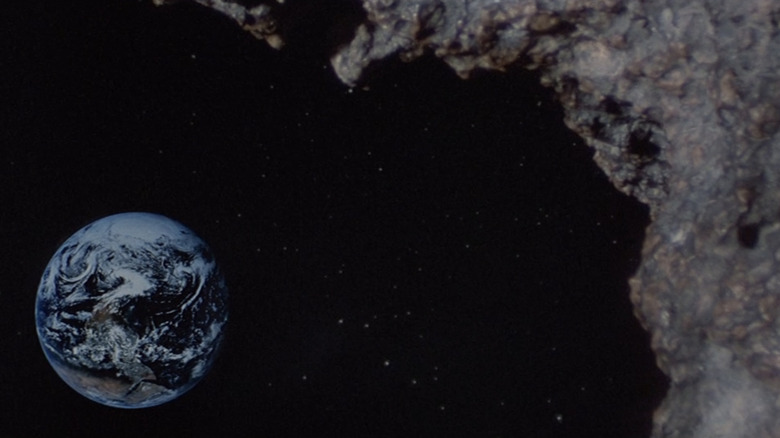
"Meteor" stars Sean Connery as scientist Dr. Paul Bradley, who's tasked with helping in the effort to deflect a giant asteroid fragment that's on a collision course with Earth. Bradley, an American with a thick Scottish accent, reaches out to his Soviet counterpart Alexei Dubov (Brian Keith) and his assistant, Tatiana Donskaya (Natalie Wood). It seems the Americans previously sent a nuclear missile-armed satellite into space, but its warheads aren't enough to successfully change the asteroid's course. Therefore, the Soviet's own nuclear satellite is required to accomplish the mission. Meanwhile, Earth is pelted by several smaller asteroid fragments that provide a taste of the destruction to come. Can the Americans and Soviets put their differences aside at the height of the Cold War to save Earth?
Sounds like a tense and gripping story doesn't it? Unfortunately, the movie was neither a critical or commercial success. "Meteor" ended up grossing $8.4 million on a $16 million budget, which had ballooned after production overruns and VFX reshoots. Meanwhile critics were less than impressed with what, in the aggregate, was deemed to be a fairly dull and formulaic disaster movie. Some of the best disaster movies of the '70s often overcame negative reviews to become box office hits regardless. But "Meteor" simply couldn't manage it. As such, it's probably for the best that Isaac Asimov's influence wasn't actually all that significant, otherwise he'd forever be associated with this late-'70s misstep.