

This '50s Western Is A Forgotten Gem That Completely Changed Television
We may receive a commission on purchases made from links.
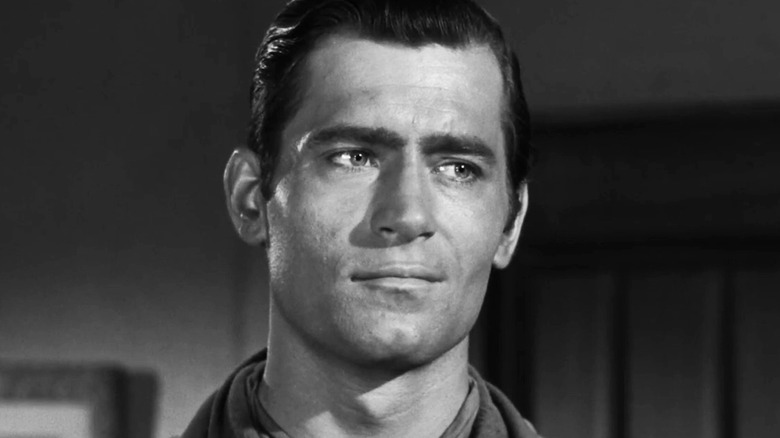
When you think of Western TV series of the mid-20th century, what comes to mind? "Bonanza?" "Gunsmoke?" "Rawhide?" Maybe even "The Virginian," "Wagon Train," or "Big Valley?" Well, what about "Cheyenne?" You may not hear this underrated Western series mentioned quite as often as the aforementioned examples, but before U.S. Marshal Matt Dillon or Ramrod Rowdy Yates dominated the airwaves, there was Clint Walker's cowboy, Cheyenne Bodie.
Not only was he adventuring in the Old West prior to his more famous descendants, Bodie and his ABC show made history as the first hour-long Western series on American television. In fact, "Cheyenne" was the first show of any genre to feature the same characters week after week and to last more than one season. Despite this, the show is rarely discussed or watched. But you can fix that right now by streaming the show on platforms such as Starz, Plex, Philo, and more.
Debuting in 1955, "Cheyenne" starred Clint Walker as the titular loner cowboy. After his parents were killed by an indigenous tribe, Bodie was taken in by the Cheyenne people and raised by his adoptive family until the age of 12 (though the show gets a little hazy on these details as it goes on). As an adult, Bodie travels the post-Civil War American West taking on multiple jobs, including Army scout, prospector, and even working as both a Deputy U.S. Marshal and a county sheriff.
"Cheyenne" had an impressive run, airing on ABC from 1955 to 1962. During that time, the series produced 108 episodes and ran for seven seasons, changing television along the way and becoming one of the best Western shows ever. Not too shabby for the first show of its kind.
Cheyenne debuted in the mid-'50s as the first hour-long Western
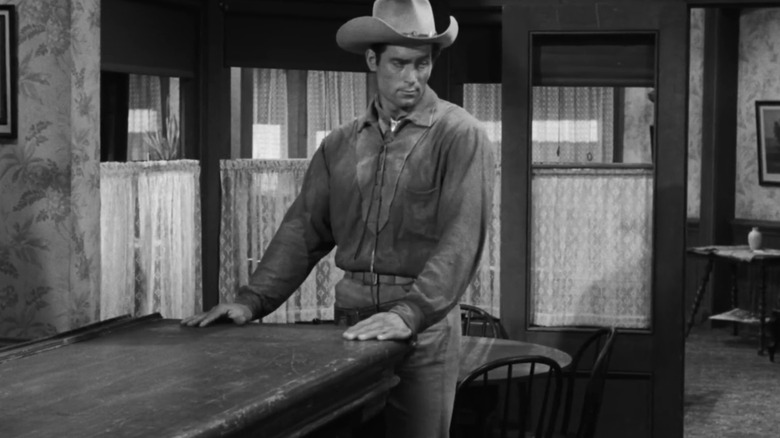
Western TV was very much a thing prior to "Cheyenne." Jock Mahoney's "The Range Rider," for instance, ran on ABC from 1951 to '52, and the anthology series "Death Valley Days" began its syndicated run in 1952. What's more, "The Lone Ranger" had been on the air since 1949 and was still running when Clint Walker saddled up. Walker's show was, however, America's first hour-long Western series, exploring the life of its itinerant hero in a much more detailed and comprehensive way (though there were still plenty of traditional Western tropes).
"Cheyenne" first aired on September 20, 1955. The debut episode, "Mountain Fortress," featured James Garner, who would soon end up fronting his own Western series with "Maverick" in 1957. In "The Garner Files: A Memoir," the actor recalled meeting director Richard L. Bare in a bar. Soon after, Bare decided Garner would be good for the lead role in "Cheyenne," but by the time Garner got his message, they'd already cast Walker as Cheyenne Bodie.
Nonetheless, Bare and his producers still found a place for the man who would later go on to star in another overlooked Western, the swiftly canceled offbeat 1970s series "Nichols." Garner was cast in the "Cheyenne" pilot as Army Lieutenant Forsythe, the fiancé of Ann Robinson's Joan Carter, who's traveling to see her beloved when her coach comes under attack by an indigenous tribe. Cheyenne maps terrain for the Army alongside his co-worker Smitty (L.Q. Jones). Together, they rescue Carter and the coach's driver and await an impending attack by the Shoshone people.
After this, Cheyenne remained the only consistent character, though Smitty showed up in a couple more installments during the first season. As "Cheyenne" went on, however, Walker's hero embraced the loner lifestyle.
Cheyenne was more influential than you might expect
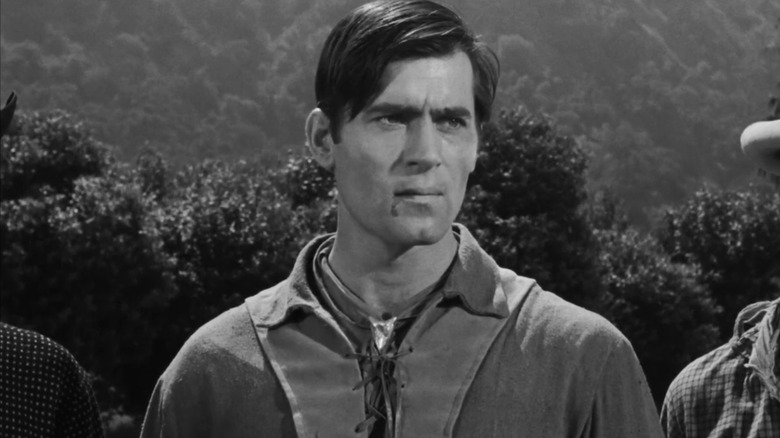
"Cheyenne" first aired as part of the fledgling "Warner Bros. Presents," a series that saw three shows rotate through the same time slot. Clint Walker's Western was one of many shows produced by William T. Orr, who later produced "Maverick" and multiple other hit shows for ABC via the Warner Bros. Television department, which he ran for years. "Cheyenne" originally rotated episodes with "Casablanca" and "Kings Row," but in season 2, it separated from the others and became its own show. By the time it came to an end in 1962, it had helped shape the way small-screen Westerns evolved. In the immediate aftermath of the success of "Cheyenne," hour-long Westerns sprang up everywhere, including the classic Clint Easwtood Western show that you can now stream for free.
Much of the success of "Cheyenne" came down to Walker himself, who combined a gentle manner with a tough exterior, exemplifying the John Wayne-esque machismo of traditional Westerns but bringing a certain sensitivity to his character. "[Cheyenne] had a lot of empathy for people that needed help," said Walker in a Television Academy interview, "which is why often he would stop and help them. He had a strong sense of justice or right and wrong, and he couldn't bring himself to stand around or tolerate somebody being abused."
In that way, Walker didn't only influence the way TV Westerns evolved in the mid-20th century. The laconic, peripatetic defender of the downtrodden was a kind of prototype for so many heroes we see in film and TV today. His attributes are, for instance, shared by Alan Ritchson's similarly nomadic Jack Reacher, and it's part of the reason "Reacher" is breaking ratings records. In that sense, Cheyenne Bodie isn't just an overlooked genre character, but an important archetypal figure in TV history.