

Everyone Is Going To Love Forbidden Fruits In 10 Years, So You Might As Well See It Now
We like to pretend that the hierarchies found in the hallowed halls of high schools dissolve after graduation, but the reality for women is that under a patriarchal system that constantly pits us against one another, we are doomed to repeat these cycles in different environments unless we actively fight against it. If we're not vigilant, we run the risk of sorority houses, churches, and workplaces turning into the same toxic, performative killing floor that proves the credo of cult masterpiece "Jennifer's Body" true: hell is a teenage girl.
Based on Lily Houghton's stage play "of the woman came the beginning of sin, and through her we all die," Meredith Alloway's feature directorial debut, "Forbidden Fruits," is a delightfully sharp satire of the dangers of commercializing feminism in our hypercapitalist hell.
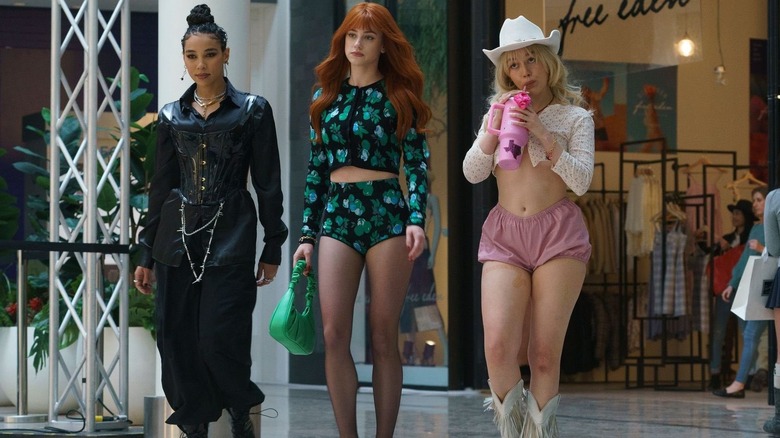
Apple (Lili Reinhart), Cherry (Victoria Pedretti), and Fig (Alexandra Shipp) are the most popular girls at the mall, the trio of retail workers at a trendy, overpriced fashion chain called Free Eden. They're also witches who hex their haters, wear matching fruit charm bracelets, have strict rules about fraternizing with workers at "lesser" brands (sucks to be you, "Keep Calm and Cookie On" employee), only communicate with boys via emoji, and deliver confessionals into the dressing room mirror to the great deity of feminism, the spirit of Marilyn Monroe. But once Pumpkin (Lola Tung) joins the staff, all hell breaks loose.
It has all the makings of becoming the next great teen-girl horror cult hit like "Lisa Frankenstein," but, like all the films that came before that "Forbidden Fruits" is in conversation with (did you know "Jawbreaker" only has a 16% on Rotten Tomatoes? I'm getting a time machine and hunting those critics for sport), it deserves to be seen in a theater now rather than wait a decade for reappraisal.
Forbidden Fruits is glamgore goodness
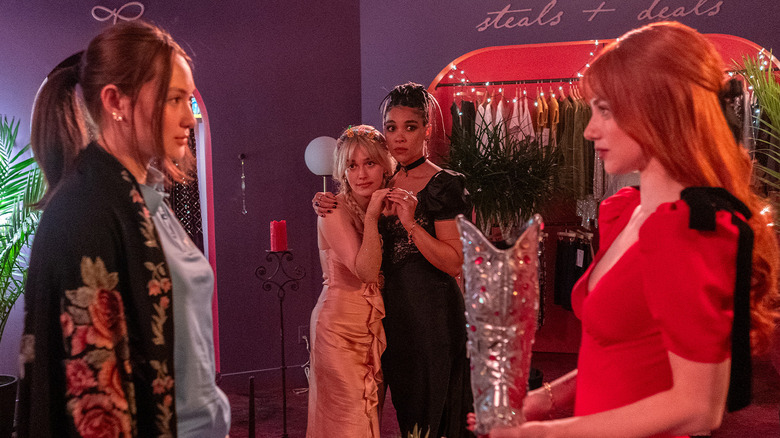
Pumpkin serves as our window to the Free Eden witches and their mall domain (it's the mall from "Mean Girls," as a treat) calling B.S. on every warped barb of weaponized therapyspeak and questioning their increasingly strange behavior. Unlike Cady Heron, who found herself losing her sense of self the more time she spent with The Plastics, Pumpkin never takes her eye off the prize of figuring out the poisonous truth about the leader, Apple.
As the leader of Free Eden, Lili Reinhart's performance as Apple will be a treat for any "Riverdale" fans who loved the Dark Betty arc, and Alexandra Shipp's Fig is the perfect bridge between her performances in "Tragedy Girls" and "Barbie." Lola Tung brings the same relatable charm from her starring performance on "The Summer I Turned Pretty," which provides a delicious meta-juxtaposition when the film goes absolutely gonzo. The real standout, however, is Victoria Pedretti's Cherry, who delivers a hilarious take on a twentysomething Anna Nicole Smith in 2026. All are dressed to perfection in every scene, thanks to Sarah Millma's mallcore glam (and some pieces taken from the actress' own wardrobe), a constant blend of legitimate high-fashion, vintage staples, and fast-fashion the characters would have believably snagged from the mall.
Every moment of the film is aestheticized to the nth degree, which not only helps push the story's satire, but also makes the film's payoff, when it finally fully leans into the horror elements teased throughout the runtime, that much sweeter. The parallels to Diablo Cody's work are inevitable but welcome, given that the Patron Saint served as a producer on the film. It also helps that Meredith Alloway and Lily Houghton's script is just as heightened and clever as the wrapping it's delivered in.
Forbidden Fruits could be your new favorite movie
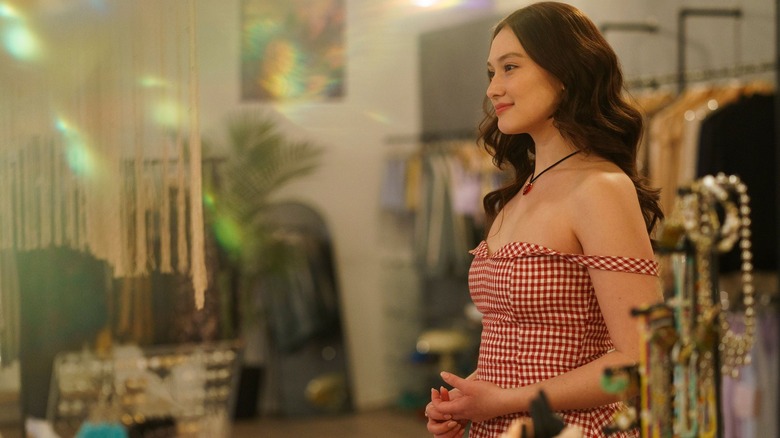
"Forbidden Fruits" follows in the footsteps of performative sisterhood films like "Heathers," "Jawbreaker," and "Mean Girls" that came before it by shredding open the destructive belief system that it's better to be in with the popular girls — hating your life and losing your identity — than to not be in the group at all. Apple delivers the line "you know I don't believe in hierarchy in female relationships" with the seriousness of a car wreck, and it's impossible to decipher whether she means it or has just positive-affirmationed herself into delusion. These are the women who've reached the top of the social ladder, and will do anything in their power to make sure they never lose that power. Apple claims she's desperate to make Paradise, a garden where women can grow, but the seeds planted in the glossy artifice of a mall will never bear fruit.
Meredith Alloway's film weaves genuine commentary on the prison of feminine existence into a constant stream of jokes without ever feeling like it's lecturing the audience. In lesser hands, these bubbly, hyper-feminine characters would be written as shallow airheads, but "Forbidden Fruits" doesn't view any of these women as villains — merely participants (or victims) of a system that has forced them to play this game for their own survival, as much as they try to hex it. They're given the permission to take sequins like drugs and dance with each other to DJ Sammy's "Heaven," but when the film fully gives itself over to the horrors of trying to exist within these confines, it's a bloodbath.
For anyone who spent a sleepover braiding hair, painting nails, and summoning ghosts of your best friend's house with a Parker Brothers' Ouija Board, "Forbidden Fruits" is for you, girly pop.