

I've Seen Every Game Of Thrones Episode, And These Season 5 Storylines Are Where It All Went Wrong
Remember the night of May 19, 2019, when the entire world came together in a rare show of unity to pile on "Game of Thrones" and lambast such an abrupt, unsatisfying end? I was among those very loud voices at the time and, almost seven years later, I stand by every word of criticism. Still, not everyone agrees on why things ended on such a sour note. Was it merely the final stretch of episodes that went awry, ruining a genre-redefining series in its wild dash to reach its conclusion? Or was the writing on the wall from the start, as original author George R.R. Martin once attempted to convince HBO that this saga needed more than eight total seasons to do it proper justice?
Having claimed a front-row seat to every episode during the show's original run, and having devoured every book in the "A Song of Ice and Fire" series (thus far, at least), allow me to suggest an alternate theory. Let's wind the clocks back to season 5, when the HBO juggernaut appeared to be at the absolute peak of its prowess and hadn't yet outpaced the books. However, the cracks were already starting to show. In the face of an increasingly complex and sprawling web of storylines, showrunners David Benioff and D.B. Weiss instead attempted to narrow down the scope and scale considerably. Nowhere did this hurt more than in two pivotal adaptation choices: the Sand Snakes in Dorne and Sansa Stark's arc in the North.
Both are linked by one glaring commonality — an oversimplified approach to deeply intricate plot lines in Martin's books. Watering down such rich and compelling material is bad enough. But, more than anything else, the mindset behind them neatly laid the groundwork for the downfall of "Game of Thrones."
The Sand Snakes subplot is the first major example of Game of Thrones falling apart
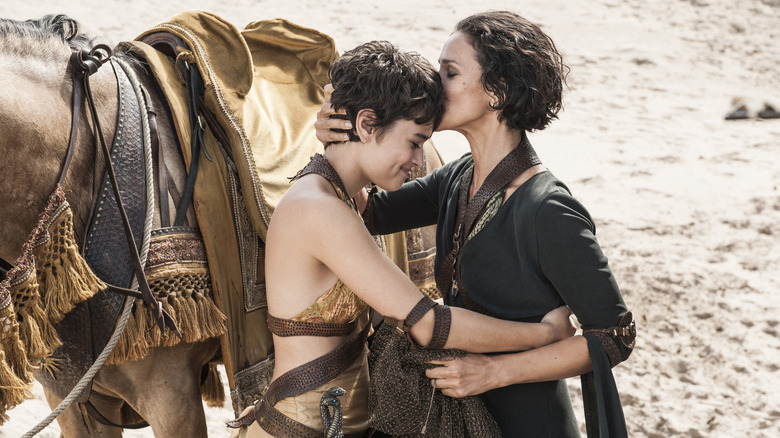
Ask any longtime book reader what triggers our "Game of Thrones" trauma the most and, after snapping out of our thousand-yard stare, I'd say most would put the Sand Snakes at the top of the list. In theory, the addition of several new characters bent on avenging someone as instantly popular as Pedro Pascal's dearly (and gruesomely) departed Oberyn Martell makes a ton of sense. In the books, the vendetta held by his bastard daughters is meant to represent the passing down of violence and bloodlust to the next generation — both a cautionary tale and a key theme of the series. In the show, well, I'm still not entirely sure what the creative team hoped to accomplish here.
Did anyone order some "Dungeons & Dragons" hijinks in their gritty, grounded "Game of Thrones" fantasy world? Even the most casual viewers knew something was amiss from the moment Tyene (Rosabell Laurenti Sellers) and her sisters were introduced early in season 5. Everything about them, from their cheap-looking costuming to their one-note motivations to their off-putting personalities (or lack thereof), felt as if they were ripped from a far inferior knockoff show. Worse yet, their arrival came at the expense of our established favorites. Once Jaime Lannister (Nikolaj Coster-Waldau) and his mercenary friend Bronn (Jerome Flynn) randomly infiltrated Dorne in episode 6 (titled "Unbowed, Unbent, Unbroken") and engaged the Sand Snakes in one of the shoddiest, most poorly-staged fight scenes we'd ever see, the damage was done.
"Game of Thrones" had made mistakes before, but never had it felt quite so amateurish. Like Nikki and Paulo on "Lost" before it, the creative team learned a valuable lesson here. If only they'd fully taken it to heart.
The controversial Sansa and Ramsay storyline set a new low for Game of Thrones
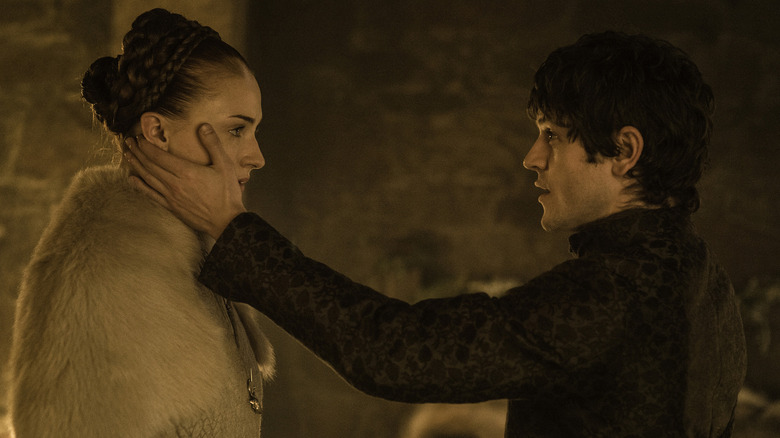
None of that, however, could've prepared us for the new lows "Game of Thrones" would descend to in little time at all: the rape of Sansa Stark (Sophie Turner) by Ramsay Bolton (Iwan Rheon). Not that this ever happens in the books, mind you — not to a main protagonist like Sansa, at least. In George R.R. Martin's telling, a minor character named Jeyne Poole is propped up as an imposter for Sansa's missing sister Arya (played by Maisie Williams in the show), the last remaining Stark of note at this point in the story. In the books, Ramsay weds her in a bid to gain control of the Stark ancestral home of Winterfell and subjects her to horrific sexual abuse and torture.
By shifting all of this over to Sansa in "Game of Thrones," someone we've come to know and love over the years, I'd argue the series made a fundamental mistake. In one fell swoop, practically all of the nuanced political maneuvering from the books ends up lost in translation. In return, the only thing "gained" was a close-up and inescapable view of the material's exploitation of women — a problem the show had struggled many times before.
In retrospect, both this and the Sand Snakes debacle might as well have been precursors for the even more overt issues in the final season(s). In other words, to me, Daenerys Targaryen's (Emilia Clarke) sudden heel turn in season 8's divisive "The Bells" wasn't the root cause of all the show's problems, but merely a symptom of what already plagued it. For those taken aback by the finale, season 5 makes it abundantly clear: The fate of "Game of Thrones" was sealed long before.