

Project Hail Mary Author Andy Weir Didn't Mince Words About This Isaac Asimov Adaptation
It should come as no surprise to the reader that author Andy Weir, the writer of "The Martian" and "Project Hail Mary," is a big fan of Isaac Asimov. He confessed as much in a recent GQ interview wherein he recommended 10 sci-fi books and movies that shaped his taste and style. Some of what he recommends are perfectly logical, given his interests in problem-solving-based sci-fi storytelling, and the inimitable power of a human's good humor.
He very much enjoys Ron Howard's 1995 biographical disaster film "Apollo 13," for instance, a movie about the moon mission that went awry and what needed to be done to rescue the space-bound astronauts. He recommends that we all read Robert A. Heinlein's 1955 novel "Tunnel in the Sky," another story about a group of resourceful astronauts, students this time, who find themselves stranded and having to survive on a distant planet. And he loves big adventure films as well, being fond of Nicholas Meyer's 1982 film "Star Trek II: The Wrath of Khan" and Irvin Kershner's 1980 epic "Star Wars: The Empire Strikes Back."
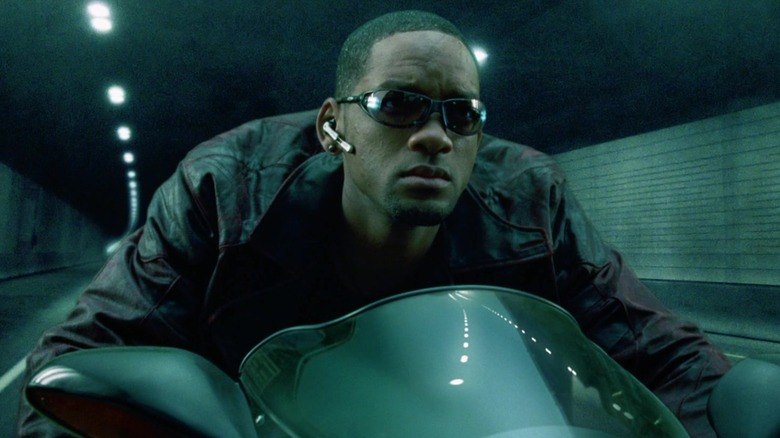
And, yes, Andy Weir is fond of Isaac Asimov's 1950 collection "I, Robot," a compilation of robot stories culled from Asimov's career up to that point. It contains the 1942 short story "Runaround," which first introduced Asimov's famed Three Laws of Robotics, a trio of ethical laws that has come to inform most robot stories that followed. But Weir wanted to clarify that it was Asimov's book he likes, and not Alex Proyas' 2004 film adaptation with Will Smith (which almost killed Smith). That movie is a very, very, very loose adaptation of the "I, Robot" concepts, and Weir is not fond of it. He said that it wasn't the least bit faithful to the original book.
Andy Weir is fond of the Three Laws of Robotics
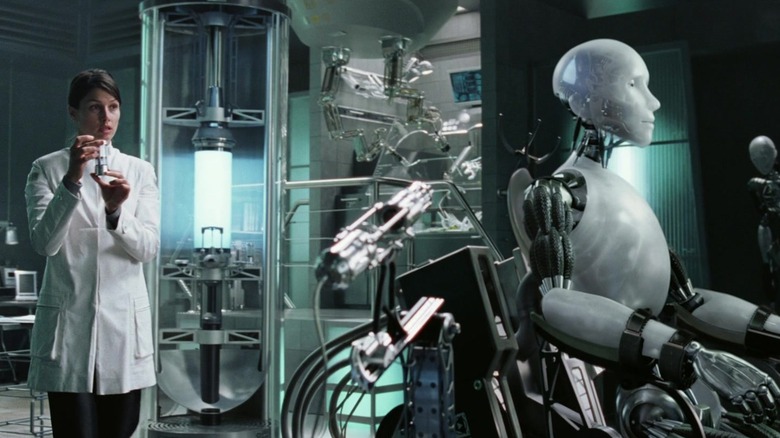
Andy Weir was explicit about his fondness for Isaac Asimov's original book, writing:
"'I, Robot' starts with a simple idea: There are the three laws of robotics, and there is a society in the future that has robots. Then [Asimov] creates these problems that contradict the rules he's established, then he has to solve the problems. Here's a story about what happens if you mess around with the second law a little bit. And I love that. And that's a lot of what my writing is. Asimov is my favorite author."
The Three Law of Robotics, for the sci-fi laypeople, are, as Asimov wrote them:
- A robot may not injure a human being or, through inaction, allow a human being to come to harm.
- A robot must obey the orders given it by human beings, except where such orders would conflict with the First Law.
- A robot must protect its own existence as long as such protection does not conflict with the First or Second Law.
Those laws hang over many robot stories, and are featured right at the beginning of Alex Proyas' film version. But the film is an off-the-rack action/detective story, not a thoughtful philosophical treatise like many of Asimov's stories. One might recall a variation of these laws being quoted in the 1956 classic "Forbidden Planet." I remember hearing them in an episode of "Buck Rogers in the 25th Century." Perhaps most popularly, the laws were paraphrased in James Cameron's 1986 film "Aliens." The laws make a lot of logical sense, and would, by Asimov's estimation, wholly prevent a robot uprising.
Andy Weir was not impressed by the I, Robot movie from 2004
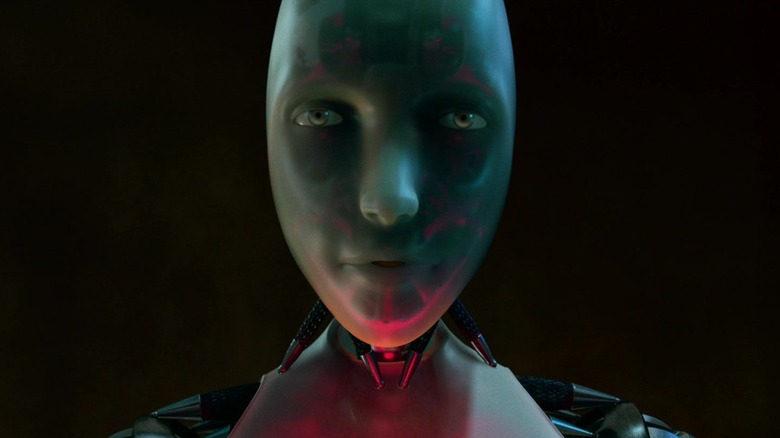
Andy Weir is not a fan of the 2004 "I, Robot" movie. The film starred Will Smith as Detective Del Spooner, a cop in near-future Chicago, at a time when robots walk around among people, although it's safe, because they abide by the Three Laws. Naturally, Spooner is assigned to investigate the death of a high-profile scientist, and it initially looks as if a robot may be responsible. The robot, Sonny, is voiced by Alan Tudyk, who wasn't included in the film's marketing for a wild reason.
Weir didn't like the movie at all, saying:
"The film adaptation wasn't remotely true to its source. No shade on the people who made it. It wasn't for me. I'm a pretty hardcore Asimov fan so it might not be possible to make a movie of 'I, Robot' that would please me, or it would please me and four other people and that would be it. It would not be a crowd pleaser. If you want a good cinematic Asimov, it's been sitting out there for a long time: 'Caves of Steel.'"
"The Caves of Steel," first published in 1953, is a sci-fi detective story set 3,000 years in the future, and stars the characters Elijah Baley and R. Daneel Olivaw (a robot). Earth is overrun with humans, but hyperspace travel allows people to move to lowly populated colony worlds. The plot is an outsized murder mystery.
If there is to be a movie based on "The Caves of Steel," perhaps Weir could produce it. I would watch the heck out of that thing. I would also be one of the three or four people that a wholly faithful, "I, Robot" adaptation would appeal to, along with that freaky Harlan Ellison version from the '70s.