

The Billy Bob Thornton Movie That Changed Stephen King's Life

Much like the "Saw" movies are morality plays that teach its characters lessons using deeply disturbing murder traps, Stephen King specializes in utilizing horror tropes to craft somber parables about subjects like the destructive power of addiction or the ways that societies fail their most vulnerable members. Bearing that in mind, you can usually figure out why a particular work of art does or does not do something for him. It's not surprising, for example, that a storyteller who wears their heart on their sleeve like King wouldn't care for Quentin Tarantino's ultra-hip martial arts/revenge pastiche "Kill Bill." Likewise, it makes sense that a comedy that blends dark laughs with earnest messages the way "Groundhog Day" does" would tickle his funny bone.
"Sling Blade," which served as Billy Bob Thornton's feature directorial debut upon its release in 1996, similarly tells a story as intense as any that King could have plucked from his own brain. A drama in the Southern Gothic tradition, the film (which Thornton also wrote) deals explicitly with domestic abuse, alcoholism, murder, assault, and various forms of emotional violence, much of which is perpetrated against small-town citizens already marginalized by the world around them. Throw in some ghosts or a killer clown, and you've got yourself a classic Stephen King tale.
It's no wonder "Sling Blade" had a profound effect on King himself. "These life-changing movie experiences became less frequent as I grew older, and for a while, I had an idea that Billy Bob Thornton's brilliant parable 'Sling Blade' might be the last time I'd ever have one," as he put it in a 2007 piece he wrote describing his favorite movies for Entertainment Weekly. It surely helped that King was entering a new phase of his artistic output when the film hit theaters.
Sling Blade speaks to the soul of Stephen King's later work
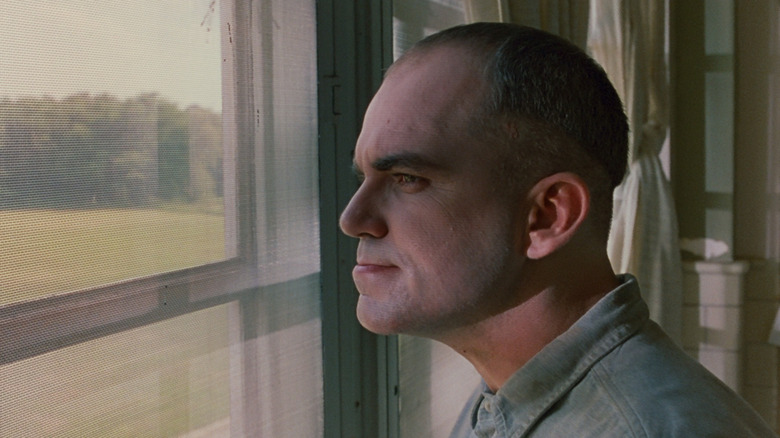
While "Sling Blade" is partially based on the Billy Bob Thornton-penned 1994 short film "Some Folks Call It a Sling Blade," Thornton told the Los Angeles Times in 1997 that it primarily draws from his original one-man stage play, "Swine Before Pearls." Regardless, its plot concerns Karl (Thornton), a mentally disabled man from Arkansas who killed his mother and her lover when he was 12 years old. Upon being deemed no longer a threat, Karl is released from the psychiatric hospital where he's been kept since then. However, he's soon tested when he befriends Frank (Lucas Black), a young boy whose mother Linda (Natalie Canerday) is dating Doyle (Dwight Yoakam), a fellow whose drinking only grows worse by the day.
An examination of the darkness lurking beneath the quaint facade of a tiny community centered on a morally complicated protagonist, "Sling Blade" has, broadly speaking, a good deal in common with later Stephen King works like "Dolores Claiborne." The author had, in fact, only published that novel a few years before Thornton's movie came out, so you can see how it spoke to where his mind was at the time. He's since continued writing mature and thoughtful stories that address related topics, whether that means depicting alcohol addiction with nuance in his "Shining" sequel book "Doctor Sleep" or exploring a May-December friendship comparable to Karl and Frank's with his novella "Mr. Harrigan's Phone."
"Sling Blade" is more subtle and grounded than most King works. It's entirely devoid of supernatural elements, and its violence is only described or occurs off-screen, leaving us with naught but its spiritual fallout. But strip away the latter's fantastical aspects and gore, and you'll find the film and King's writing share a troubled soul.