

Why Project Hail Mary's Most Disturbing Book Moment Was Cut From The Movie [Exclusive]
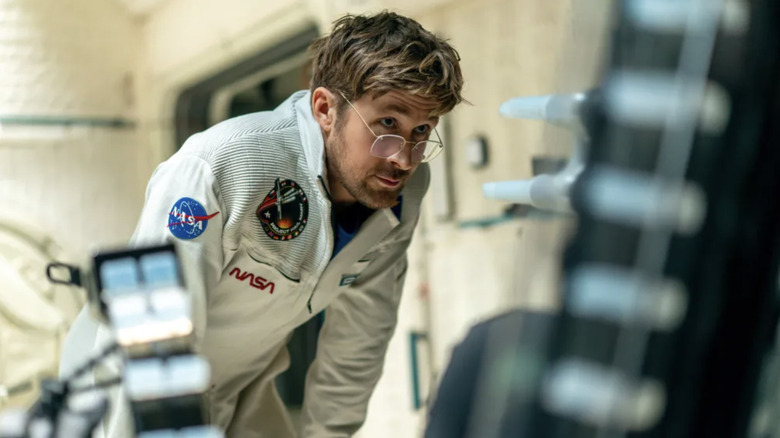
Adapting a story from one medium to another is an art, and a tricky one at that. Whether it's adapting a comic book into a TV series, a film, or a video game, various concessions and omissions must be made. It feels like the current era of IP-crazy media has largely forgotten this, with millions of fans getting up in arms about particular elements of the story they're obsessed with becoming altered or fully deleted in an adaptation. The response to facing such a reality is what separates the fans from the artists, for it's the artists who realize that, as much as they also love these elements they wish to retain, everything has to serve the greater whole and work within the constraints of the medium.
Andy Weir's novel "Project Hail Mary" has gained a passionate fan following since its publication in 2021. Although the novel has an engaging premise perfect for a feature film adaptation, it's sprawling enough that no single movie would have space to include everything seen in its 496 pages. This was the dilemma faced by Drew Goddard, who was tasked with adapting Weir's novel for the film version directed by Phil Lord and Christopher Miller. Even though Goddard had adapted Weir before (for Ridley Scott's film "The Martian"), "Project Hail Mary" has its own unique tone.
Maintaining control over that tone is part of what led Goddard to cut the most disturbing subplot seen in Weir's book from the movie at the script stage, in which the world's governments decide to nuke Antarctica to keep Earth alive long enough for the Hail Mary mission to work. Though Goddard tried to keep it in, the issue came down, of course, to a matter of space.
The Antarctica subplot could've added a wild extra dimension to 'Project Hail Mary'

Although the Antarctica subplot in Andy Weir's novel is a tonally tricky one, Drew Goddard did attempt to keep it in "Project Hail Mary" while he was writing the first few drafts of the script. The subplot wasn't the only unique element the writer tried to retain from Weir's book; in fact, Goddard told /Film's Ethan Anderton that "of my 10 favorite things in the book, nine of them are there, which is a very good batting average." Sadly, the additional Antarctica narrative was not destined to join the others, despite Goddard's valiant efforts. As the writer explained:
"But the one that's the hardest, and I was the one who cut it so it was nobody's fault; there's a moment in the book or scenes in the book where they decide they have to nuke Antarctica to buy themselves time on the earth side of things. And it was in there and I loved it. It was such a concept that was interesting and showed the desperation that we were in. [...] And so that is the thing that I'm saddest about that we had to lose."
On paper, one can understand why Goddard would try to retain the storyline as much as possible. After all, most of the dire circumstances and stakes surrounding the fate of Earth (and the universe) are explained to the audience in the film, but barely shown. The nuking of Antarctica would've made the threat more imminent and the stakes more dire. Yet perhaps it could've unbalanced the film's vibe, too. Fortunately, the movie makes up for this lack of on-screen devastation via the lived-in, no-nonsense performance of Sandra Hüller as Eva Stratt.
Drew Goddard tried to retain the Antarctica subplot, but couldn't find space for it
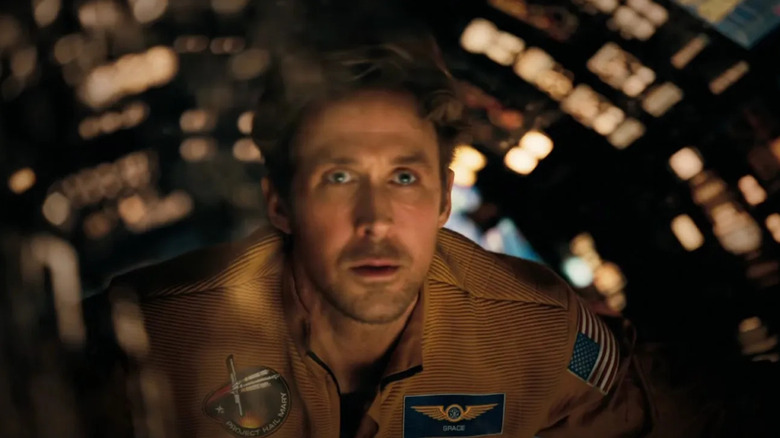
If you've seen "Project Hail Mary" already, you know that the film deftly weaves between gritty, almost bleak material as well as more lighthearted sci-fi adventure fare. While it's possible that the Antarctica subplot could've played decently well as mentioned above, Drew Goddard explained that its omission was more an issue of timing than of tone:
"...it was just too complicated to explain to an audience within a short period of time and we just didn't have a lot of screen time to take the time to do that correctly. And so you would just feel it and you're like, 'I keep trying to do this in three pages but you have to do this in eight pages and I don't have eight pages to do this. I just don't.'"
This is a fair point for several reasons. One is that such a delicate concept would need the proper space to be handled well, otherwise it could compromise the film. Additionally, much of "Project Hail Mary" centers on Ryan Gosling's Dr. Grace and his alien companion, Rocky (James Ortiz), doing science and solving problems in real time. Thus, an additional problem-solving sequence, especially in flashback, might have felt too exhausting when the movie was taken as a whole.
In any case, the film adaptation of "Project Hail Mary" turned out great, and Antarctica remains safe ... for now.