

The Madison Episode 4 Continues The Most Annoying Trend Of The Taylor Sheridan Series
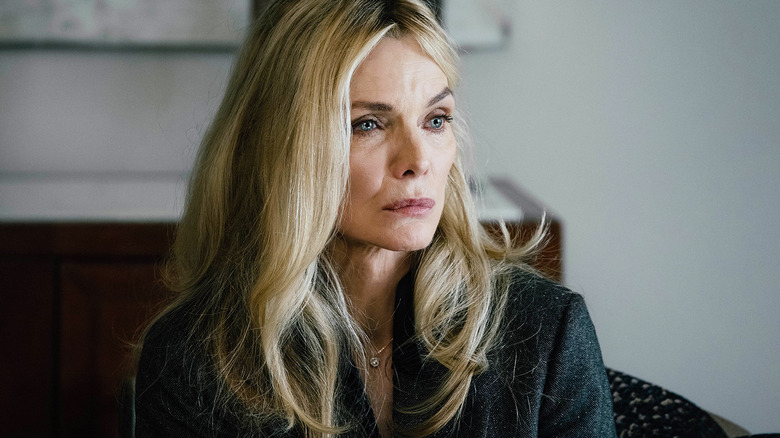
"The Madison" might be Taylor Sheridan's most quietly intimate show yet, but it sure isn't above bashing big city life. The show seemed to have a strangely outdated view of New York City when the first three episodes debuted on March 14, 2026, and now the final three episodes continue this bizarre trend.
Sheridan proved he was ready to take risks with episode 1 of "The Madison." The "Yellowstone" creator seemingly swapped melodrama for melancholy with his latest series, opting for a protracted exploration of grief that felt unlike anything he'd made prior. What's more, "The Madison" set itself apart from "Yellowstone" in one major way. Whereas Sheridan's popular neo-Western portrayed big city folk as greedy land-grabbers, "The Madison" renders the Clyburn family as real, multi-faceted people, as vulnerable to every sharp pang of grief as anyone else.
But while Sheridan's latest effort is undoubtedly refreshing, it also had a strangely unenlightened streak to it. This was most obvious in the way in which it depicted life in the Clyburns' hometown of New York City. Now, with episode 4 of the new series, we're told that cycling in the Big Apple is basically impossible because of rampant crime, raising the question of whether Sheridan has spent too much time on the ranch to really know what's going on in the places he's writing about.
The Madison paints New York as a no-go zone

"The Madison" was influenced by a classic Brad Pitt movie that similarly revolves around the healing power of a Montana river. But before the show moves to the Madison River Valley, it begins in New York City, where Elle Chapman's Paige McIntosh is mugged while walking with her shopping bags. A hooded figure approaches, strikes the youngest Clyburn daughter in the face, and makes off with her bags. She then tells two barely-interested NYPD officers about her ordeal. Soon after, Stacy Clyburn asks her daughter, "Why were you walking? You know better than that," before Paige replies, "I was on Fifth Avenue, Mom, if you can't walk on Fifth Avenue where can you walk?" Stacy's answer? "You can't, that's the whole point."
What is this? Does Taylor Sheridan really think women are unable to walk through New York City without being mugged? Sure, the Clyburns attract unwanted attention due to their elitist aura, but it's not as if the real Fifth Avenue is entirely devoid of women like Paige going about their business.
In "The Madison" episode 4, Sheridan once again paints the city as some sort of crime-infested hellhole. The episode sees Ben Schnetzer's Sheriff Van Davis take Paige, Patrick J. Adams' Russell McIntosh, and Beau Garrett's Abigail Reese on a boat trip down the Madison River. During the ride, Russell claims he uses a Peloton because it's too dangerous to ride his bike in New York. At first, it seems like a joke at Russell's expense, but Abi actually backs him up. "If he doesn't get run over, he'd probably get robbed," she says. "Thieves will just pull you off at a red light." Forgive me, but what in God's name is anyone talking about here?
Does Taylor Sheridan really think New York City is some sort of lawless hellscape?
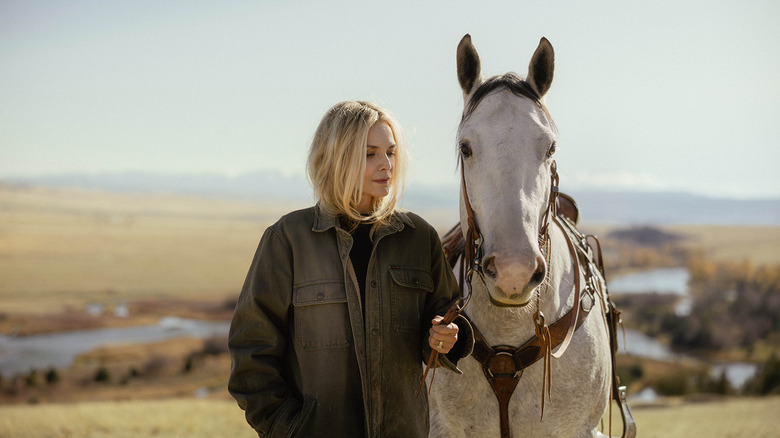
Star Kurt Russell promised "The Madison" would challenge Taylor Sheridan's biggest weakness, i.e. his writing of women. But after four episodes of "The Madison," I'm starting to wonder if his biggest weakness is that he thinks New York is basically just Times Square in the 1970s. Are these constant references to crime in the city supposed to be a joke? Because for all its sentimentality, "The Madison" does have some moments of levity. But it would seem unusual for characters who have thus far been written so believably to genuinely think they can't go for a bike ride or walk down Fifth Avenue.
Making matters more perplexing is the fact that Sheridan did live in New York during his 20s. The show creator told People he has a "love-hate relationship" with the city, which seems to inform some of the "Madison" characters' oddly outdated view of that same city. It's a shame, too, because this show seemed to be Sheridan extending an olive branch to the city slickers after writing them as soulless colonizers for years.
For a show that's frequently sensitive to the searing pain of losing a loved one and the way in which grief is an utterly life-altering experience, this attempt to cast New York as some sort of haven for criminals feels particularly out of place. Episode 4 is also the episode that sees Sheridan dismantle the seven stages of grief paradigm in convincing fashion. So much of it rings true, which makes the anti-New York bias even more perplexing. Has Sheridan really not stepped off the ranch in the last few decades?