

Robert Pattinson's Forgotten 2014 Satirical Comedy Is A Box Office Flop Worth Revisiting
Robert Pattinson's tendency to deliver silly, eccentric performances is the gift that keeps on giving. Pattinson will grace our screens soon as the villainous Scytale in "Dune: Part Three," and he even appeared in a secret voice cameo role in Josh Safdie's "Marty Supreme." The "Mickey 17" actor is obviously capable of inhabiting dramatic roles with equal ease, as seen in his moody, grungy turn as the caped crusader in Matt Reeves' "The Batman."
That said, Pattinson has also played an understated everyman in David Cronenberg's "Maps to the Stars," which satirizes contemporary Hollywood and its glorious and cruel moving parts. "Maps to the Stars" didn't do well at the box office due to a limited release window in select countries, but the film impressed critics after premiering at the 2014 Cannes Film Festival. Bruce Wagner's brilliant script for the film carries a bitter edge — there is no silver lining here, as the focus is on the commodification of celebrity culture and the unforgivable cost one has to pay to bask in fame.
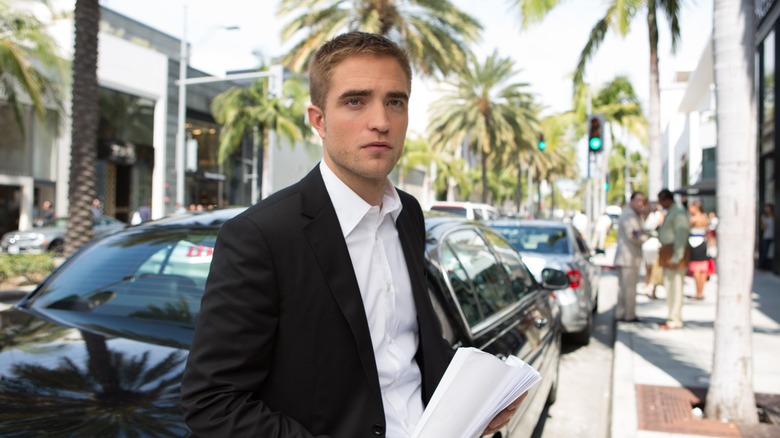
Cronenberg has always excelled in creating little pockets of hyperreality. We have seen a variation of this idea play out in everything from "Crash" to "Videodrome," right up to his latest "The Shrouds," which emerges as a thought-provoking thriller about death and grief. "Maps to the Stars" places this surreal hyperreality at its center, where the Hollywood machine becomes a sentient and malevolent organism eager to consume everyone. In the film, Pattinson plays Jerome Fontana, a struggling actor and limousine driver (just like Wagner when he had penned the script) who carries the tender aspirations of making it big in Los Angeles like every other artistic dreamer.
Pattinson's presence is just one of many reasons to revisit this overlooked Cronenberg satire, but is it any good?
Maps to the Stars highlights Cronenberg's strengths with its unsettling and vitriolic edge
Spoilers for "Maps to the Stars" to follow.
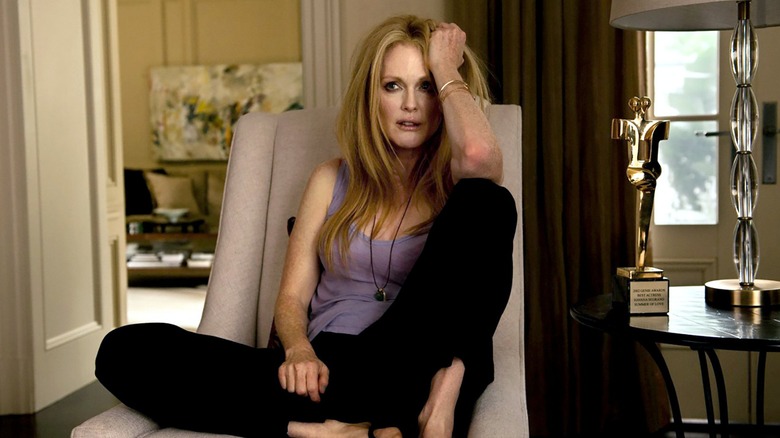
"Maps to the Stars" opens with Agatha Weiss (Mia Wasikowska) arriving in Los Angeles and hiring Jerome (Pattinson) to drive to her brother's house. Estranged from her parents, Agatha wrestles with her troubled past while wanting to make amends with them. She takes up a job as the personal assistant of washed-up actor Havana Segrand (a brilliant Julianne Moore), who has to live in the shadow of her super-famous mother and constantly deal with insecurity and resentment.
As Havana's mental health declines over time, Agatha's presence in her life is perceived as a threat by her father, Stafford (John Cusack), who also happens to be Havana's psychologist. These messy dynamics only get uglier as the film progresses, with Havana's overwhelming self-loathing demanding our attention at all times. Moore belts out an engrossing performance, infusing Havana's trauma with complex psychosexual vignettes.
To call "Maps to the Stars" mean-spirited would be an oversimplification, as both Wagner and Cronenberg operate on the assumption that their hyperreality is unforgiving. The absence of hope might feel a tad odd — after all, Cronenberg is known to have found beauty within the grotesque throughout his illustrious career, as his films often root for humanity to shine through when things get dire. "Maps to the Stars" might be too bleak for its own good, but its departure from Cronenberg's usual impulses yields intriguing results. It is not easy to pull off dark humor when a film's fictional world is so steeped in visceral pain, but "Maps to the Stars" makes this tonal blend work.
This might not be among Cronenberg's finest work, but "Maps to the Stars" deserves our attention as an unforgettable psychodrama about trauma.