

Peaky Blinders: The Immortal Man Title Explained By Creator Steven Knight [Exclusive]
Warning: This article contains minor spoilers for "Peaky Blinders: The Immortal Man."
When "Peaky Blinders" fans around the globe switch on Netflix and begin watching "The Immortal Man" (those who didn't already catch it during its limited theatrical release, that is), a few urgent concerns may quickly come to mind. Where has Cillian Murphy's Thomas Shelby been since the season 6 finale all those years ago, and what's he up to now? Who else among the Shelby clan will be joining him for this next chapter of the long-running story? And what on Earth does "The Immortal Man" actually refer to in the first place?
Does that last part seem like a silly thing to ask? Well, it's par for the course when it comes to a show that has had many pondering the question of what "Peaky Blinders" is even supposed to mean. When this spin-off movie was first announced and the title officially revealed, those who hadn't brushed up on their series lore recently might very well have raised an eyebrow over such an unusual turn of phrase.
Fortunately, I had the chance to interview series creator (and solely-credited screenwriter on the film) Steven Knight on behalf of /Film and ask him about this very topic. As it turns out, it has to do with a memoir that Tommy has devoted himself to writing throughout "The Immortal Man." According to Knight:
"I tend not to plan too much and I trust whatever comes to me. It's almost like a dream [...] So, the name 'Immortal Man' came to me before the justification for what it means [laughs], if you like. I just liked it. And [Tommy's] writing a book, and I liked the title of the book to be 'The Immortal Man.'"
Steven Knight created a backstory for Peaky Blinders explaining Tommy's sense of immortality
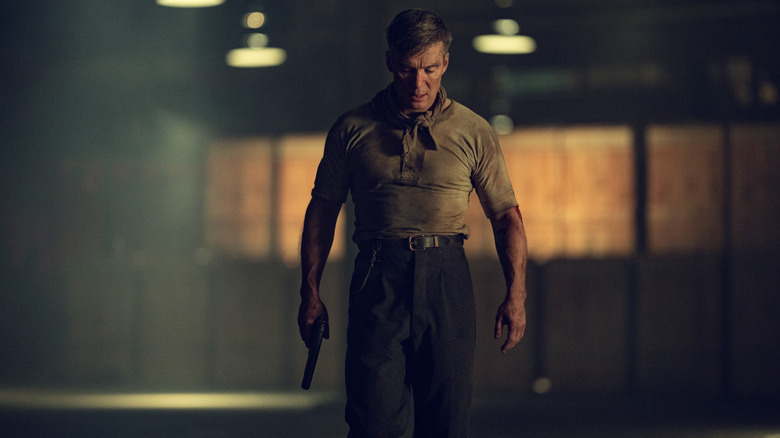
While that's the practical explanation behind the title of "The Immortal Man," the thematic reasoning is much more compelling. "Peaky Blinders" fans are bound to be familiar with the single most defining moment in the life of Tommy Shelby, his brothers, and a select few compatriots caught up in World War I. Faced with almost certain death, Tommy and his friends only narrowly escape and make a vow to live their lives as if they were already dead.
As Steven Knight tells it, this was the underpinning behind the spin-off film's title and his own interest in exploring similar ideas of how Tommy could remain "immortal" (so to speak):
"In rationalizing it, there's a backstory which I've always had in mind where Tommy and his brothers and their comrades were in World War I in No Man's Land, trapped and certain they were going to die. And so they all sing the song 'In the Bleak Midwinter' and wait for death. But it doesn't come and they're reprieved. And so they say, 'Okay, from now on, everything is a bonus. From now on, everything is extra.'
"And that's how Tom has lived his life. It's almost been his superpower, that he's careless of his own life, which gives him a sense of immortality."
This mindset goes a long way towards explaining some of the more reckless actions Tommy engages in throughout "Peaky Blinders," taking bigger and bigger risks where others might've opted for more restraint. There's nothing quite so dangerous as someone with little regard for their own life, as his enemies soon find out. More than anything else, this aspect goes on to dictate Tommy's overall arc in both "Peaky Blinders" and "The Immortal Man."
Peaky Blinders: The Immortal Man is about Tommy Shelby's legacy and what he leaves behind
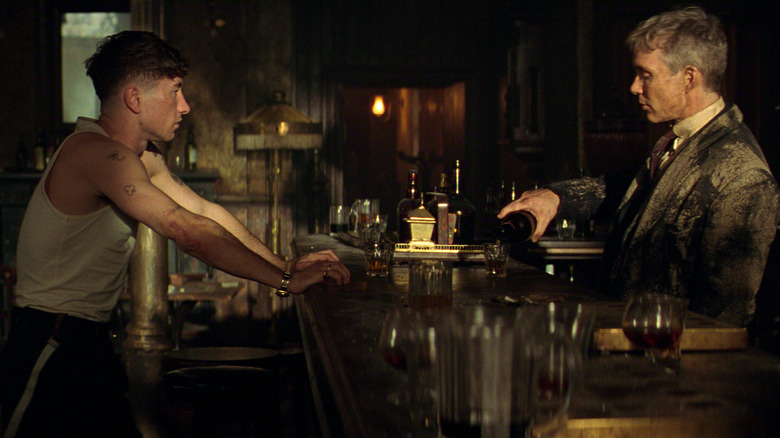
Of course, things aren't quite as simple as that for a figure as complicated as Tommy Shelby. A revisit of the "Peaky Blinders" series — particularly "Peaky Blinders" season 6 — reveals another connection to the phrase "Immortal Man" and how it factors into Tommy's journey. When he first learns of what appears to be a fatal diagnosis of tuberculoma, a brain tumor caused by the tuberculosis disease prevalent at the time, Tommy mutters to himself that he's now nothing more than an "ordinary mortal man." Although this proves to be a ruse, meant to motivate him to behave even more erratically in the hopes of ending his own life prematurely, the aftereffects clearly linger into the events of "The Immortal Man."
For his part, Steven Knight emphasizes that Tommy realizes that nobody lives forever. That's where his memoir comes in, which he writes in the hopes of passing his experiences down to the next generation. While this technically includes his young son Charles from early seasons of the show, this also includes his grown-up problem child Duke (Barry Keoghan), who wreaks quite a bit of havoc in the movie. To quote Knight directly:
"But at the same time, [Tommy] doesn't really want — in the words of John Keats, he's 'half in love with easeful Death.' And that writing of the book, him calling it 'The Immortal Man,' is basically saying, because he's writing it for his sons, he's basically giving something to his sons that he thinks they can pass on and pass on and pass on. So, that element of him will be immortal, and that's why he calls it that."
"Peaky Blinders: The Immortal Man" is now streaming on Netflix.