

Fox Claimed Bones Wasn't A Big Hit To Avoid Properly Paying Its Creator And Stars
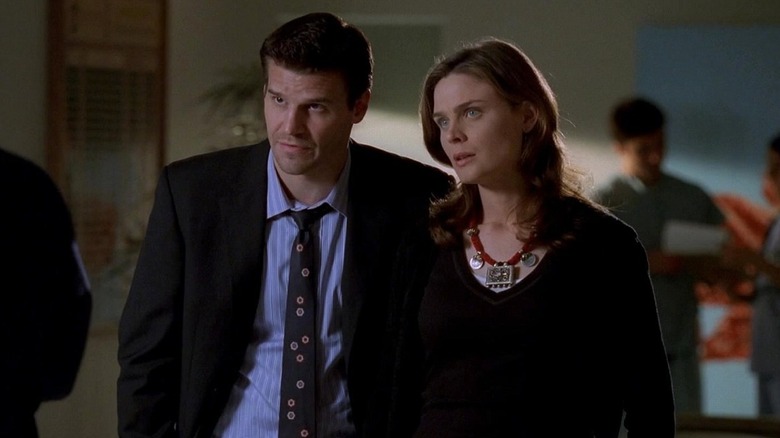
An infamous "Bones" lawsuit revealed just how unscrupulous TV studios could be. "Bones," recall, was the massively popular Fox police procedural that aired from 2005 to 2017, lasting a whopping 246 episodes over its 12 seasons. The series starred Emily Deschanel as the dispassionate, intellectual, and focused Temperance "Bones" Brennan, and David Boreanaz played the more rough-hewn Seeley Booth. The pair regularly solved very strange, often very gory murders. The series began as an offbeat detective show, but soon turned into a romance series between the two leads. "Bones" became a TV comfort food staple for millions, and was a bedrock of Fox for many years.
The series remained popular throughout its production, even as it moved over to streaming. "Bones" was one of the more visible titles to turn up on Fox's service, Hulu.
For some context: the mid-2010s was also an era of increased vertical integration; that is, companies came to own their own shows, as well as the services/networks that exhibited them. For many decades, this sort of vertical integration was illegal, thanks to the Paramount Decision of 1948, but that decision was overturned in 2019. By the end of that span, a lot of studios were kind of ignoring the decision anyway.
The problem arose, however, when Fox — in brief — sold their own show to Hulu for a pittance. Deschanel, Boreanaz, author Kathy Reichs (whose life served as the primary inspiration for the show), and executive Barry Josephson had a deal that would have allowed them a cut of that sale. In lowballing "Bones" to its own affiliates — and by claiming that the show wasn't really THAT big a hit — Fox cleverly found a way to cut their pay. The quartet sued. The case, described in the Hollywood Reporter, was settled in 2019.
Fox deliberately tried to stiff David Boreanaz and Emily Deschanel from their cut of the Bones profits
The lawsuit was instigated way back in 2015, when "Bones" was still on the air. The Hollywood Reporter summed up succinctly that Fox's studio division was charging its own affiliates for the rights to broadcast "Bones," but that the studio was massively undercharging those affiliates. That meant that people who got royalties from such sales — like its stars — were deliberately getting those royalties slashed.
Fox was apparently not honest about this entire affair. It seems that a studio rep argued to an arbitrator that "Bones" wasn't making as much money as it appeared, and that the series, despite having a long, healthy lifespan, wasn't actually a hit. Luckily, the arbitrator — a man named Peter Lichtman — saw through Fox's ruse. Looking over the studio's licensing practices, he figured out that Fox was saving money by lowballing its "Bones" sales, and by deliberately having its talented actors sign a series of releases. This, as Lichtman figured out, was brazen and open dishonesty.
He actually lashed out against Fox, saying in his decision: "[Fox representatives] appear to have given false testimony in an attempt to conceal their wrongful acts. [They have taken a] cavalier attitude toward its wrongdoing," and held a "company-wide culture and an accepted climate that enveloped an aversion for the truth." Ouch. Very ouch, Fox was busted so hard. It was decided that David Boreanaz, Emily Deschanel, and Kathy Reichs were owed $51 million (!).
Bones was a half-billion dollar monster
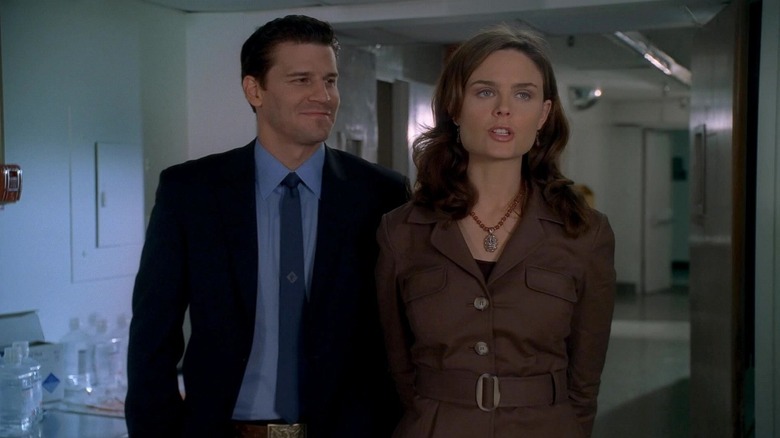
In a separate Hollywood Reporter article it was clarified that "Bones" was indeed a hit. It was actually said to have made half a billion dollars for the network over the course of its first seven seasons. It was very clearly a cash cow, and the height of hubris for Fox to claim that it wasn't a hit. The streaming model, meanwhile, was ripe for corruption. In a previous generation, a studio would make a TV series, and then sell it on the open market, eventually handing it over to a network or local TV affiliate (if it was syndicated). If a network or station could sell ads during a show they bought, the show would turn a profit. Then portions of the profit would be handed out to the executives and stars.
If a studio was selling a show to its own arm, though, it worked a little differently. Recall that streaming services are based on a subscription model, and stars didn't get any royalties from a subscription fee. By selling a show for almost nothing, a studio could rake in all the profits from a series, and never pass on any royalties to its stars. Clear? If not, chalk it all up to that most ineffable of beasts, "Hollywood accounting."
The "Bones" case, one might assume, would have ended this kind of dishonest streaming trickery in perpetuity, but it didn't really end all of the dishonesty. One might recall the 2023 strikes, wherein (among other things) professional writers, actors, and directors all went on strike because streaming revenue wasn't being shared with them. The industry has been mutating ever since, and will never look the way it did ever again.