

KPop Demon Hunters' Oscar Journey Is The Ultimate Cinematic Cinderella Story
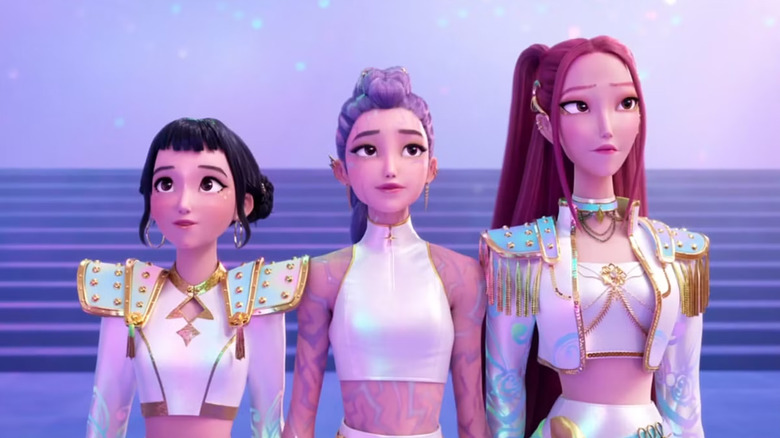
"We're shattering the silence, we're rising, defiant."
While "Sinners" and "One Battle After Another" led the 98th Academy Awards in nominations, 2025 was defined by the animated Netflix sensation "KPop Demon Hunters." Not only did Maggie Kang and Chris Appelhans' movie, about a K-pop girl group keeping the world safe from the ever-present supernatural danger of demons between selling out stadiums, become the most watched film in Netflix history, but the film became so unignorable, it exposed the hypocrisy of Netflix's "streaming-first" approach to distribution when it also became a hit at the box office. And it wasn't even originally produced as a Netflix Original.
"KPop Demon Hunters" was developed through Sony Pictures Animation, but even after it was clear Netflix would be the film's final home, all signs pointed to Alex Woo's "In Your Dreams" being the streaming juggernaut's horse to bet on (and it should have also been nominated, to be clear) because this was a movie musical about K-pop, demon hunting, and the most controversial subject matter of all when it comes to Award-winning stories: young women. Could the historically stuffy voting members of the Academy actually get over their pretentiousness and support a film where characters' eyes turn into six-pack abs, then corn on the cob, and then popcorn at the sight of hunky boys?
As it turns out, the answer is a resounding, "Yes."
After winning the Golden Globe and Critics' Choice awards for Best Animated feature (and sweeping the Annie Awards with 10 wins), "KPop Demon Hunters" took home the statue in the same category, as well as the award for "Best Original Song" for "Golden." The wins solidify the cinematic Cinderella story of "KPop Demon Hunters" — a movie whose journey embodies the fictional underdog stories the awards bodies love to celebrate.
KPop Demon Hunters is original storytelling worth celebrating
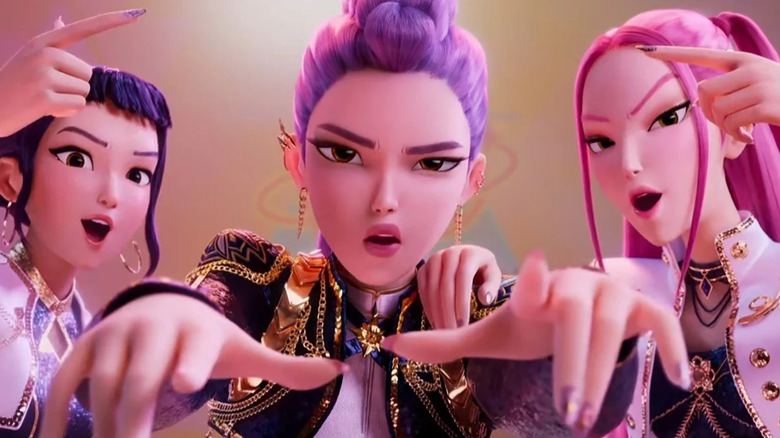
"KPop Demon Hunters" stormed onto the scene like a glitter-bomb of genres and stacked with dynamite earworms from EJAE and Mark Sonnenblick. The animation is vibrant and jaw-dropping, but the story has a heart beating underneath all the neon chaos. Yes, it's a movie about a K-pop girl group battling demons who are disguised as a K-pop boy band, but it's also a movie about embracing your identity, fighting back against impossible odds, and the importance of finding a community that supports you as your fullest self.
"To all the fans who got us here and for all of those who look like me, I am so sorry that it took us so long to see us in a movie like this," said director Maggie Kang as she accepted the Oscar. "But it is here, and that means that the next generations don't have to go longing. This is for Korea and for Koreans everywhere." The personal connection Kang has to the story cannot be overlooked, and the specificity of Korean culture incorporated into the film is why audiences love it.
Like K-pop music itself, "KPop Demon Hunters" plays like a clever remix of recognizable beats to blend into something that feels entirely its own. At a time when so many movies are busy chasing nostalgia or replaying the same old formulas, "KPop Demon Hunters" takes those familiar ingredients and spins them into something dynamic, confident, and genuinely exciting.
I don't care how many studio executives aligning themselves with techno oligarchs keep claiming that the industry will only be saved if we prioritize existing IP; I will never believe it as long as original stories with distinct creative visions like "KPop Demon Hunters" continue to thrive. As HUNTR/X sang, "Truth after all this time, our voices all combined. When darkness meets the light, this is what it sounds like."
It sounds like Oscar history.