

Why Some Of Battlestar Galactica's Technology Seems Unadvanced
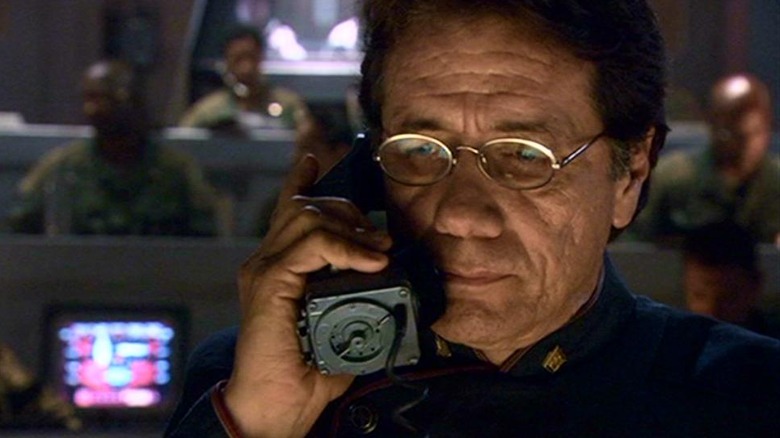
The goal of the reimagined "Battlestar Galactica" was to create a space opera that stayed relatively close to reality. Series' co-creator Ronald D. Moore, who wanted to write the stories he never could on "Star Trek," coined the style as "naturalistic science-fiction." That meant handheld cameras in the style of "cinéma vérité" documentaries, as well as a world that resembled the one the audiences lived in.
The characters on "Battlestar Galactica" behaved like they worked on a U.S. Navy aircraft carrier — and indeed, aside from the faster-than-light travel, the technology on Galactica is at about that level. The primary communication system on the ship is corded telephones, not the handheld communicators or viewscreens seen on "Star Trek." Rather than tablets, the Colonial Navy still uses paper documents. Even the more advanced Battlestar Pegasus had CRT computer monitors right out of the 1990s.
If you look closely, you'll notice it's mostly computer technology where "Galactica" seems behind the times — and there's a good reason for that. The premise of the series is, of course, that the people of the 12 Colonies of Man created robots called Cylons who rebelled, evolved, and waged war on their masters. (No wonder Edward James Olmos says "Battlestar Galactica" and "Blade Runner" share a universe.)
As Moore wrote in the "Battlestar" series bible, this meant that Colonial society did away with innovations like computer networking and microprocessors, because Cylons could hack and infiltrate them. The 12 Colonies were left without digital luxuries like the internet, video games, etc. as the price of vigilance against the Cylons. While the Colonials regressed their technology, the Cylons evolved to take on human form.
The lack of computer networking in "Galactica" wasn't just narrative backstory, either, but directly tied to the series' aim of tactility.
Battlestar Galactica showed a civilization that abandoned computer networking

"While the ship can travel faster than the speed of light, officers have to verbally go through long checklists while cadres of enlisted personnel flip switches and press buttons in order to make it possible," wrote Ronald Moore in the series bible. "Human brains need to crunch numbers, organize data, and come up with solutions to complex problems."
The abandonment of computer networking technology is also a compelling look into how a civilization that survived a robot uprising might adapt. Indeed, the prequel series "Caprica" (which unfortunately didn't work, and "Battlestar Galactica" co-creator David Eick knows why) showed Colonial technology was more advanced 58 years before "Galactica." On the cusp of creating artificial intelligence, scientists had also cracked virtual reality as a consumer product.
In the "Battlestar" pilot mini-series, one of the first scenes that Commander William Adama (Edward James Olmos) and future-President Laura Roslin (Mary McDonnell) share is a debate over putting a networked computer on Galactica. Adama, a Cylon war veteran, is adamantly against it and the show proves him right. The Colonial fleet has started to reintegrate computer networking systems designed by Dr. Gaius Baltar (James Callis) — but Baltar's lover, a Cylon infiltrator (Tricia Helfer) added a backdoor to the system. The Cylons exploit that opening to carry out nuclear armageddon on the 12 Colonies. Galactica only survives because it didn't have Baltar's software installed.
"In general, the Cylons should be an extension of current, cutting edge ideas about how computer technology could potentially be exploited and be put to use in the service of an artificial intelligence," Moore wrote in the "Galactica" bible. Real-life AI tech isn't Cylon-level yet, but "Battlestar Galactica" still stands as a preeminent warning against creating technology you can't control.