

How Sci-Fi Author Isaac Asimov Really Felt About Frank Herbert's Dune Books
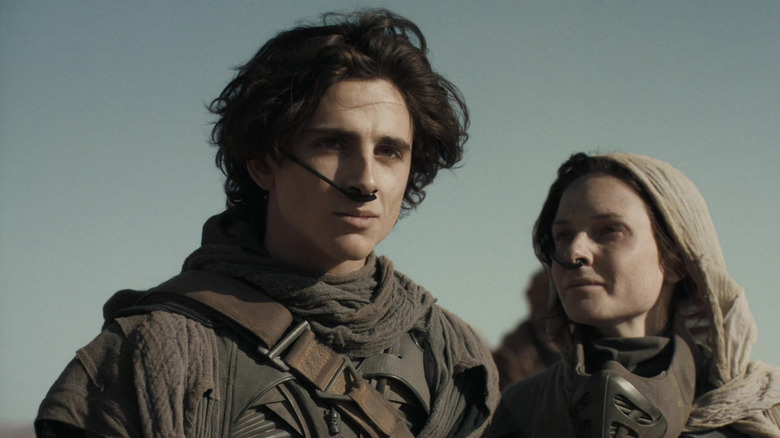
Following its publication in 1965, Frank Herbert's sci-fi novel "Dune" attracted a cult fanbase that loved its narrative density and complex mythology. The world of "Dune" was so vast and complicated that Herbert included a lengthy glossary of proper names and oblique tech to explain how everything locked together. The book served as a metaphor for real-world colonialism and the way imperialist nations tend to forcibly occupy other nations with richer natural resources. In Herbert's sci-fi version of things, multiple royal families from across the galaxy are placed in charge — by a corrupt Emperor — of a distant planet called Arrakis, the only known source of the spice Melange. The Spice, as it's also called, is a hallucinogen, but it's capable of enhancing one's brain and allow them to calculate difficult space travel mapping problems. Basically, it's vital for transportation.
The plot of "Dune" involves powerful households conspiring against and/or betraying one another, all while local religions are manipulated to wrest violent power from others. There's even a healthy dose of mysticism to boot and, oh yes, a sect of witches is pulling the strings on everything. Thanks to the assorted "Dune" film and TV adaptations released over the years, many people now know the details of the first "Dune" novel quite well.
Isaac Asimov, as it were, was born around the same time as Herbert, and he, too, penned a collection of vast sci-fi stories that, like Herbert's "Dune" novels, were once considered unfilmable in the form of his "Foundation" book series (which began in 1951). In his intro for the fifth volume of the sci-fi literary anthology collection "The Hugo Winners," itself published in 1986, Asimov even praised "Dune," describing it as a child of his "Foundation" novels and arguing that Herbert had improved on his ideas.
Isaac Asimov felt that Frank Herbert improved on his Foundation ideas with Dune

Mind you, Isaac Asimov only mentioned "Dune" in passing and lumped it together with the Childe Cycle, as was written by Gordon R. Dickson. The Childe Cycle began in 1959 with the publication of "Dorsai!" and ultimately included 11 volumes in all. It's not as well known as "Foundation" or "Dune," but it's flattering that Asimov felt it comparable. He similarly discussed the apparent influence of his "Foundation" books on the "Star Wars" franchise, a property that Asimov himself played a small but memorable role in shaping. As he put it:
"It is with delight that I realize that the 'Foundation' series has, in turn, influenced other writers who have, in turn, improved on me and enriched the field with such tales as those of 'Dorsai!' by Gordy and those of 'Dune' by Frank Herbert. I think I have even contributed significantly to the thinking that went into the film 'Star Wars' and its sequels, where a Galactic Empire is also featured and it is pictured as fighting to suppress a small band of human beings trying to build a new and better galaxy."
Indeed, a lot of the sci-fi operas we know and love to this day are still rooted in stories, philosophies, and ideas that originated in the 1950s and 1960s. Asimov was immodest about his contributions to the genre, but then his immodesty was earned; no critic would dare imply that he wasn't one of the most influential figures in sci-fi literary history.
It's also worth noting that both Asimov and Herbert won Hugo Awards, with Herbert winning for "Dune," and Asimov for "The Gods Themselves" and "Foundation's Edge." Dickson was nominated in 1960 for "Dorsai!" but lost to Robert A. Heinlein's "Starship Troopers."