

This Batman Cartoon Episode Combined The Dark Knight Returns With A Tom Stoppard Play
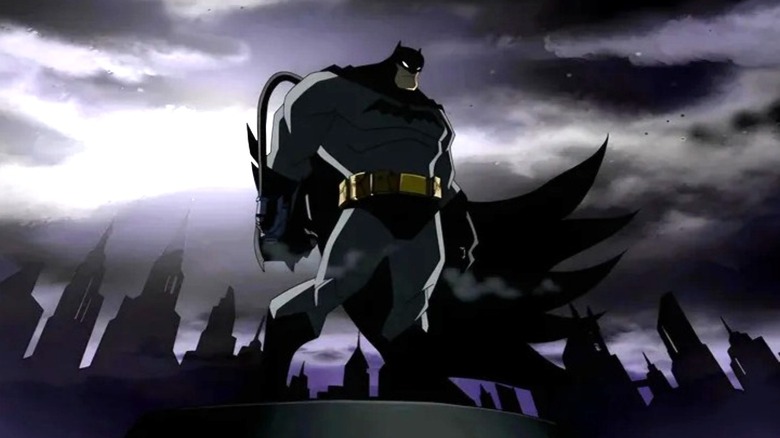
Frank Miller's "The Dark Knight Returns" is among the most seminal Batman stories ever told, and despite being a rather dark and violent story, it has influenced Batman cartoons aimed at children. "The New Batman Adventures" anthology episode "Legends of the Dark Knight" included a segment recreating scenes from "Dark Knight Returns" (which won Miller's approval). But another unique adaptation can be found in "Artifacts," one of the best episodes of 2004 cartoon series, "The Batman."
"Artifacts" is set in 2027, 20 years after the episode first aired in real life, and depicts Batman's (Rino Romano) last battle with Mr. Freeze (Clancy Brown). In the intervening two decades, the now scarred and gray-haired Bruce Wayne has bulked up and redesigned his suit; the blue-on-black highlights and yellow oval around his chest insignia are gone, leaving a grimmer, darker Batsuit.
Batman in "Artifacts" thus looks like the spitting image of Frank Miller's Dark Knight. He's even traded in his sleek sports car Batmobile for a tank, based on Miller's Batmobile redesign. When Batman first climbs out of that Batmobile, Freeze quips "the Dark Knight returns," which serves as a blatant homage.
But the episode is only half a "Dark Knight Returns" homage. There's a parallel story, set one thousand years in the future, about the unearthing of the long-abandoned Batcave. This part of the story was inspired by the play "Arcadia," written by the late Tom Stoppard, which also has two timelines. The play cuts between British manor owned by the Coverly family in the early 19th century, and then present day (1993) when academics are piecing together the lives of the people we follow in the first story.
As "Artifacts" writer Greg Weisman put it on his personal Q&A site: "It's fun when your influences range from Stoppard to Miller."
Artifacts feels like Batman meets Tom Stoppard's Arcadia
The title "Arcadia" is a word meaning rural and idyllic life. In the play, it refers to the gardens at the Coverly house, and the contrast between tradition and knowledge. Dissenting views on hot-button topics of the early 19th century, such as scientific enlightenment and naturalistic art, are discussed. Young Thomasina Coverly wants to question the world, while her mother, Lady Croom, quips to teacher Septimus Hodge: "As [Thomasina's] tutor, you have a duty to keep her in ignorance."
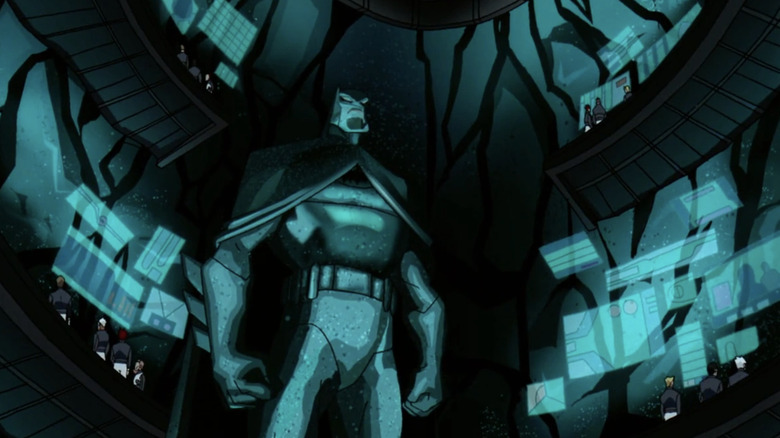
With only 20ish minutes to tell an action-packed story, "Artifacts" cannot plunge into intellectual debates nearly as deeply as "Arcadia" does. However, it does explore how history can be lost in record, because future Gotham's archaeologists make completely wrong guesses about Batman.
In 3027, Batman is a myth and his secret identity was either never discovered or lost to time. One of the investigators, Moira (Danielle Judovits), learns the Batcave was built under the former site of Wayne Manor. She proposes Bruce Wayne was "the Red Robin" and his parents Thomas and Martha were Batman and Batwoman. This misunderstanding is similar to a plot point in "Arcadia."
Naturally, a key theme of "Arcdia" is the contrast between past and present; the stage directions note the scenes should have the same set but with different furnishings across the two timelines. To decode the past, historians must rely on supposition from incomplete evidence. The 1800s-set scenes in the play feature the character Ezra Chater, a poet and guest at the Coverly House. In the present, we learn Ezra has almost vanished from the historical record, with only two poems left behind. Professor Bernard Nightingale proposes the (incorrect) theory that Ezra was killed in a duel with Lord Byron, "explaining" his abrupt disappearance.
Artifacts explores the legacy Batman will leave
Tom Stoppard, who died in 2025, was widely considered one of the great modern playwrights. In "Rosencrantz and Guildenstern Are Dead," he retold "Hamlet" through the POV of those two minor characters. Many writers iterate on Shakespeare, but some do it more brilliantly, like Stoppard — and Greg Weisman.
Weisman's urban fantasy cartoon "Gargoyles" is filled with Shakespeare homages; the actual Macbeth is even a recurring character. One of Weisman's later cartoons, the short-lived but superlative "The Spectacular Spider-Man," featured a subplot of Midtown High putting on a production of "A Midsummer Night's Dream." Amusingly, Weisman indicated the "Arcadia" homage came first for "Artifacts" and the "Dark Knight Returns" influence developed as he crafted the story.
While "The Dark Knight Returns" featured Bruce Wayne coming out of retirement to be Batman again, this Bruce has evidently never retired. Age is getting to him, though, and is slowing him down. (While Rino Romano was cast as a younger Batman, he's surprisingly good voicing a cranky old Dark Knight, too.) Still, Bruce refuses to retire until "the mission" is complete.
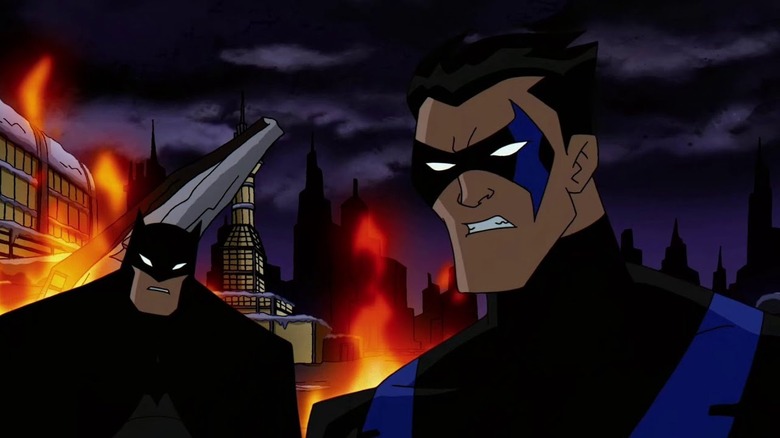
By "The Batman" season 4, Batman had Batgirl (Danielle Judovits) and Robin (Evan Sabara) as his partners. "Artifacts" shows they've grown up into Oracle (Kellie Martin) and Nightwing (Jerry O'Connell), respectively. This cements the episode's theme of how Batman's legacy is going to live past him through his students.
The climax of "Artifacts" ties the two timelines together. Freeze has awoken in future Gotham and is attacking the Batman-free city (presumably this is why Freeze was chosen as the episode's villain, because his cryogenics tech could keep him alive into the future). And the Batcave contains the secrets to defeating Freeze, because even with Bruce Wayne gone, Batman will always be there to protect Gotham.