

The Twilight Zone Creator Rod Serling Didn't Mince Words About Star Trek
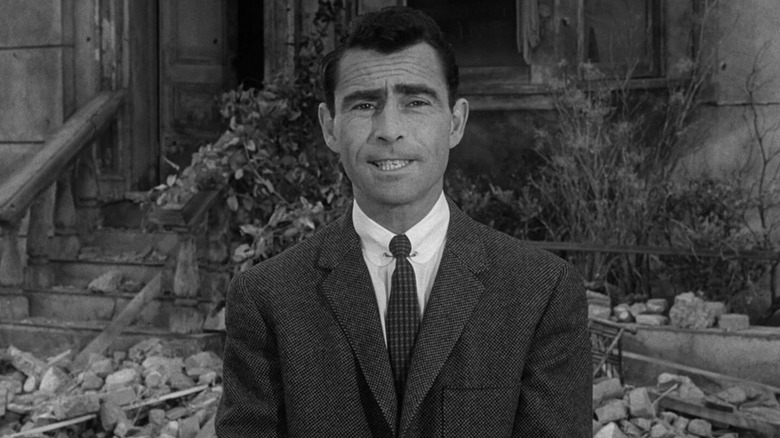
Rod Serling's anthology series "The Twilight Zone" originally aired on CBS for five seasons and 156 episodes from 1959 to 1964. Thanks to some sweet syndication deals, however, the show was rerun frequently well into the 1980s. There are now several iterations of "The Twilight Zone" spanning film and television, and the property remains an essential piece of pop culture. Movie and TV fans aren't fully educated until they've seen multiple episodes of the original "Twilight Zone."
By comparison, Gene Roddenberry's sci-fi series "Star Trek" aired on CBS for three seasons and 79 episodes from 1966 to 1969 before it, too, landed a sweet syndication deal that to it being rerun well into the '80s. It similarly spawned numerous spin-offs (with new "Star Trek" shows being made to this day) and remains a noted pivot point in pop culture history. Once again, movie and TV fans aren't fully educated until they're familiarized themselves with Roddenberry's creation.
However, while the original "Star Trek" and "The Twilight Zone" TV shows have many mutual fans, the pair are notably different. "The Twilight Zone," because it is an anthology series, plays a little more fast and loose with its themes. Its episodes explore everything from the supernatural to technology, with most of them focusing on a tragic flaw in the human spirit that's exploited by the ironic gods of the Zone itself. "Star Trek," meanwhile, is more traditionally scripted and focuses exclusively on sci-fi scenarios.
Serling, as it so happens, wasn't a huge fan of "Star Trek." He admitted as much in a 1970 interview with James Gunn (the TV personality and author/academic, not the filmmaker you're thinking of), declaring that the original "Star Trek" TV series, while displaying fits of ingenuity, was inconsistent. And he had a point; many Trekkies would agree.
Rod Serling felt that Star Trek was inconsistent
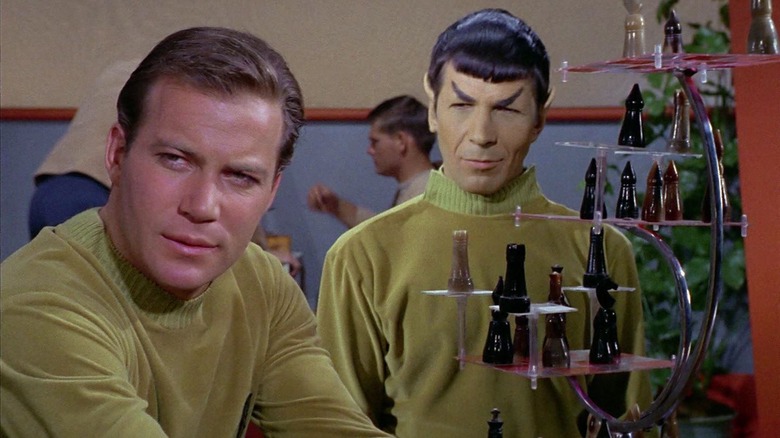
Rod Serling had every right to criticize "Star Trek." One could glean from watching "The Twilight Zone" that Serling was trying to push genre storytelling forward, as it deals with complex themes and invents novel scenarios that allow for all manner of narratives. Moreover, it's an adult series that explores matters like guilt, addiction, and hubris. "Star Trek," which takes place on a singular starship in the distant future, feels more family-friendly in comparison, even while it occasionally deals with utopian concepts and war metaphors. Serling preferred his science fiction to be more literary, which "Star Trek" wasn't. As he put it:
"'Star Trek' — we discussed it earlier, privately — 'Star Trek' was, again, a very inconsistent show. Which, at times, sparkled with true ingenuity and pure science fiction approaches. At other times, it was more carnival-like, and very much more the creature of television than the creature of a legitimate literary form."
Serling then went on to say that the prime example of sci-fi TV prior to "The Twilight Zone" was the 1950s series "Tales of Tomorrow," which boasted adaptations of stories by H.G. Wells, Mary Shelley, Jules Verne, and Arthur C. Clarke. Serling liked extant sci-fi writing and was deep into the realm of ambitiously weird fiction.
Gene Roddenberry and Serling were very different types of writers, of course. Serling, one might say, was a more intellectual author, as he was interested in theater and literature. Roddenberry, on the other hand, was more keen on adventure stories and famously loved the Horatio Hornblower novels (which served as an inspiration for Captain Picard). He was also looking to the present, not the past, and trying to comment on the world around us.
Is Star Trek for grown-ups?
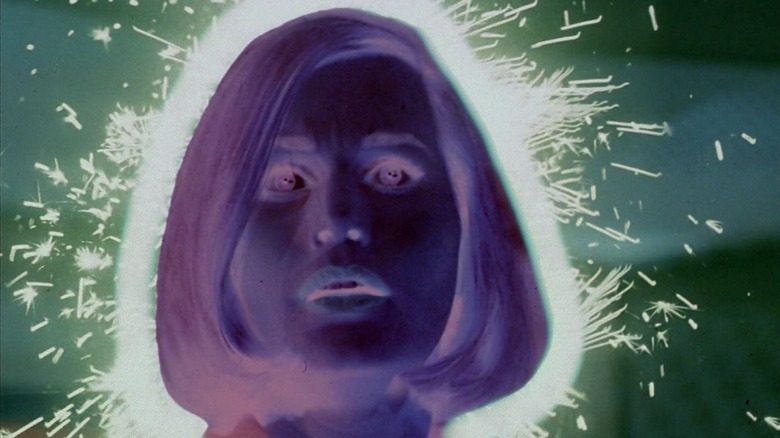
Rod Serling was certainly right that "Star Trek" was inconsistent. The series evolved rapidly over its three-year run, sometimes butting up against budget problems and even requiring a letter-writing campaign to make it to season 3. This is partly why its episodes were less consistent in quality and overall not as mature as those of "The Twilight Zone," which could afford to tell different types of stories every week.
"Star Trek" may have been based in a utopian setting, but its plots were the stuff of pulp mags and fantasy and sometimes dealt with magic rather than sci-fi concepts. Think of when a transporter split Captain Kirk (William Shatner) into "good" and "evil" twins or when a planet of androids was reduced to a "nagging wife" gag. There are even numerous gods throughout "Star Trek," and while one could argue they were present to serve as a counterpoint to the utopian secularism of "Star Trek," they also frequently functioned as wizard-like supervillains who could do silly crap like resurrect Abraham Lincoln (Lee Bergere) or trap the Enterprise in plastic. It wasn't until "Star Trek: The Next Generation" debuted that the franchise became a little more stringently science-driven. Well, only a little, as that show likewise had its share of gods and pulp adventure stories.
It begs the question: Was "Star Trek" even meant to be all that mature? I would argue yes. The show's utopian underpinnings — its message that humanity will have made peace, foregone racial prejudice, and given up money in the future — gives "Star Trek" the consistency that Serling felt it lacked. "Star Trek" was a constant aspirational reminder that the future will be better, while "The Twilight Zone" acknowledged that we humans still have weaknesses to overcome.