

Clint Eastwood's Unforgiven Got An Underseen Samurai Remake With A 94% Rotten Tomatoes Score
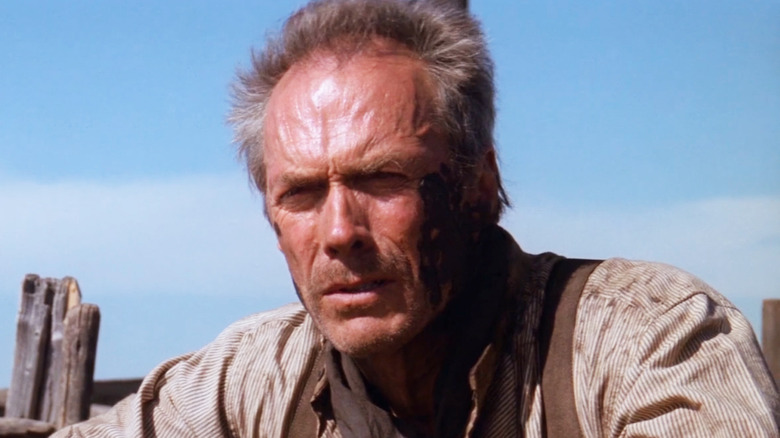
Westerns have been linked with Japanese samurai films since before World War II. In fact, some of the best Westerns of all time have been remakes of samurai movies. But in 2013, things went the other way when Clint Eastwood's 1992 classic "Unforgiven" got a Japanese remake. That film, also titled "Unforgiven," saw Ken Watanabe play an aging former samurai who, like Eastwood's William Munny, is called back into battle one last time. Remaking "Unforgiven" seemed like a tough thing to do on paper, but happily, the 2013 version was met with solid reviews.
If you're going to remake a film, "Unforgiven" seems like a bad choice. Eastwood's 1992 Western was a singular work, and much of that had to do with very specific aspects of its creation and the context in which it emerged. The film was Eastwood's eulogy for the anti-hero archetype he'd brought to the fore back in the 1960s. It was also quite literally a farewell to his mentors and friends Sergio Leone and Don Siegel, both of whom received a tribute in the film's credits. Beyond that, it was a movie that directly interfaced with Western tropes of the past, subverting every single one of them and essentially marking the point at which the myth of the Old West died. If Eastwood's 1973 Western "High Plains Drifter" had upset John Wayne, the Duke would have imploded had he been alive to witness "Unforgiven."
In other words, the film belongs to a very specific lineage, and mapping all that historical context and specificity onto a samurai movie should have been nigh on impossible. But if director Lee Sang-il didn't quite pull it off, he did as well as anyone could have hoped with his 2013 remake.
The Unforgiven remake closely follows the original film
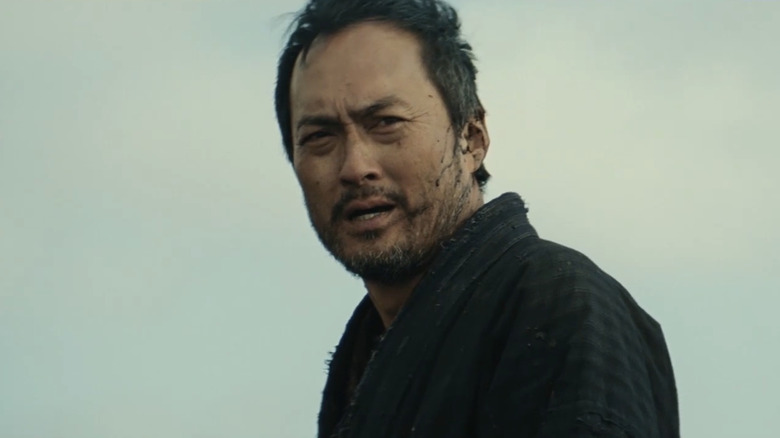
John Sturges believed anything could be a Western, and "The Magnificent Seven" proved it. But does it work in reverse? "Unforgiven" (2013) makes a solid case for the affirmative. The movie is a jidaigeki film, which usually refers to works that focus on the period in Japanese history before the 1868 Meiji Restoration, in which centralized imperial rule was restored in the country. But "Unforgiven" is actually set in the early Meiji era, which refers to the period after 1868 when Emperor Meiji took power.
Amid this turbulent time, Ken Watanabe's ex-samurai Jubei Kamata is a farmer in Japan's Hokkaido frontier. Like Clint Eastwood's former outlaw William Munny, Kamata has left his life of violence behind. Soon, however, he's called back into action after two brothers, Sanosuke and Unosuke Hotta (Yukiyoshi Ozawa and Takahiro Miura, respectively) disfigure a sex worker in a frontier town brothel.
The rest of the film follows the plot of the original "Unforgiven" closely. Jubei sets out to collect a bounty put on the brothers by the sex workers and is joined by a former comrade and a cocky young warrior who are essentially Morgan Freeman's Ned Logan and Jaimz Woolvett's the Schofield Kid. The town where the brothel is located is overseen by a violent ex-samurai turned police commander, who is the film's version of Gene Hackman's Sheriff "Little Bill" Daggett. There's a cowardly writer, a famed fighter who's immediately embarrassed by the police commander, and a matriarchal leader of the working girls. If it isn't quite the monumental achievement that "Unforgiven" was, it's about as close as an international remake was ever going to get.
Unforgiven was a critical success that's well worth a watch
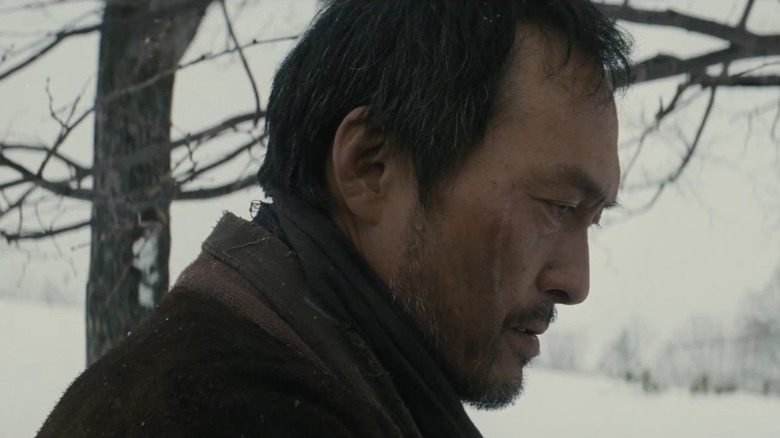
"Unforgiven" was Clint Eastwood's spiritual sequel to his "Dollars" trilogy, which is yet another reason why a Japanese remake seems like a tough sell prima facie. Luckily, the film was actually quite good. Instead of trying to emulate Eastwood's deconstruction of a genre, director Lee Sang-il placed more emphasis on the visuals, which seems to have paid off since critics mostly liked the movie.
"Unforgiven" (2013) managed an impressive 94% critic score on Rotten Tomatoes, which is close to the original's 96%. The remake's percentage is, however, based on just 10 reviews, while Eastwood's film hit 94% after a full 108 reviewers had their say. Still, "Unforgiven" (2013) was clearly well received by those who did review it. Geoffrey Macnab of the Independent noted how the film was "remarkably faithful to Eastwood's version" and successfully "carries on a long tradition of exchange between Westerns and Japanese samurai films." Empire Magazine's Angie Errigo gave the film four out of five stars and praised the way in which the remake provided a "terrific new surge" to the "samurai/Western osmosis" with a "beautiful-looking, smartly modified translation of the Eastwood classic."
Interestingly enough, Charlotte O'Sullivan of the London Evening Standard wasn't a fan of Eastwood's "Unforgiven" but found Sang-il Lee's "reverent remake" absolutely "gripping." So, even if you're not a fan of the original or if you haven't seen it yet, the 2013 film is worth a watch on its own merits. If you're looking for further recommendations, "Unforgiven" fans should check out controversial '60s Western "The Wild Bunch."