

Billy Bob Thornton's Underrated Coen Brothers Movie Is A Must-Watch
The Coen Brothers have one of the most extraordinary filmographies in movie history. I know that sounds hyperbolic, but I genuinely mean it. With the notable exception of their misguided remake of "The Ladykillers," I firmly believe that all of the movies the brothers made together are either good or great (I even like "Intolerable Cruelty," a film that often gets lumped in with "The Ladykillers" as a Coens dud). This impressiveness has a curious effect: the Coens have so many bangers that some of their movies get lost in the shuffle, even though if these films had come from another director they'd be heralded as full-blown masterworks.
Take "The Man Who Wasn't There," for instance. This brilliant 2001 neo-noir should be counted as one of the top 5 Coen Brothers movies, but it seems to have none of the cultural impact of titles like "Fargo," "The Big Lebowski" (which went from box office bomb to bonafide cult classic), or "No Country For Old Men." Maybe that's about to change, though, as the fine folks at Criterion have added "The Man Who Wasn't There" to the collection this month, with a beautiful new 4K transfer supervised and approved by legendary cinematographer Roger Deakins.
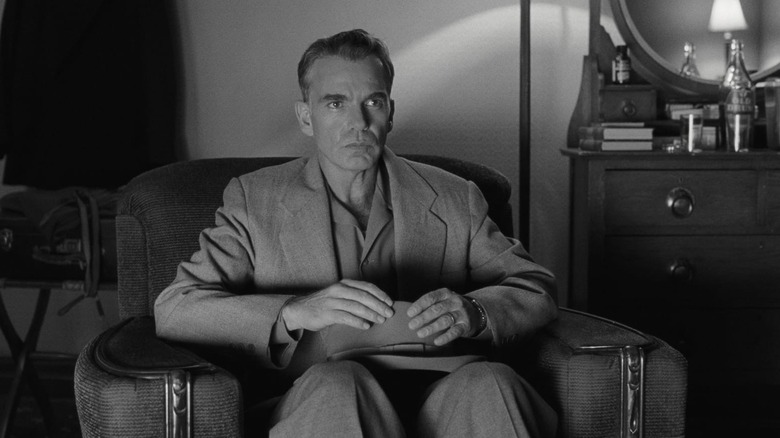
Darkly funny and unapologetically bleak, "The Man Who Wasn't There" is the Coens channeling the work of James M. Cain ("Double Indemnity," "The Postman Always Rings Twice"), with a little Jim Thompson ("The Killer Inside Me") mixed in for good measure. It's a sordid tale of blackmail, murder, infidelity, UFOs, and dry cleaning, and it gets better every time you watch it. Billy Bob Thornton delivers what might be his best performance (the other two contenders would probably be "Bad Santa" and Sam Raimi's underrated "A Simple Plan") as Ed Crane, a barber living in California in 1949. While Ed narrates our tale — with Thornton delivering the narration in a delightfully flat, monotone manner — he's a man of few words.
The Man Who Wasn't There's main character is a total mystery
Ed is married to Doris (Frances McDormand). Does the couple love each other? I think they do, in their own ways. One early scene has Ed sensually shaving Doris' legs and sharing a cigarette with her while she soaks in the bathtub. And yet, Doris is also seemingly having an affair with her boss, department store owner and local blowhard Big Dave (the late, great James Gandolfini). Ed is aware of this affair, but he makes seemingly no effort to do anything about it. His motivations remain a total mystery to us by design.
After Ed learns about a business opportunity involving the burgeoning technology of "dry cleaning," he attempts to blackmail Big Dave for the money to invest. Things don't go exactly according to plan, however, and Big Dave ends up dead — and Doris gets arrested for his murder. From here, we follow Ed as he attempts to mount his wife's defense with the help of a hot-shot lawyer (a scene-stealing Tony Shalhoub). Ed also develops a strange infatuation with local teen girl Birdy (Scarlett Johansson). Is it a "Lolita"-like lust? Maybe, maybe not.
Again: Ed is a mystery, and that's part of what makes the film so fascinating. One of the most memorable sequences in the film has Ed narrating the story of how he and Doris first men, stopping the story so he can go out and commit a murder, and then returning home to finish the narration where he left off. Is he even thinking about the crime he just committed?
The Man Who Wasn't There has earned its Criterion Collection release

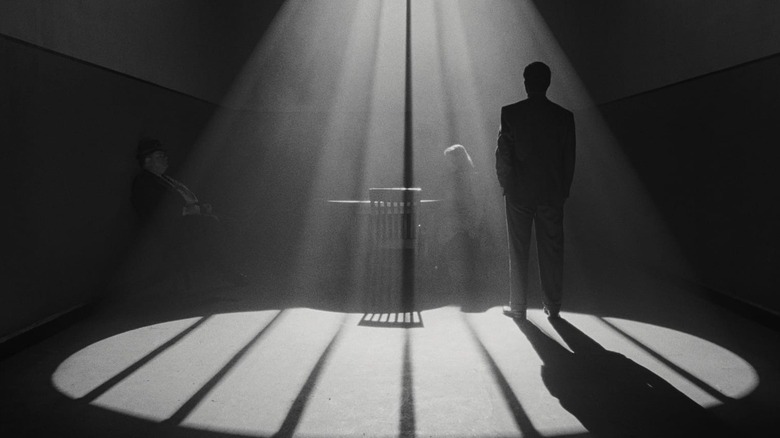
While "The Man Who Wasn't There" is frequently funny (Shalhoub's fast-talking, food-loving lawyer is hilarious, as is Michael Badalucco, playing Ed's doofus brother-in-law), there's a haunting melancholy to the whole thing that makes the film truly unforgettable. Deakins' black and white cinematography is stark and gorgeous, full of long dark shadows and blinding white lights (interestingly enough, Deakins actually shot the film on color 35mm film and converted it to black and white during post). Then there's Thornton's narration, which alternates between being dryly droll to downright profound.
Thornton's quiet, strange performance is a puzzling enigma; a riddle we can't really solve. Is he angry that Doris had an affair? He doesn't seem to be. Does he really think the dry cleaning investment will make him rich? It's hard to say, and when he finds out he's been apparently cheated in the deal, he barely reacts. And what about his relationship with Birdy? He becomes convinced she's a piano prodigy even though she's not, and tries to help her with her future. She assumes his attentions are lustful — but are they? Ed says they aren't. But does he even know for sure?
There are no concrete answers here, and I suspect that might be why "The Man Who Wasn't There" never caught on the way other Coen classics did. But every time I rewatch it, I find it to be even stronger than I remember. It's held up exceptionally well, and this Criterion release is the perfect way for fans to snap up the film or for new audiences to discover what they've been missing all this time.