

The Moment Director Explains The Hidden Layers To The Charli XCX Movie's Final Song [Exclusive]
The music industry has long been a branch of the arts where image is paramount. Sure, obvious elements like talent and originality contribute to a musician's success and longevity, but there's something powerful about the pull of a popular persona. Popularity is fickle, too; whatever's deemed uncool or unpopular today could change practically overnight. These things go in cycles, so ultimately, the artist is the only person who consistently has true ownership over themselves and their art.
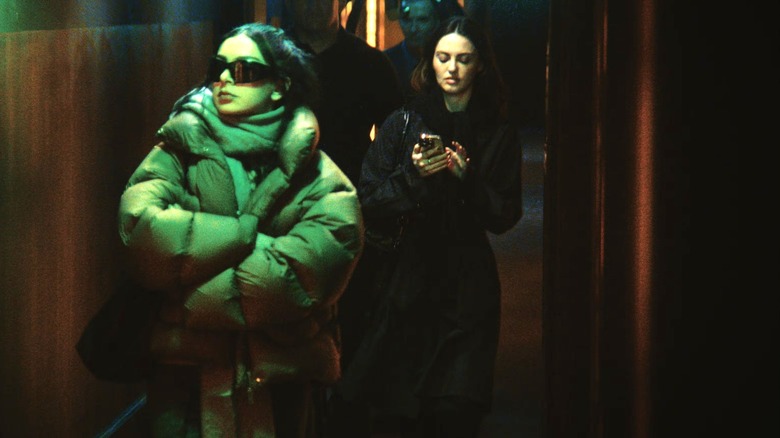
These themes and more are compellingly explored in a meta mockumentary fashion in "The Moment," the new film about and starring pop star Charli XCX (which is, ironically, not her feature debut). Rather than being a straightforward documentary or concert film, Charli, co-writer Bertie Brandes, and director/co-writer Aidan Zamiri have made a movie that essentially takes place in a fictionalized alternate universe in which Charli makes some different (and destructive) choices in the wake of the release of her best-selling album, "Brat." As such, it's not just a film in which the pop star faces some of her worst fears and biggest insecurities through metafiction, but it's also a cheeky satire of the current pop world and showbiz in general (made most apparent by Alexander Skarsgård's performance as Johannes, an odious film director).
I recently had the opportunity to chat with Zamiri about "The Moment," his ethos behind it, and more. During our conversation, he had some fascinating things to say regarding the movie's final (and only full-length) song, which isn't a Charli track, but is actually The Verve's 1997 hit "Bitter Sweet Symphony." It's a great needle drop, and one which holds layers of hidden meaning for the film.
Note: This interview has been lightly edited for clarity and brevity.
Aidan Zamiri and Charli XCX move from music videos to mockumentary
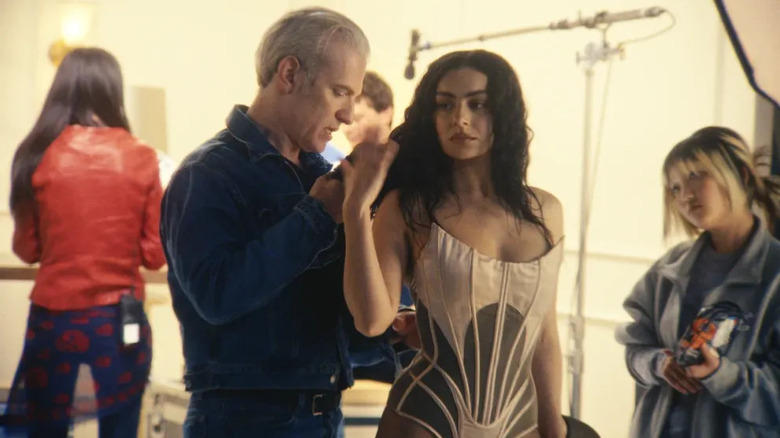
Bill Bria: You first worked with Charli on the videos for "360" and "Guess," and I wanted to know when the conversations about "The Moment" started. How did Bertie get involved? Was it always a mockumentary from the beginning? And what was it like approaching Charli with this idea?
Aidan Zamiri: Yeah, so the first kind of conversations about doing a feature at all, after we did "360," Charli had said, "Hey," in a text, she'd been like, "I think we should make a film together." But that was very much a hypothetical ... well, maybe not for Charli, but I was like, "Oh, maybe that'll happen in five years or something." And we did actually start talking about a couple of other ideas completely unrelated to "The Moment," things that were more completely narrative driven. So it was definitely in there that we wanted to make something bigger and potentially also completely unrelated to her music or "Brat" or anything like that.
I've known Bertie for about 10 years. She used to run a magazine in London called Mushpit. And it was a really cool magazine, really small, independent magazine. And I actually met her because when I was at uni, her and her partner that she ran the magazine with, they were doing a talk at our uni, so I came in to coordinate. I was the student liaison or something. So I was actually the one holding — when they did the talk to our [class], I held the clock to show them how much time they had left. So that's actually how I met Bertie.
But Bertie, I had just been a massive fan of hers for a really long time. After that first meeting, we met again, and then we'd worked together in small ways, whether it was on commercial projects or other bits and pieces, but we'd wanted to work together in a larger capacity for a long time. And we'd sort of spoken about, again, writing something bigger. We'd spoken about doing something narrative for ages.
So when this popped up and Charli — because the initial idea of doing something that was a mockumentary came from Charli, really, because she'd said she basically received a lot of interest from people to do a real tour doc or a real concert film. And for her, she was like, "That didn't seem interesting." More than anything, it was it didn't feel new. And I think doing this felt like an opportunity to do something fresh and something exciting. So all those factors together, she said, "Hey, there's interest to make a concert doc, but we don't want to do that. Do you want to do this?" And then I'd brought in Bertie. So those three things together resulted in it turning into something.
Keeping the improvisational magic alive in 'The Moment'
So when you guys were all getting together, because I've read different things from different sources, how tight was the script? Was it really tightly scripted, or was it more a loose improv situation from scene to scene?
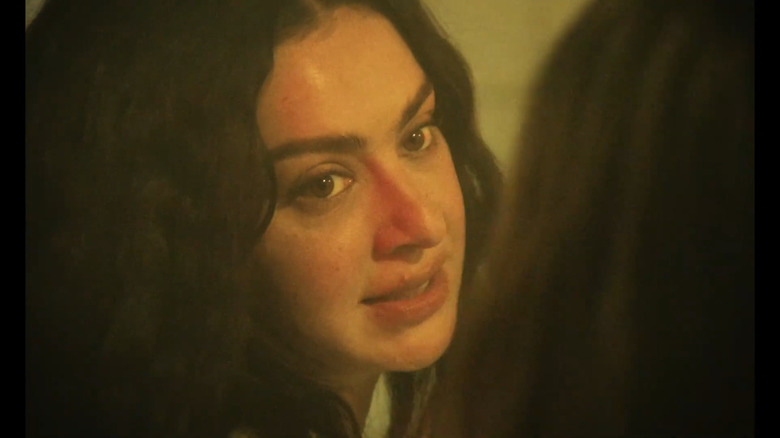
Yeah, so we made sure that everything was on the page and everything was written. But in order to make it feel alive — and speaking of the mockumentary format, it's funny, we used that as a loose guide for us in terms of the genre, but it's quite ... the film undulates through a bunch of different forms, I think, throughout, because that was something we were always interested in. We really didn't want it to follow even the expected formula of a mockumentary. Do you know what I mean? We avoided talking heads. We avoided that stuff that would've felt like we were playing too much into a form. Throughout, it goes from straight comedy to then horror movie, to then a sad poem. But we do move between these different feelings throughout. And that was definitely, when Bertie and I were writing, that was something we were somewhat interested in, particularly the thing of not doing something that felt too expected or formulaic, really.
But yeah, sorry, to actually answer your question [laughs], we had it on the page, but in order to make it feel alive and feel spontaneous, because one of the biggest challenges was to make sure that this thing which was scripted felt unstaged and didn't feel contrived. So in every single scene, I would allow time for improv and sometimes something amazing would land. And so, that would make its way into every take. I have to admit — it's so painful for me to admit this — but "metaphorical cocaine" was actually an ad lib. The minute that Alexander said that for the first time, that obviously was then in every single take.
But in general, the language was always like, "This is the script." Sometimes we would follow it exactly as written because we wanted some things to land how they were said. But most of the time, we'd say that as long as the general feeling of it was said out loud, that was right. So yeah, it was all scripted, but with a loose approach in order to make everything feel as real as possible. We even took that approach with how Sean Price Williams had to act as our DP in the way that it was like every scene we had our coverage and we knew what our marks were, we knew what we were doing. But in order to make the camera feel alive and feel like it was moving and accidental, there had to be an instinctiveness with the way it moved as well. It couldn't feel too solid, it couldn't feel too locked off.
So me and Sean would often talk about allowing him to feel distracted by things that were happening. And obviously sometimes in the edit, it would drive me nuts, because it'd be an amazing take and then he'd tilt to something else or pan over to somebody else or something. But in the same vein, we would find a lot of magic doing that. We'd find a lot of unexpected reactions from people, or frame up on something we weren't expecting to frame up on. So yeah, that looseness had to be built into the DNA of what we were shooting, I think.
How Aidan Zamiri and Alexander Skarsgård cooked up the movie's best character
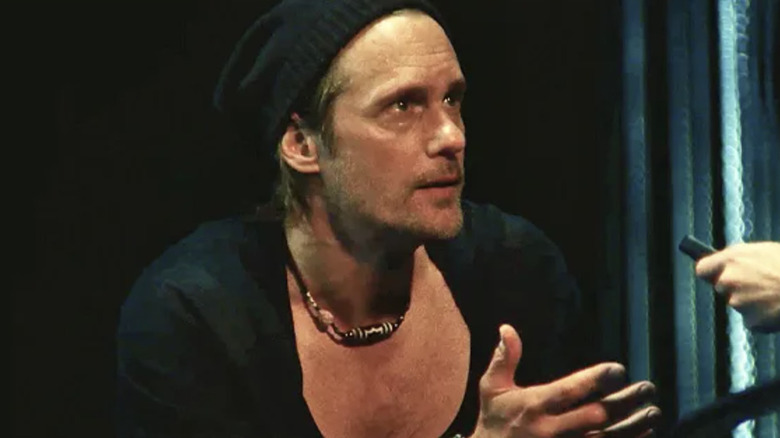
Since we brought up already a guy I really wanted to ask you about: What was your process with Alexander Skarsgård? That Johannes character is just so incredible. I love him to bits and I love watching him. Did you have to rein him in at all?
I mean, Alex is really, really incredible. Intimidatingly brilliant, and he was so down from the jump. He was actually the first person that came on board, I think, cast-wise. We knew that was a role we had to nail, and we had to figure out who that was going to be, and he was the first person, really, that we went to. And part of the reason Alexander was drawn to the script — me and Charli had a call with him, and the reason he was drawn to it is because he was really into the idea that this kind of defied the expectations of a music doc or a music movie in some way, where Charli was very, very much not the hero. He was really impressed by her openness to being perceived as badly as possible and paint herself like that. He really enjoyed the script. He also seemed to really know characters like this, and he brought a lot of extra thought to it. I think Alex was like, "I really think I should have a fake tan." And I was like, "Sure, sure, sure. Let's dial that up."
On the question of whether to rein them in at all, what we did was, early on, I had a lot of conversations with all of the cast about the background of their characters. I felt like I really knew every single character really well. And that's part of the reason, actually, I think we were fine with the idea of adding in improv, and even people that didn't have a background in improvisation felt more comfortable doing it. Charli felt really comfortable doing it, obviously, because she knew her character really well. [laughs]
But with all of them, we would have really long convos about who they were, why they did certain things, what their background was. And me and Alex had that as well, because there's a version of Johannes I think that could have been a lot more obviously evil from the jump and a lot more — he's definitely evil from the jump, but it would've been more outright villainous or cartoonishly villainous. But we really liked how smarmy and faking [being] on the same page that Alex was able to make Johannes. So I think having that kind of knowledge of the way he operates, it just meant that Alex was always able to really, really advocate for Johannes and be like, "Oh, cool. I think in this situation..." We knew he would never be outright and say exactly what he thought until he was really under his breaking point.
I mean, one of the funniest scenes ever for us to shoot was when he's walking Charli through the [tour set], and that scene could have been a 45-minute scene because it was so funny. But no, I think everyone knew their characters so well that we really dialed as a cast and crew, I think.
The importance of The Verve's 'Bitter Sweet Symphony' to 'The Moment'
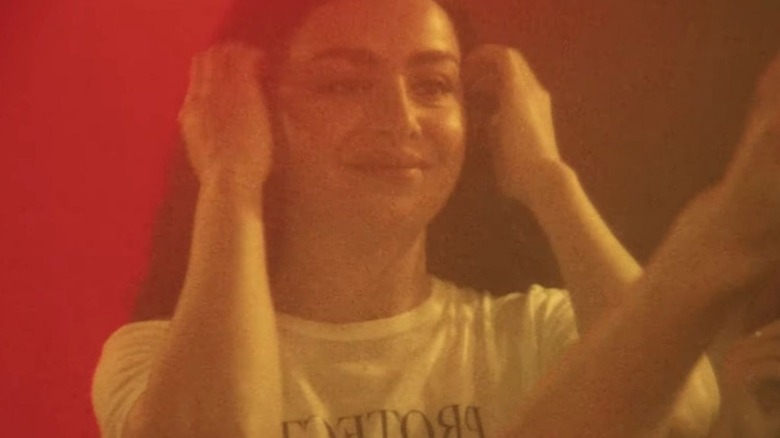
Ever since I saw the film premiere in Park City, I had to ask you this question, because I was just floored, so delighted by the ending. It really made the whole thing come together for me, especially the use of The Verve's "Bitter Sweet Symphony." I started punching the air when I started hearing those notes. What was the decision that led to that needle drop? Was there ever pressure or worry of like, "Should we be using a Charli song instead?"
I'm so glad you asked this question, because one, I'm really grateful that the ending landed for you like that. It made me really happy. But yeah, so okay, there's a couple of really ... I'm really glad you asked about this. There's a couple of reasons that I think "Bitter Sweet Symphony" was the perfect ending to it. One, funny enough, "Bitter Sweet Symphony" has kind of been ... I mean, I've loved that song for so long. I've loved the music video for so long. The Walter Stern music video. It's an incredible video. Funny enough, that video was one of the main references I had for "360," the music video, where it's like someone walking with a terrible attitude, you know what I mean? Unbothered with the world around them. And actually I did dial a lot into that. I've never actually got to tell anybody that, but that was one of our key references for "360."
So it was something that I held in the back of my head as a bit of ethos for the "Brat" attitude, you know what I mean? But then down the line when we were thinking about it again, there's some other reasons [...] I feel like it's a video where London is presented in a really cool way. And I would always refer back to it when I was talking to Sean about, "I love the way London looks in this music video, that it looks kind of a bit messy and grimy." So that was also another reference for us there.
Then when I actually came to ["The Moment"] ending, I think "Bitter Sweet Symphony," it's such a massive, massive track that it's obviously a cool and emotional song, but then it's had this experience in life where it's become so massive that it's moved through eras of being extremely cool, to then being overplayed, to being cool again. And it's kind of experienced all these lives, where it sort of moved beyond being kind of popular in the same way.
The other thing that I thought was very interesting is that for a very long time, The Verve weren't able to make any money off of that track whatsoever, because it used this sample from The Rolling Stones. And I thought this was such an interesting tie to the idea of the ownership of art and who owns art, and it weirdly tied so thematically to our film. So putting that at the end there, I think it kind of summed up a lot of the main themes of our movie. We were able to get rights to it because I think it was only a couple of years ago, they were actually able to, again, get rights to the track and be able to get royalties off of it. Charli wrote a letter to Richard Ashcroft, and he was really happy for us to use the song, which was really cool.
Yeah, it's a super emotional track, and it's also got this kind of curse of being so overplayed and so in the zeitgeist, but also outside of it. And then obviously that kind of funny relationship with ownership, which is what we play with in our film. Similarly, when we go to A.G. [Cook]'s remix of "I Love It," again, that's the only other kind of needle drop in the film. But it's again, a song which has had the same kind of relationship with creative ownership. Charli wrote this song for Icona Pop. It was an Icona Pop song for a very long time. Now it's kind of Charli's song again, but it's all a bit muddy and a bit wooly. So I thought it was really cool to have these two tracks back to back that have had this funny life and relationship with credit, creative ownership, that kind of thing. And also, we did think it was cool that there's never ... all music in the film is either score, either A.G.'s score or it's Charli practicing a track, so it's slightly heard diegetically. I thought it was kind of cool to finish on a song that wasn't hers. It was also another kind of like — what's the word I'm looking for — a kind of emancipation from "Brat." [laughs]
"The Moment" is in theaters now.