

Alexander Skarsgard's Pillion Is Already 2026's Most Subversive Movie Thanks To One Decision

We're 15 years removed from Lady Gaga's anthemic "Born This Way" perpetuating the idea that queerness is a fixed state of being, and while that may be the reality for many, there are countless queer people who come to terms with their identity through physical exploration and lived experience. For many queer people, sexual and romantic experiences are not incidental to self-knowledge; they are catalytic, representing the moment queerness stops being abstract and becomes real. Harry Lighton's directorial feature debut, "Pillion," starring Alexander Skarsgård and Harry Melling, understands this on an innate level.
During a time when online discourse insists that sex scenes must either be sanitized into metaphor or rendered graphically enough to justify their existence, "Pillion" chooses a far more radical path. Colin (Harry Melling), an earnest parking ticket attendant and barbershop quartet member, meets a handsome, mysterious biker named Ray (Alexander Skarsgård) on Christmas Eve while on a date with another man. After Ray wordlessly tests Colin's willingness for submission by tossing coins on a bartop to see if he'll organize them to give to the bartender, he invites him to meet him on Christmas night. Colin expects this to be a traditional date, but Ray has a back-alley test of devotion planned instead. From the moment Ray lets down his zipper, Colin establishes his eager appetite to please. Ray then disappears for weeks, only to reemerge and invite Colin into a dom-sub relationship governed by rigid rules: Colin cooks, cleans, shops, and sleeps on the floor beside Ray's bed.
On paper, this dynamic sounds salacious, but "Pillion" is charming, romantic, and emotionally restrained. It trusts longing over spectacle and, in doing so, it rejects both reactionary moral panic and the shallow belief that explicitness is the only route to honesty.
Pillion's refusal to sensationalize is the point

Harry Lighton directs the relationship with the seriousness afforded to any romance, allowing awkwardness, tenderness, and imbalance to coexist without apology. Ray is more experienced and gives the impression that he is the kind of man who lives to induct submissives into this world. This asymmetry is never hidden, and characters often comment on how shocked they are that a meek guy like Colin has found a partner who looks like, well, Alexander Skarsgård, but the imbalance is never exaggerated for shock.
Power is presented as a fact of intimacy, not a scandal ripe for debate. Ray stays emotionally opaque for much of the film, a choice that aligns the audience with Colin's perspective. This is Colin's story about figuring out who he is, what he wants, and what he sees for the future of his relationship with Ray, which is not dissimilar from any number of "conventional" romance stories. The film refuses to translate Ray's interiority for the audience because wanting someone who won't fully reveal themselves is not a failure of romance; it is one of its oldest truths.
By refusing to eroticize every interaction or over explain its power dynamics, "Pillion" replicates the experience of early love; those feelings of desperate yearning, understanding imperfectly, and being changed by the experience regardless of outcome. This transformative experience comes at the perfect time, as Colin's mother is dying. The leather community surrounding Ray offers warmth, humor, and care. The other subs embrace Colin, celebrate his birthday, and gently demystify Ray. These moments are among the film's strongest because they situate BDSM within a network of social bonds where power is contextual, negotiated, and communal. In turn, they completely dispel the stigmatized beliefs many "normies" have about counterculture sex communities.
Pillion proves you can be charming without the pressure of being chaste
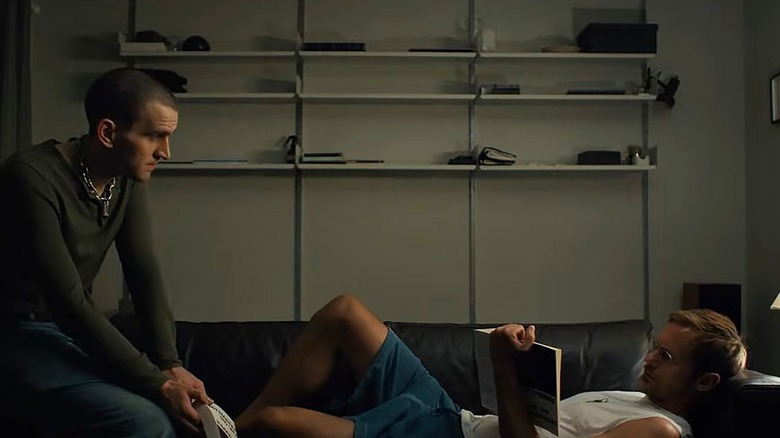
For audiences trained to believe that sex scenes must either be graphically excessive or eliminated, "Pillion" offers a third option: sex that is emotionally legible because of who is involved, not because of what is shown. It's not unlike the way "Heated Rivalry" destroys the worst trend of American streaming TV by exploring character growth in what isn't said as much as what is said.
Melling plays Colin with aching openness, his transfixing bright eyes giving way to the vulnerability and longing that radiate through every scene. Skarsgård, meanwhile, delivers a restrained performance that resists easy villainy or misunderstood redemption. When he finally softens — granting Colin a rare day off from submission — it reads less as a grand romantic gesture and more like a crack in armor. We'll be needing to make more room on our list of Alexander Skarsgård's best performances to make way for "Pillion."
Predictably, ignorant fools have accused the film of romanticizing exploitation, but in reality, by foregrounding consent rather than explicitly spelling out to the audience that these adult men agree with what they're doing — something seldom demanded of straight or "conventional" love stories — "Pillion" exposes the dishonesty of those critical of counterculture, queer relationships. This movie is kink-forward and sexual, sure, but at its core, "Pillion" is a love story for the ages.
Viewers may elect to reject the film for not being a titillating display of objectification or align themselves more with Colin's disapproving mother, but as Ray tells her when she expresses her disdain, "Well, that is fine, it's not for you to like."
"Pillion" is now playing in theaters everywhere.