

Clint Eastwood's Two Favorite Westerns That He Directed Are Very Different Masterpieces
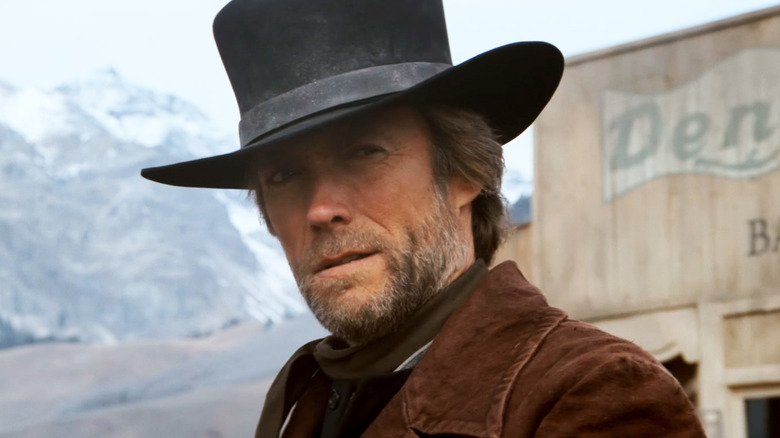
If you were Clint Eastwood and you had to pick the very best films you'd ever made, you'd likely struggle. This is a man who has delivered every kind of classic imaginable. Heck, you'd be hard pressed just to pick a favorite Western considering the array of legendary oaters in Eastwood's filmography. But for the man himself, the choice is clear ... sort of. The veteran star picked two Westerns as part of his six favorite films: 1976's "The Outlaw Josey Wales" and 1992's "Unforgiven." While these two Western share a lot in common, they're also very different in very important ways.
By the end of the 1960s, the revisionist Western wave had already begun in earnest, thanks in large part to Clint Eastwood and Sergio Leone with their "Dollars" trilogy. As the 1970s played out, the Western would undergo all sorts of further changes on its way to falling out of favor with mass audiences. From the controversial Acid Western "El Topo" that earned a perfect score from Roger Ebert, to 1973's "High Plains Drifter," which prompted a feud between Eastwood and John Wayne, oaters were evolving.
Aside from "High Plains Drifter" Eastwood made three other Westerns in the 1970s, the last of which, 1976's "The Outlaw Josey Wales" he also directed. In the 1980s, he'd only appear in two Old West adventures, before returning in 1992 to deliver the quintessential revisionist Western with "Unforgiven," which he once again directed. It was these two movies that ultimately made his own personal list of the greatest Eastwood movies.
The Outlaw Josey Wales is one of Clint Eastwood's favorites
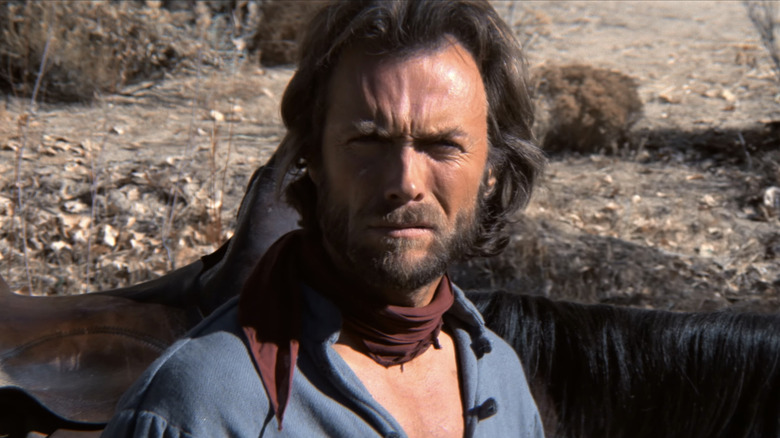
After he'd upset John Wayne with "High Plains Drifter," Clint Eastwood took a three year break from Westerns. During that time, Eastwood made a movie that's pretty much a James Bond parody and managed to upset the writer of "Magnum Force" with a distasteful ending to the "Dirty Harry" sequel. Then, he returned with "The Outlaw Josey Wales," which would turn out to be one of the best oaters the actor ever made and one of his personal favorites.
As reported by CBS News back in 2010, the actor picked six favorites from his own filmography, two of which were Westerns. The first was "The Outlaw Josey Wales," which was based on a book by racist author Asa Earl Carter. But rather than parroting the anti-government views of the writer, Eastwood's film was concerned simply with conveying the message that war turns good men bad.
In the film, Eastwood plays a Civil War Missouri farmer who, after his wife and child are killed by Union soldiers, becomes a Confederate bushwhacker. When his fellow fighters are massacred, Josey Wales escapes and becomes a feared gunfighter before ultimately finding a new surrogate family. "It came out in the '70s when the country was restless about Vietnam," Eastwood told CBS. "It addressed the divisiveness of war, and how it can tear at heart and soul. But it also dealt with the rejuvenation of a cynic, re-instilling his life with purpose, and with a surrogate family."
Eastwood has spoken about how he felt "The Outlaw Josey Wales" was a career high, and the critics certainly agreed. To this day, the film bears a 91% score on Rotten Tomatoes, and remains not only a classic Western, but a classic film in general.
Clint Eastwood thought Unforgiven was intelligent and rich
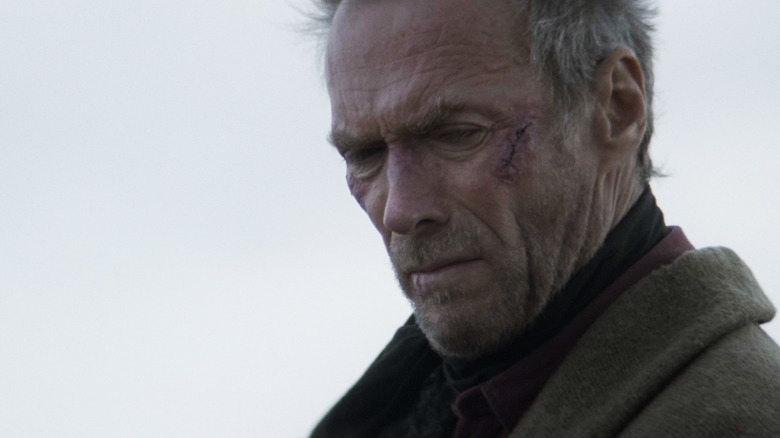
By the early 1990s, the Western was as dead as it was ever going to be. Though the genre had endured several lulls in popularity since the 1930s, it had pretty much fallen out of favor completely by the end of the century. Then, Clint Eastwood unleashed "Unforgiven."
Another Eastwood-directed Western in which he also starred, "Unforgiven" was nonetheless a markedly different film than "The Outlaw Josey Wales." Whereas the titular outlaw found redemption in the latter, "Unforgiven" saw Eastwood portray a man who simply couldn't escape his dark and brutal past. In what was one of the most haunting and effective deconstructions of the myth of the Old West, the actor/director played William Munny, a former outlaw turned farmer who takes on one last job to track down a group of violent cowboys. But Munny doesn't wind up with any sort of surrogate family, and the film is the ultimate fulfillment of the revisionist ethos, refusing to delineate clearly between good and bad and solidifying Eastwood's separation from more traditional Western directors like John Ford.
Evidently, Eastwood liked that aspect of the film. As he told CBS, "I loved the 'Unforgiven' script. You had to get a ways into it before you knew who was the protagonist and who was the antagonist. Even the villains, with the exceptions of the renegade cowboys, had good points to their character, and had dreams." Eastwood highlighted the way in which the film dealt with issues of gun control, and "the struggles people have within," adding, "The hero went against instinct. It was a very rich story, involving loyalty to friends, family and rationalizing deeds. It was a very intelligent script."