

Star Trek: Starfleet Academy Has A Next Generation Homage You Might Have Missed
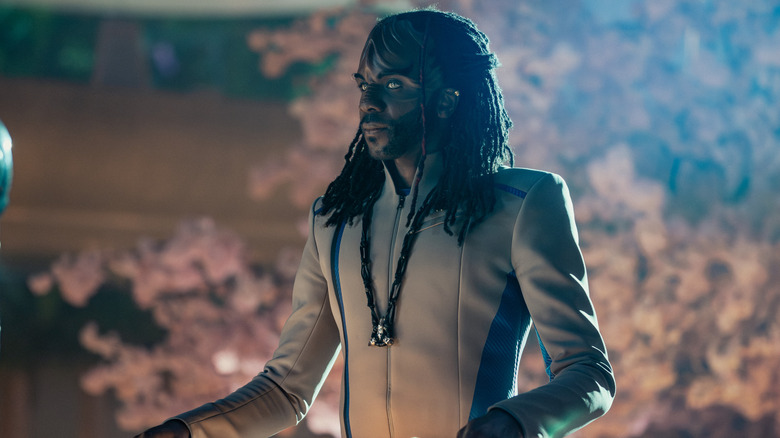
In the "Star Trek: Starfleet Academy" episode "Vox in Excelso," the central cadets and professors openly discuss the fate of the Klingon Empire in the 32nd century. It seems that the Burn — the galaxy-wide cataclysm that wiped out all active starships using dilithium crystals — utterly destroyed the Klingon homeworld, leading to a shocking new status quo. The Klingons used dilithium reactors as a power source, and the Burn killed billions of citizens. The surviving Klingons became nomads with no homeworld to call their own.
Traditions were barely kept alive. "Vox in Excelso" surrounds a perhaps-ill-advised debate at the Academy as to the Klingon diaspora. Should Starfleet help the Klingons, despite limited resources, or should the Klingons be left to their own devices? Klingons famously don't accept charity, preferring to earn their cultural advances through combat.
The solution at the end of the episode is novel. Starfleet has located a new planet for the Klingons to settle on, but knows they won't merely accept it as a handout. Instead, Starfleet stages a rigged fight with Klingon warships to allow the Klingons to "earn" it in battle.
The final battle of the episode doesn't take up a lot of time, and there aren't casualties by design. There is a large gang of Starfleet vessels on hand at Faan Alpha, and each one introduces itself by name. The show's central ship, the U.S.S. Athena, is there, of course, as is the U.S.S. Crimson, the U.S.S. Horizon, and the U.S.S. Lexington.
Those with sharp ears will also hear that one of the ships is the U.S.S. Riker, clearly a reference to Commander William T. Riker (Jonathan Frakes) of "Star Trek: The Next Generation." It's only a split second, but Trekkies are going to notice.
Welcome aboard the U.S.S. Riker
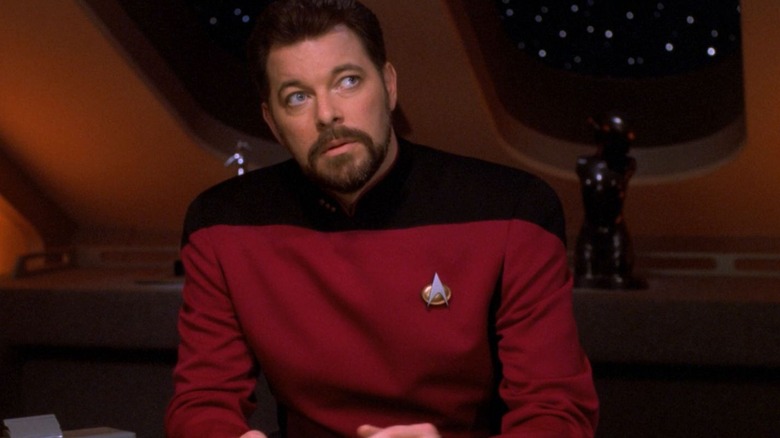
Trekkies, of course, need no primer on Commander Riker. He was one of the core characters on "Star Trek: The Next Generation," appearing in 176 episodes of the show. William Riker was also central to all four "Next Generation"-derived feature films, appeared in one episode of "Star Trek: Voyager," and infamously led the disappointing finale episode of "Star Trek: Enterprise." On more recent "Trek" shows, Riker was featured in 11 episodes of "Star Trek: Picard," and in three episodes of the animated series "Star Trek: Lower Decks." In the 2002 feature film "Star Trek: Nemesis," Riker was said to be taking command of his own starship, the U.S.S. Titan, as its captain. The scenes in "Lower Decks" saw him in the captain's chair, while "Picard" traced what happened to the "Titan" after he left command.
Riker was always a careerist, and several episodes of "Next Generation" were devoted to Riker contemplating new jobs or considering his current one. For many years, though, he was content to merely be a first officer on the U.S.S. Enterprise-D, the Federation flagship. By the 32nd century — over 800 years after the events of "Next Generation" — it seems that Riker had become something of a mythic figure. He was at least historically significant enough to have a starship named after him. Because the U.S.S. Riker only flashes by the screen for a second in "Starfleet Academy," though, Trekkies know nothing about its history. It could be the very first ship named Riker, or the latest in a long line of them.
The importance of Jonathan Frakes
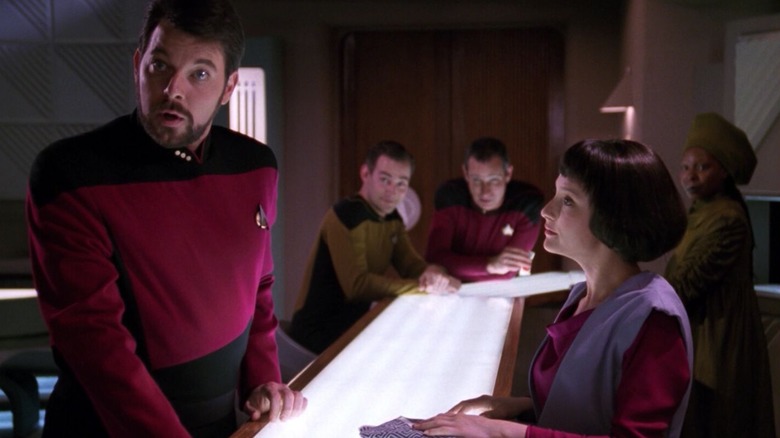
The U.S.S. Riker was a cute, split-second tribute to William T. Riker, but I would argue that actor Jonathan Frakes is more important to the "Star Trek" franchise than Riker is within the "Star Trek" universe. It may have been a little too on-the-nose for the makers of "Starfleet Academy" to name a ship the U.S.S. Frakes, but it would have been just as apt.
In addition to playing William Riker (as well as his own transporter clone Thomas), Frakes ended up becoming one of the franchise's most prolific directors. /Film has covered Frakes' directorial debut in the past, where he described the directorial "boot camp" that the show's producers put him through. His directorial debut was on the episode "The Offspring," and it opened doors for him. He would go on to direct seven additional "NextGen" episodes, two of the "NextGen" movies, three episodes of "Star Trek: Deep Space Nine," and three episodes of "Star Trek: Voyager."
In more recent years, he helmed eight episodes of "Star Trek: Discovery," six episodes of "Picard," and two episodes of "Star Trek: Strange New Worlds." He also directed two episodes of "The Orville," which I think ought to count.
And Frakes has been a prolific film and TV director besides. He directed the time-machine thriller "Clockstoppers" in 2002, and the unfortunate flop "Thunderbirds" in 2004. On TV, he has overseen shows like "Roswell," "Leverage," and "The Librarians."
It's possible that the U.S.S. Riker, then, was a tribute to both Riker and to Frakes. Either way, I'm sure Frakes appreciated it. He seems like an affable dude.