

Early Designs For Avatar's Na'vi All Had The Same Problem For James Cameron
We may receive a commission on purchases made from links.
James Cameron's "Avatar" spawned one of cinema's biggest franchises, but getting there was no easy task. Cameron sacrificed the chance to make other movies to make "Avatar," and he's dedicated himself to the cause. It all started with creating the Na'vi, which, in itself, was a complicated feat. Getting them right, in the early stages, proved challenging for a variety of reasons.
In the book "The Making of Avatar: Avatar, Avatar: The Way of Water, Avatar: Fire and Ash," it's explained that Camereon and his team of artists began with the filmmaker's original vision for the Na'vi of Pandora, which he first described in a 1995 treatment. That description reads as follows:
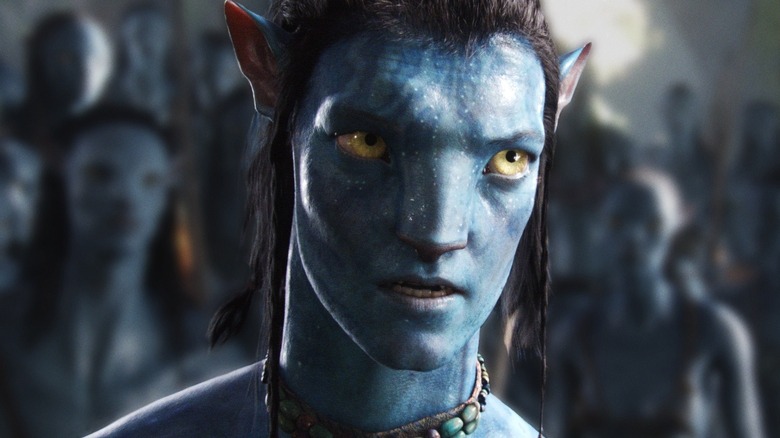
"Its skin is blue...two shades of blue in a banded pattern. The waist is narrow and elongated, the shoulders very wide, giving a V shaped upper back...The hands are graceful, with three very long fingers, and one opposed thumb...The faces are exquisite... large wise eyes, maybe twice the size of ours...like those of a cat, or a lemur...The teeth are white, with pronounced canines...They have a tail...like the tail of a panther...A complex pattern of iridescent dots and lines, perfectly symmetrical, runs over the body...these glow in the dark like fireflies...there is what looks like a black ponytail, or queue...hanging down almost to the waist. This is not hair, but actually an external part of the nervous system."
That description matches the Na'vi in the movie as we know it. The problem? There was still too much room for artistic interpretation. There was some room for improv with the Na'vi language, but the designs had to be just right. Unfortunately, the early concepts were all far too alien.
James Cameron needed the Na'vi to have human qualities
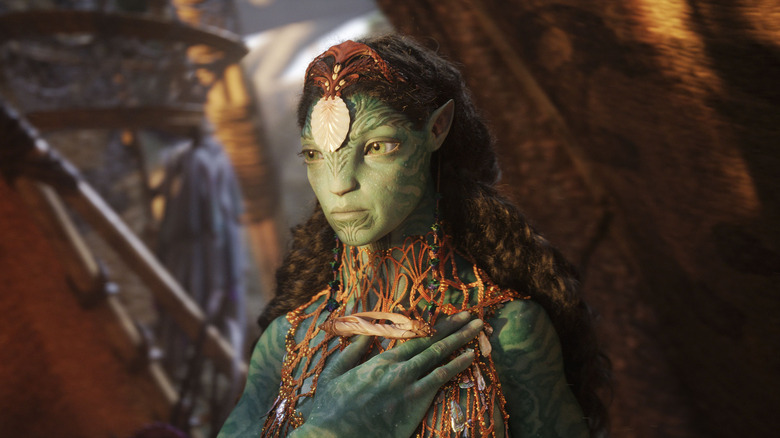
"Everybody was coming back with insectile, amphibious, or fish-like Na'vi designs," James Cameron explained. "It was difficult to relate to those. I decided to play more with proportion, scale, color, and pigmentation. We played with structures of tails and ears. But I didn't want to lose contact with the emotional effect of the actors."
Cameron didn't aim for photo-realism with the Na'vi, but they couldn't feel too alien. Neytiri, played by Zoe Saldaña, was used early on. That was before the artists knew who would play her. The book explains that Cameron ultimately guided the artists back toward the original concept, focusing on designs that wouldn't interfere with the actors' expressions or emotions. Also, Neytiri needed to be "attractive" and "not a fish-girl."
Stan Winston Studio, which worked with Cameron dating back to his breakthrough hit "The Terminator," collaborated in character creation and produced studies of Navi physiognomy, defining their feline qualities, physique, and empathetic features.
"Stan Winston Studios did some of the first really good Na'vi adaptations using photography of real people," said production designer Dylan Cole. "Joe Pepe was one of the main artists over there, who came to work with us at Lightstorm on 'The Way of Water.' With every Na'vi, a lot of the character has to do with casting. Our basic Na'vi formula is to use the performer's mouth and chin almost as-is. And then, we widen the Na'vi eyes and do the leonine nose."
Lightstorm's lead character designer Joseph C. Pepe said that Cameron had "hit a wall" and needed a fresh perspective. Specifically, some realism. "Fortunately, my methodology involved compositing and collaging photographs, rather than drawing with a pencil, or painting in a purely digital medium," Pepe revealed.
A cat helped inspire the Na'vi in Avatar
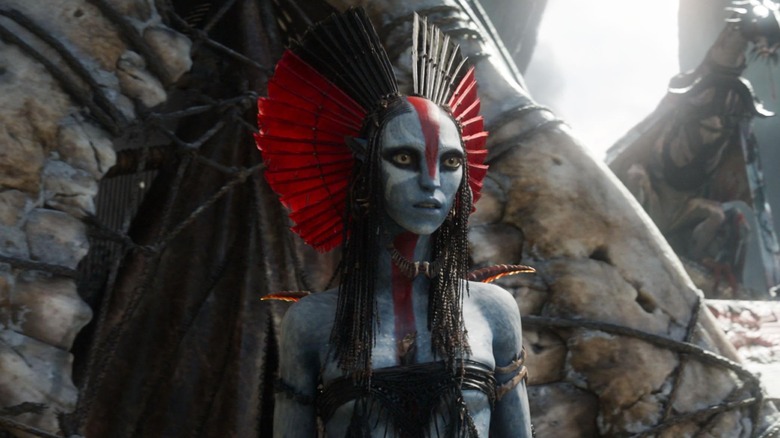
Designing the Na'vi was just one small part of bringing "Avatar" to life. It was all hugely expensive. Even though James Cameron had made giant hits like "Titanic" and "Aliens," Hollywood believed that "Avatar" was going to flop when it arrived in 2009. Spoilers: it didn't flop.
Joseph C. Pepe's initial concept placed skin imperfections on a Na'vi elder. "I randomly selected a high-resolution photo of an elderly female from Stan's archive of sculpting reference," Pepe said. "I included skin pores, scars, moles, and fine wrinkles around the eyes that naturally existed in the photos." He also "explored a biologically plausible blue skin tone using subtle striations of pigment, depth, translucency, and feline qualities."
Those feline qualities are particularly important. It was actually a cat — specifically Pepe's hairless cat — that would prove to be invaluable in cracking the code. Here's what he had to say about it:
"I had recently bought a hairless sphynx cat. His name was Spooky. I realized this was the perfect reference for a feline without hair. I photographed and took video of Spooky, and I was able to sample all the subsurface scattering of light shining through his ears. Those were real details, and I put them in my artwork. I'm sure Weta had their own reference, but Spooky was my muse."
"Avatar" became the biggest movie of all time, generating two sequels to date: "Avatar: The Way of Water" and "Avatar: Fire and Ash." Cameron is also the only director to ever make four movies that made at least $1 billion at the box office. The first two entries in this franchise made well north of $2 billion. All of that design work paid off.
"Avatar: Fire and Ash" is in theaters now.