

Roger Ebert Walked Out Of This '70s Comedy, Calling It 'One Of The Worst' Ever
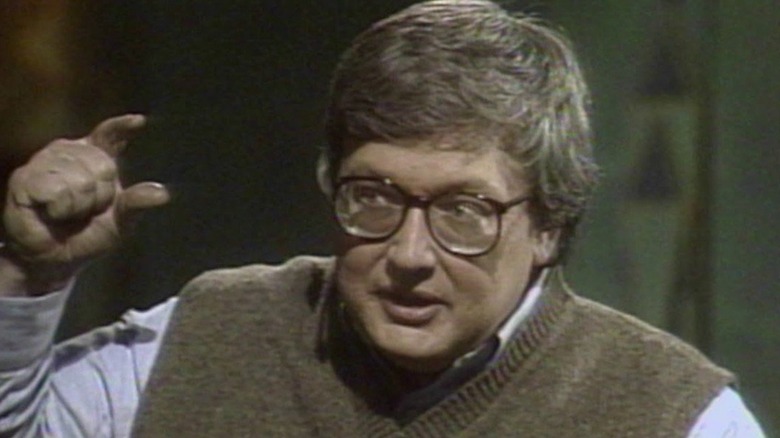
There seems to be some dispute as to just how many movies Roger Ebert walked out of during his decades-long career as a film critic. In a 1996 interview with Entertainment Weekly, he claimed that "Mediterraneo," which won the 1992 Academy Award for Best Foreign Language Film, was the only film to get him hoofin' it before the end credits. But in previous interviews, he said he'd also bolted screenings of "Jonathan Livingston Seagull" and the notorious 1979 Roman epic "Caligula." Later in his career, he condemned the 2008 queer coming-of-age drama "Tru Love" after shutting it off eight minutes into the movie. He regretted this decision, but still despised the film after sitting through all 102 minutes of it.
That would bring the count to four, but if you've read every single Ebert review ever published, you know there's a fifth film that sent him fleeing early on. Have you ever seen Rod Amateau's "The Statue?" Probably not! Despite boasting a starry cast that includes David Niven, Robert Vaughn, John Cleese, and Graham Chapman, the zany 1971 comedy based on an Alec Coppel play is completely unavailable to stream through traditional means and is hard to find on physical media. And its cause is not helped by Ebert's savage pan that was published at the time of the film's theatrical release.
I've never seen the film (though I'm curious because Coppel was a co-writer on Alfred Hitchcock's "Vertigo"), so I can't opine on its quality, but Ebert and his contemporaries hated it. Why?
Ebert took a sledgehammer to The Statue
Roger Ebert's "thumbs down" review of "The Statue" begins with an amusing anecdote about how he used to receive calls from a random Sun-Times reader who wanted to team with the critic on a screenplay. Ebert had written three wonderfully gonzo movies with Russ Meyer ("Beyond the Valley of the Dolls," "Beneath the Valley of the Ultra-Vixens," "Up!"), but this guy wanted him to collaborate on a script about his experience in wholesaling.
Ebert wrote that he'd lost contact with the man over the last year, but believed the goofball dreamer finally hit filmmaking paydirt with "The Statue." This was not a compliment. "In addition to being one of the worst movies ever perpetrated," said Ebert, "The Statue" is based on one of the two or three worst ideas ever conceived for a movie."
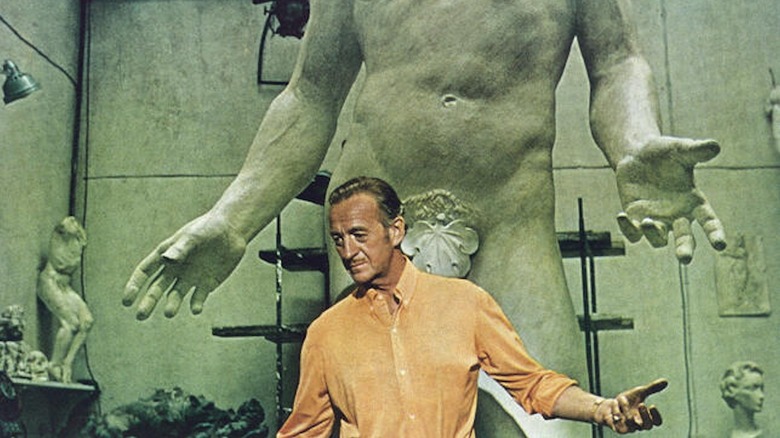
It gets pretty convoluted, so let me give you the thumbnail: a brilliant professor who's just won a Nobel Prize for creating a universal language is surprised to be honored with an 18-foot Greco-Roman nude statue of himself. His embarrassment turns to rage when he realizes the edifice's likeness does not extend to its concrete genitalia. This statue representation of the professor is astonishingly beefy below the belt, which leads the subject to believe his wife is having an affair with a preternaturally packaged man. So he resolves to find and destroy his wife's paramour.
Once Ebert got a sense of where the film was heading, he admits in his review that he sprinted for the exit. I understand the impulse, and I've done it myself, but I would never write a full review of a movie I left early. Millions of people work thankless jobs, while you get to write about movies for a living. Suck it up.