

28 Years Later's Rage Virus Origin Explained

"28 Years Later" is, as most readers likely know, director Danny Boyle's 2025 sequel to his 2002 film "28 Days Later." One can also immediately see from that release date, though, that "28 Years Later" was not released 28 years after the latter movie. It seems that Boyle wanted to jump the gun a bit. This is a mere peccadillo, however, as all the "28" films to date have been critically praised and rattled the zombie movie genre. Just to be thorough: "28 Years Later" was the third entry in the series after "28 Days Later" and director Juan Carlos Fresnadillo's 2007 film "28 Weeks Later." Only recently, the sequel "28 Years Later: The Bone Temple" (read /Film's review) hit theaters, although the disappointing box office performance of "The Bone Temple" has left the franchise's future in question.
The "28" films begin with the outbreak of what's known as the Rage Virus, which spreads very, very quickly through the human population of England. The progression of the virus has been very carefully documented in these movies. Infected victims, when exposed, almost immediately begin to spasm and wail in pain, screaming about a burning sensation. Their eyes subsequently hemorrhage, turning them red and bloodshot, after which they start to bleed out of their orifices. From there, the virus more or less wipes out their brain functions, forcing them into a state of perpetual, extreme anger. Then, after the victims become feral, they begin to chase after uninfected humans, killing them by any means necessary. In effect, they're zombies, albeit fast-moving ones.
And where did the virus come from? Its origins were partly explained in "28 Days Later," along with some ancillary, expanded-universe material. In short: The virus was the result of some viral tinkering at a primate research center in Cambridge.
The Rage Virus started in chimpanzees
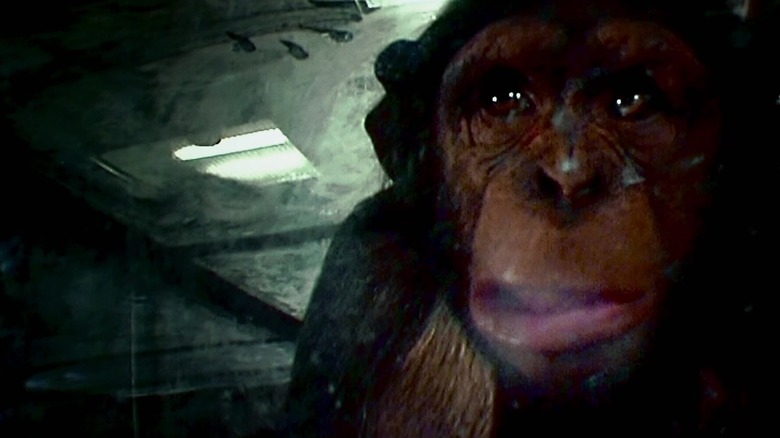
The release of "28 Days Later" had unexpectedly fortuitous timing. Earlier in 2002, before the film hit theaters in England, there was a scandal at Cambridge University involving its allegedly unethical use of marmosets in a series of brain experiments (via BBC News). This research led to advances in the understanding of Parkinson's Disease and the way learning and memory function, but those participating in it were accused of cruelly mistreating the animals in Cambridge's labs. The initial reporting on the alleged animal abuse, in turn, led to an investigation that controversially cleared Cambridge in 2003 (per The Guardian).
"28 Days Later," as alluded to earlier, starts in Cambridge's Primate Research Center, where chimpanzees with the Rage Virus are being studied. The whole situation is a little vague, as a scientist merely states that chimpanzees had been given some kind of "inhibitor" and that the researchers have been trying to comprehend it. The actual nature of the Rage Virus wasn't explained until the 2007 comic book series "28 Days Later: The Aftermath."
As for the initial outbreak, the opening moments of "28 Days Later" make it clear: a team of animal right activists broke in and freed an infected chimp, not knowing about the Rage Virus. The activists were immediately infected by the chimp, and the virus only spread from there. Because the virus' incubation period was so brief, it was able to spread very, very quickly. Initially, victims became so angry that they didn't even think to eat or drink. In the sequels, it's explained that the virus eventually mutated, allowing the infected to remember to eat and drink and, thus, live with the virus for years and years. The Rage Virus, rather curiously, appears to be non-lethal unto itself.
The Rage Virus was extrapolated in a lab from the Ebola Virus

"28 Days Later: The Aftermath," however, flashes back to a moment shortly before the above outbreak and reveals that the Rage Virus was actually derived from the real-life Ebola Virus.
In "Aftermath," it's explained that a pair of scientists — first names Clive and Warren — were hired by Cambridge University to discover the exact neurochemical reactions in the human brain responsible for anger. The idea was that the scientists could then develop an inhibitor that could suppress anger, specifically for use in people that have anger control issues. Continuing, "Aftermath" reveals that Clive and Warren actually did invent such a chemical inhibitor and had begun testing ways to implement it. Their mistake was using the Ebola Virus as a model for spreading the chemical, feeling that the inhibitor could be essentially turned into a virus unto itself.
When the Ebola Virus was exposed to the inhibitor, unfortunately, it mutated into something completely different. Rather than being an inhibitor, it became an enhancer, saturating a chimp's brain with rage chemicals. And, lo, it already spread like Ebola, so now Clive and Warren had a Rage Virus on their hand. The comic then goes on to clarify that Warren was also disgusted by all the rage experiments when they failed so spectacularly and quit the project in a huff. After that, the spiteful Warren told the above-mentioned animal activists about the Cambridge primate experiments, leading directly into the events of "28 Days Later."
Decades later, the virus had mutated rapidly, and the infected have taken on other qualities. As a result, England has been quarantined by the time "28 Days Later" begins, with only a scant few individuals remaining immune.