

Clint Eastwood's 1982 Comedy Was A Major Pivot For The Western Actor
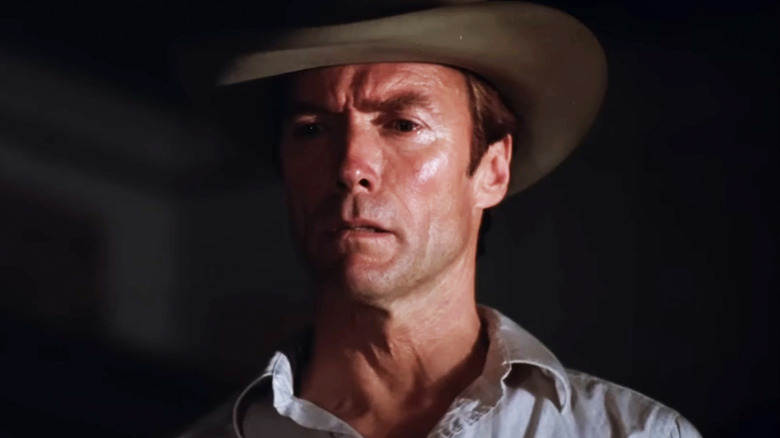
If you had become the biggest Western star in the world, ushered in a new age of gritty action heroes, and established yourself as a more-than-capable director, what would do you next? Make a musical-comedy-drama, of course. That's what Clint Eastwood did with 1982's "Honkeytonk Man," which wasn't anywhere near the disaster it easily could have been, and actually represents one of the star's best films of the '80s.
As misguided as it initially sounds, "Honkeytonk Man" is far from one of the worst Clint Eastwood movies – and it was also far from the first time the actor had made a surprise turn in his career. Back in 1978, he made the controversial decision to star in "Every Which Way But Loose," a buddy comedy that saw this titan of cinema star opposite an orangutan named Manis. The only thing more surprising than seeing Dirty Harry riding across the United States alongside his great ape companion was the fact that "Every Which Way But Loose" was successful enough to warrant a sequel, which arrived in the form of 1980's "Any Which Way You Can." Sadly, the second film didn't match the first's success. But that didn't mean Eastwood had to stop making unorthodox career moves.
Two years later, he once again made a major pivot when he made "Honkytonk Man," a Western musical-comedy that actually fared well with critics even while it wasn't exactly a box office triumph. This wasn't Eastwood's first time fronting a Western musical: In 1969, he'd starred in "Paint Your Wagon," which garnered mixed reviews and featured Eastwood at a time when he was still very much establishing himself as a big screen star. "Honkytonk Man," however, is interesting for faring much better critically and for featuring Eastwood at the height of his stardom.
Clint Eastwood's 1980s filmography was a mixed bag
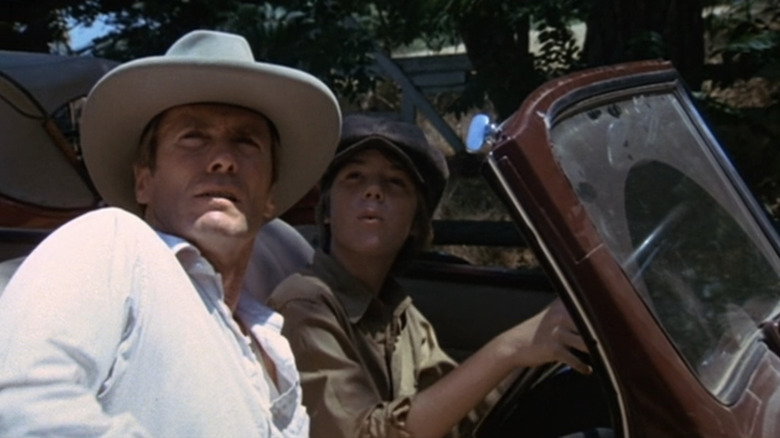
In 1971, Clint Eastwood fronted the seminal (and controversial) action thriller "Dirty Harry," playing the titular cop in what became one of the star's most legendary features. It helped Eastwood break away from Westerns and maintain his relevance in the 1970s, which he ended by once again teaming up with "Dirty Harry" director Don Siegel for one of the best prison movies of all time, 1979's "Escape from Alcatraz." By that point, he'd also showcased his comedic sensibility with "Every Which Way But Loose" and was at the height of his popularity.
The 1980s would be much more uneven for the veteran star, who turned 50 at the very start of the decade. At that point, the actor/director found himself in what was surely a disorienting and confusing position. The 1970s had seemingly heralded the death of the Western, the genre in which Eastwood had made his name. Thanks to movies like the aforementioned Siegel collaborations and his burgeoning directing career, however, he had managed to pivot successfully enough to survive. But the '80s raised the question of just what Clint Eastwood meant to audiences, and it was one he struggled to answer.
Taken by themselves, the two "Dirty Harry" sequels Eastwood made during that decade seemed to suggest he was starting to enter has-been territory. "Tightrope," however — Eastwood's best film of the '80s — was dirtier than "Dirty Harry" and suggested quite the opposite. "Honkytonk Man" fell somewhere in the middle. Set in the Great Depression, the film was produced and directed by Eastwood, who also starred as Red Stovall, a tenuous analogue for early 20th Century songster Jimmie Rodgers. He also brought his son along for the ride, resulting in one of his best-reviewed films of the '80s.
Honkeytonk Man was a surprisingly tender cross-country musical adventure starring Clint Eastwood and his son
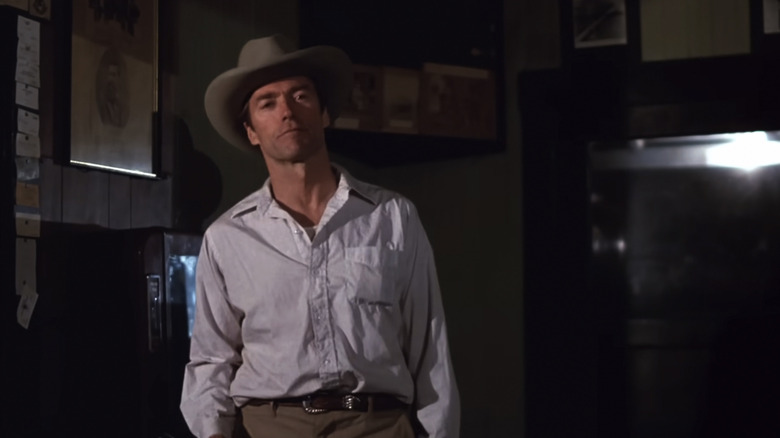
In "Honkeytonk Man," Clint Eastwood's Red Stovall embarks on a road trip with his young nephew Whit Wagoneer, played by Eastwood's son Kyle. The tuberculosis-striken musician is determined to play at the Grand Ole Opry in Nashville, Tennessee despite his illness, and Whit comes along to keep his hard-drinking uncle out of trouble. Once again, Eastwood was off on a cross-country trip with a little friend, but this time, there was no ape in sight. Just a real-life father-son duo, a ton of whimsy, and a surprising tenderness that emerged as Whit came to respect and care for the man he initially dismissed as his luckless, drunk uncle.
Red and Whit's travels are full of misadventure, but there's also plenty of heart in the film, which Roger Ebert recognized as being of particular significance to the then-quinquagenarian Eastwood. In the critic's estimation, the actor seemed "to have a personal stake in this story," which lent the film an authenticity of feeling. Eric Henderson at Slant noted the "veneer of nostalgic sentimentality," but praised Eastwood for never letting "Honkytonk Man" "veer into maudlin territory."
Despite the fact Eastwood's musical-comedy-drama only made $4.4 million on a $2 million budget, it was easily one of his best movies of the '80s. It was also yet another career pivot that paid off and remains notable for displaying the tender side of a man who spent much of the '70s thoughtlessly blowing criminals away as Harry Callahan. Sadly, when Eastwood crossed paths with Jim Carrey in forgotten '80s comedy "Pink Cadillac," he undid much of the goodwill he'd built with "Honkeytonk Man." Thankfully, he managed to rescue his career from hitting rock bottom with 1992's "Unforgiven."