

Two Starfleet Academy Characters Reveal Just How Much The Star Trek Universe Has Changed
Spoilers for "Star Trek: Starfleet Academy" episode 3 to follow.
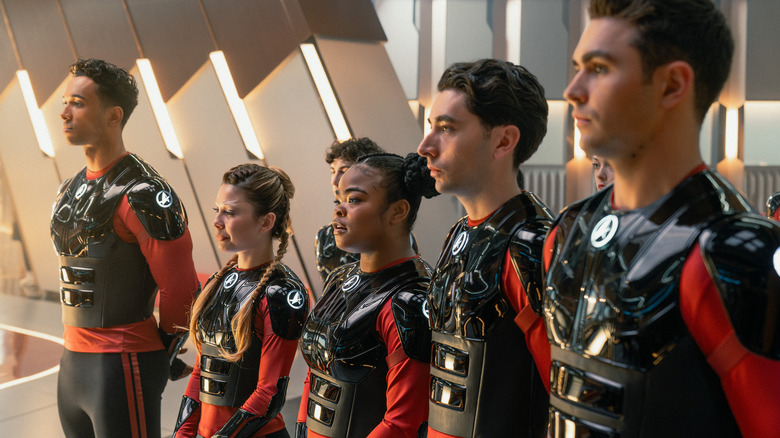
In the third episode of "Star Trek: Starfleet Academy," titled "Vitus Reflux," the show's central students find themselves locked in a prank war with various star students at the school's adjunct War College. As the name implies, the War College is where students have to report for their combat training, so its own star students tend to be aggressive and adversarial. They're also clever, which means they have the means to transport the likes of Caleb (Sandro Rosta), Genesis (Bella Shepherd), Sam (Kerrice Brooks), and several others straight from their showers into various public places around campus. It stands to reason that impish 18-year-olds in the 32nd century would play pranks on each other using the technology of the time.
The main "Academy" cadets spend the bulk of the episode contemplating the means and the ethics of escalating a prank war. If they strike back, they have a chance of regaining their dignity, but they also run the risk of angering the Academy faculty. If they shrink away, they will continue to be good students but will always be seen as inferior to their War College peers. It may seem like a low-stakes dilemma for a "Star Trek" series, but it's a concern for the kids in question. And it illustrates that even a millennium from now, college students will still be college students.
In terms of the "Star Trek" universe, though, the rivalry does reveal something notable. The rival students include Ozolo (Cecilia Lee), a Romulan, and her logical compatriot (Alexander Eling), a Vulcan. So, given that Romulans and Vulcans have long been at odds in the "Star Trek" franchise, something has clearly happened to bring them together by the time "Starfleet Academy" takes place in the 32nd century.
The Romulans and Vulcans have reunited by the time Starfleet Academy takes place
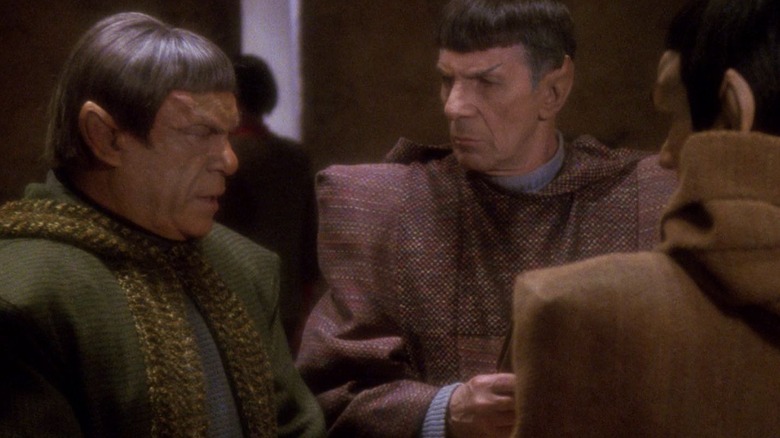
Going all the way back to the "Star Trek: The Original Series" episode "Balance of Terror," Vulcans and Romulans have been described as distant cousins, with both sporting the same pointed ears. In "Star Trek: The Next Generation," the Romulans were fleshed out, proving to be a very militant society based on paranoia, dastardly spy work, and espionage. Eventually, the relationship between Vulcans and Romulans was more carefully explained in the two-part "Next Generation" episode "Unification," in which it came to light that, many millennia earlier, Vulcans and Romulans were the same people. The two species fractured, however, and had an uneasy warlike resentment for many, many years after. Spock (Leonard Nimoy) appeared in "Unification," and he stated that his new life mission was to re-unify the Romulans and the Vulcans under one peaceful government. This, he noted, would take many generations to accomplish, given that Romulans and Vulcans had a deep cultural hatred for one another at the time.
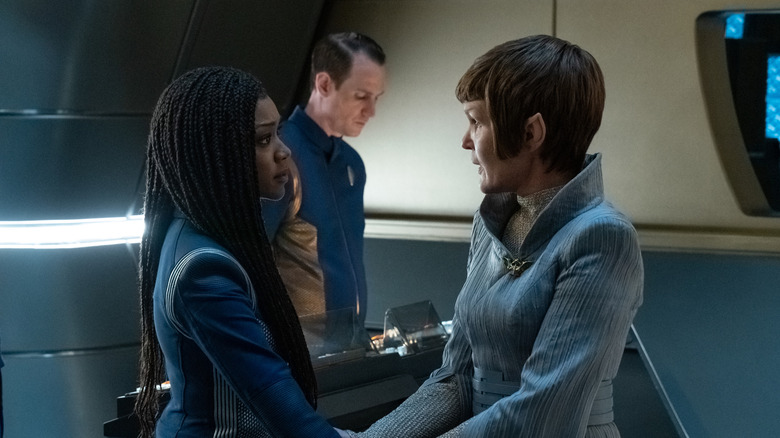
Fast-forward to the "Star Trek: Discovery" episode Unification III," and it seemed that Spock's mission was ultimately a success. "Unification III" took place about 840 years after the events of "Unification," so a lot had changed in the "Star Trek" universe. It appeared that the Vulcans and the Romulans had to unify after a galaxy-wide cataclysm dubbed the Burn made starship construction nearly impossible. The two species now lived unified on the new Vulcan homeworld, a planet called Ni'Var, where they had developed a safe alternative form of space travel. As it so happens, Captain Michael Burnham (Sonequa Martin-Green) was raised with Spock many centuries earlier and was thrown forward in time through a bizarre set of circumstances. She was able to see Spock's dream come true.
Vulcans and Romulans are now prank buddies on Starfleet Academy
"Starfleet Academy" takes place only a few years after the events of "Unification III," so Trekkies already knew that Vulcans and Romulans had become copacetic by the time the show begins. What we didn't know was just how friendly they had become. As "Discovery" established, Vulcans are still devoted to a lifestyle of logic, but the many centuries that have elapsed since the "Next Generation" era have brought a certain amount of society development with them. As such, Vulcans are now allowed to express emotions and passions, albeit to a small degree, and are more motivated by isolationism and paranoia than diplomacy.
Just as notably, "Starfleet Academy" takes place during a period of reconstruction following the Burn. Many worlds had become isolationist in the Burn's wake, so Starfleet Academy has re-opened its doors as a way to usher in a new period of diplomacy and cooperation. It's heartening to see the Academy populated by just about every possible species in the galaxy, showing that a new generation is eager to mix and mingle. We may know that Romulans and Vulcans have reunited, but "Starfleet Academy" is the first time we've seen Vulcan and Romulan youths cooperating in any kind of meaningful way. Well, it may not be all that meaningful, as they are only cooperating in order to participate in a college prank war. But it's significant all the same.
As the series progresses, many Trekkies will find that "Starfleet Academy," at its core, is carrying a lot of traditional "Star Trek" ideas underneath its youthful surface. If Romulans and Vulcans can play pranks together, then something is definitely healing.
"Star Trek: Starfleet Academy" is currently streaming on Paramount+, with new episodes hitting the platform on Thursdays.