

5 Forgotten Superhero Movies From The '70s That Are Worth Watching
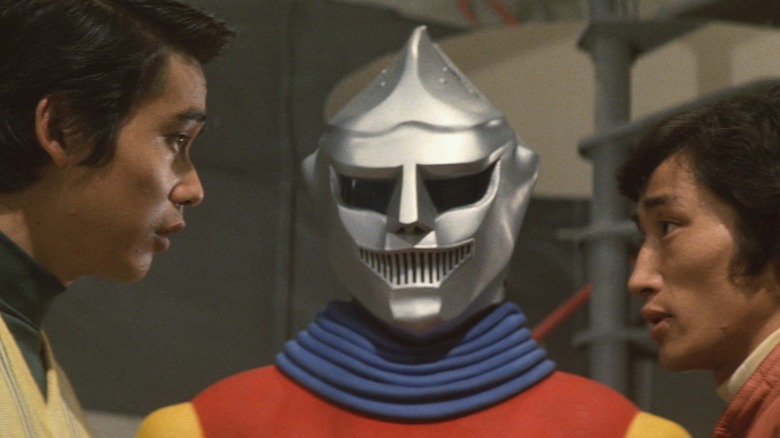
Remember the 2010s? If you liked superheroes, that was a good time to be alive. Thanks to the popularity of the films in the Marvel Cinematic Universe, superheroes became the center of all cinematic conversations for over a decade. We recall the publicity cycle, don't we? Marvel Studios would announce a years-long timeline of upcoming feature films, and then (more or less) stick with that timeline, releasing three films a year for many years. Each release would warrant a media firestorm of speculation. Their serialized format allowed the MCU to create a TV-show-like super-narrative to form between their movies, and fans lapped it up. The entire media ecosystem changed.
An unintended media offshoot of the MCU glut was that news outlets and YouTubers would begin exploring the history of cinematic superheroes, exploring what led us to the MCU. All the genre's previous failures and obscurities were dug up and shown off in daylight, given new re-litigation. Some old superhero movies remained pilloried ("Daredevil," "Catwoman"), while others were given new consideration ("Hulk" is more interesting than you remember). After a while, there were no obscurities left.
But that re-litigation only stretched back so far. Because there weren't too many superhero films before 1978's "Superman," pundits rarely dared to delve back into the 1970s looking for superhero precedent. And it's easy to see why. The superhero movies of the 1970s were, compared to the mainstream slickness of the MCU, very, very, very, very, very weird. But for those who like weird stuff, it was a goldmine of camp and a glorious revelation of crazy action.
The following five movies are some of the weirder and more worthwhile superhero films of the 1970s. If you're of age, pour yourself a strong drink and settle in with some of these bugnuts kooky movies.
3 Dev Adam (1973)
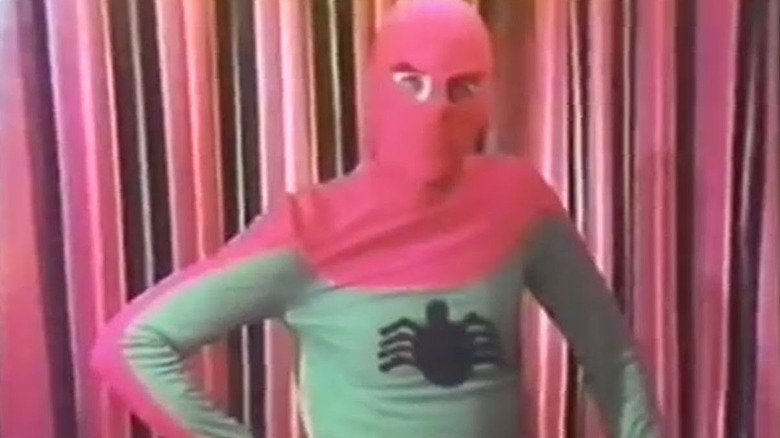
"3 Dev Adam" (translated as "Three Giant Men") is one of the more notorious Turksploitation rip-offs ever made. In Türkiye, there didn't seem to be much regard given to American copyright laws, and exploitation filmmakers would frequently churn out brazen, low-budget knockoffs of recent American blockbusters, sometimes with the same titles. Americans fond of grindhouse cinema (and those with a strong taste for kitsch) often seek out Turksploitation, astonished by their open theft of other people's ideas. Of course, if Hollywood is going to hoard IP, many view Turksploitation movies as acts of punk rock.
"3 Dev Adam," directed by T. Fikret Uçak, stars Captain America (Aytekin Akkaya) in a very different capacity than Marvel fans might be used to. This Cap wears a bulletproof costume and has mild psychic powers. He's not so much a vigilante as a freelance luchador. And speaking of luchadors, Cap teams up with Mexican luchador/folk hero El Santo (Yavuz Selekman) to take down the criminal machinations of the evil Spider-Man (Tevfik Şen, one of the Spider-Man actors that time forgot). This Spider-Man is a cackling evil monster who, in the film's first scene, buries a victim up to their neck in sand and then shreds their head off with an outboard boat motor. Oh, and Inspector Clouseau from the "Pink Panther" movies has a cameo as well. Spider-Man murders him.
Much of the pleasure of "3 Dev Adam" is witnessing unauthorized versions of your favorite characters behave very much out-of-character, but that's not where the pleasures end. The film is also enjoyably campy, cheap, and undeniably earnest. It's funny, fun, and a hoot. I'd rather watch something as gritty and mercenary as "3 Dev Adam" than a misguided, overmoneyed mess like "Captain America: Brave New World."
Godzilla vs. Megalon (1973)
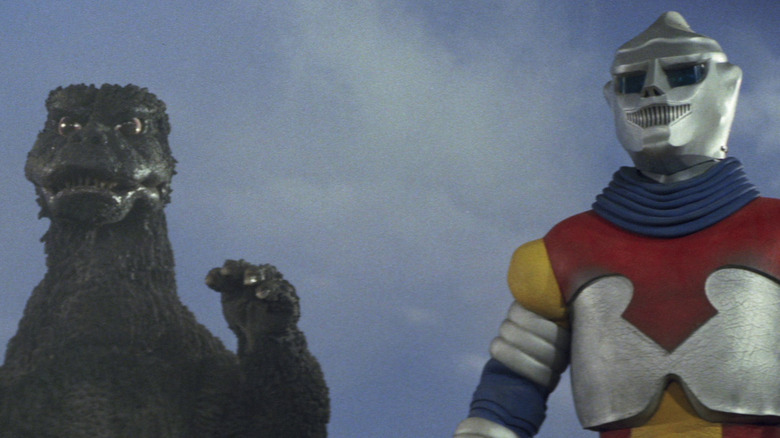
When Godzilla first appeared in Ishiro Honda's "Gojira" in 1954, he was merely an unstoppable force. Born of the atomic bomb, Godzilla would walk up on dry land and continue the bomb's legacy of destruction. The film was a hit, and dozens of Godzilla movies have been made in its wake; "Godzilla Minus Zero" is due in theaters at the end of 2026. Back in the late 1960s and early 1970s, though, Godzilla had already been transformed from a monstrous force of nature into a cantankerous nightclub bouncer, personally assigned to keep 100-foot-tall interlopers out of Japan. He didn't necessarily like humans, but he couldn't abide by other nasty monsters trying to smash up their cities. Those cities belonged to Godzilla.
In 1974's "Godzilla vs. Megalon," the Big G (Shinji Takagi) got into a fight with his old robotic bird-like nemesis Gigan (Kenpachiro Satsuma), as well as Megalon (Hideto Date), a Big Bad Beetleborg with drills for arms. This time, however, Godzilla was aided by a new hero on the scene, the colorful, shape-shifting robot Jet Jaguar (Tsugutoshi Komada). Jet Jaguar, as many Godzilla fans may be able to tell you, was the result of a robot design contest that Toho held back in 1972. An elementary school kid designed a superhero robot named Red Alone, and it was eventually re-worked through Toho's executives as Jet Jaguar.
The story of "GvM" involves a species of evil undersea beings called Seatopians who aim to steal the recently invented Jet Jaguar robot and use it for nefarious purposes. Jet Jaguar will eventually fall back into the control of the film's protagonists and fight alongside Godzilla. "GvM" is one of the sillier Godzilla movies, but to many of us, that also means it's one of the more enjoyable.
Flesh Gordon (1974)
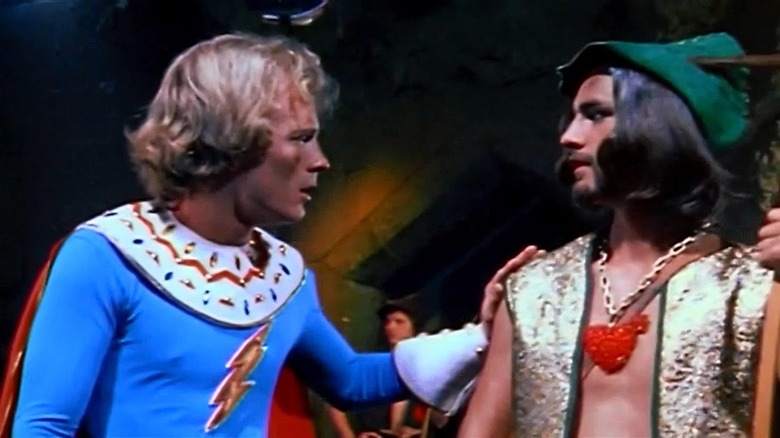
Thanks to the mainstream success of Jerry Gerard's "Deep Throat," a new conversation opened up about the place of hardcore sex in mainstream cinema. If a large audience of consenting, horny adults would like to gather in a theater to watch hardcore pornography, why should theaters and exhibitors stop them? There was a brief sense in the early 1970s that a lot of taboos were being shaken off of sex and porn, and rumors began to circulate that popular Hollywood filmmakers might want to start filming hardcore sex scenes. Sex is not something to be hidden in small, dark theaters at the edge of town. Put it in the palaces.
As such, a lot of adult films began to orbit in the mainstream for a few years in the 1970s. Some were classy, but a lot of them were dumb, slapstick comedies that made idiotic penis jokes and only occasionally depicted zesty coitus. One of the goofier X-rated comedies of this era was Michael Benveniste's "Flesh Gordon," a sexed-up superhero spoof of "Flash Gordon" (itself adapted into a film in 1981).
The plot is absurd, natch. Earth is being blasted by libido-enhancing sex rays by the evil Wang the Perverted (William Dennis Hunt). The heroic Flesh Gordon (Jason Williams) gathers his friends Dale Ardor (Suzanne Fields) and Dr. Flexi J*rkoff (Joseph Hudgins) to stop the evil Wang. Along the way, they'll don the Pasties of Power (that allow one to fire lightning from their nipples), and face the wrath of the Great God P*rno, realized through some fun stop-motion animation.
"Flesh Gordon" is silly, sexy fun. It doesn't just insert (heh) sex into "Flash Gordon," but riffs on old superhero tropes. It's actually a pretty sharp comedy, given its budget and sexual intentions.
Infra-Man (1975)
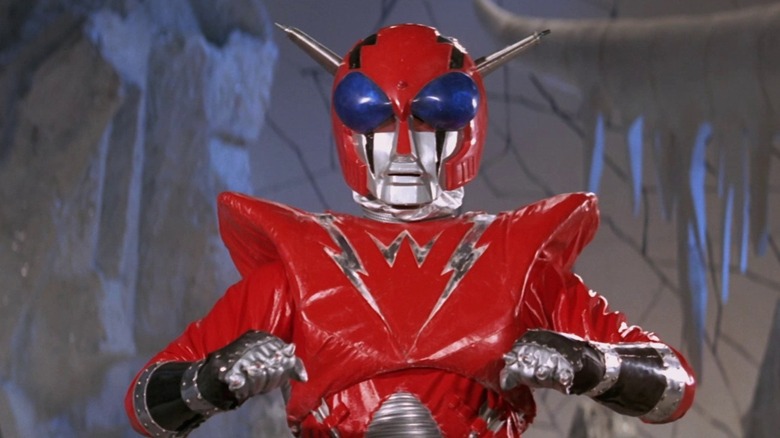
Hua Shan's 1975 sci-fi movie "Infra-Man" was Hong Kong's answer to Japan's wave of popular tokusatsu entertainment, and it surpassed Japan on every level. The plot involves an ancient demonic queen named Elzebub (Terry Liu) who emerges from a long slumber inside the Earth to attack the surface with her dragons. She also resurrects an army of Skeleton Ghosts and unleashes a phalanx of robots across the surface. It all looks pretty bad. Luckily, some resourceful cyberneticists turn the military man Lei Ma (Danny Lee) into the bionic superhero Infra-Man.
The variety of monsters in "Infra-Man" is eye-popping. There's an attack plant, a fire dragon, and a giant spider. There's a mole monster with a drill hand, a pair of evil supernatural knights, and an evil witch. To make sure that "Infra-Man" possessed the same energetic qualities as the Japanese genre films it was imitating, Shaw Brothers Studios hired the same costumers who made superhero costumes and monster suits for various Toei TV shows. But none of those would be exciting to watch if the film weren't so gloriously filmed and cleverly presented. "Infra-Man" is a bottomless well of creativity, and it will keep you utterly surprised throughout its scant 88 minutes.
"Infra-Man" is glorious, colorful, brisk, fun, and insane. Roger Ebert once called it a berserk masterpiece, and he's not wrong. The Skeleton Warriors, some sharp fans will notice, resemble the skeleton band seen on the revival of "Mystery Science Theater 3000." That was an intentional homage. "Infra-Man" has leaked into American pop culture in a subtle — and fortunate — way.
Captain America (1979)
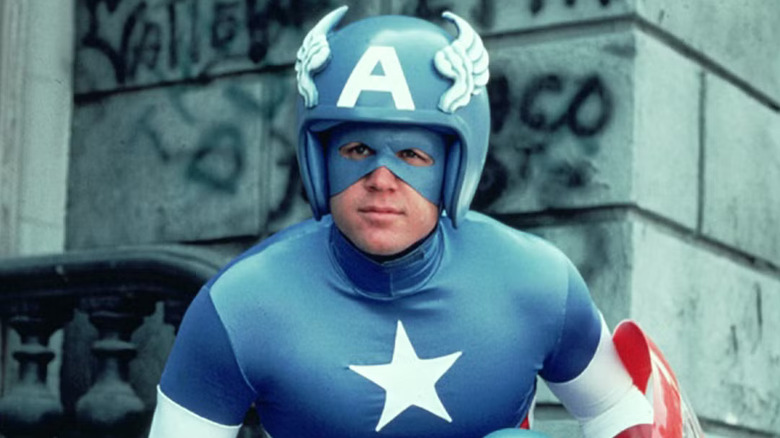
This is easily the best-known film on this list, as Captain America was recently featured in the Marvel Cinematic Universe. And while many curious superhero anthropologists may have seen it, few paused to acknowledge just how weirdly mellow the 1979 "Captain America" TV movie is.
Cap's origins were changed dramatically for Rod Holcomb's film. In this version, Steve (Reb Brown) is actually the son of the original Captain America, a superhero who was killed during World War II. Steve, however, is no patriot and has no interest in combat or war. This was the late 1970s, after all, and America was still smarting from all the damage and horror wrought by the war in Vietnam. It was a cynical time to be Captain America. Steve is following the path of "Easy Rider," and tours around the country in a van, making a living selling drawings. He is the least likely person to become a violent superhero or a jingoistic symbol of America. Steve is injured in an accident, however, and has to take a super steroid to survive. He becomes super-strong, and a friend makes him a vigilante outfit, based on whimsical sketches he made.
The 1979 version of "Captain America" is almost ironic in its presentation. It's low-energy and downbeat by design. It connects to mainstream Marvel Comics, of course, but the tone is very different from a traditional comic book. This makes "Captain America" fascinating to watch. There was a time when we hated the violence inflicted by superheroes and still told stories about them. The director considered "Captain America" to be a devastating failure, but perhaps it's time to re-litigate this one as well.