

V: How Hollywood Ruined What Could've Been A Great Sci-Fi TV Franchise
This post contains major spoilers for 1983's "V."
Kenneth Johnson's 1983 miniseries, "V," should be on every sci-fi lover's radar. At first glance, it relies heavily on the time-tested alien invasion trope in which the extraterrestrials claim benevolence. This species, called the Visitors, wishes to aid human progress and ends up influencing major policies on Earth over time. While all of this sounds pretty par for the course, "V" ultimately takes inspiration from Sinclair Lewis' 1935 novel "It Can't Happen Here," a dystopian narrative that documents the rise of a dictator. Indeed, just when we think "V" is headed down a conventional route (which it does, to an extent), it reveals itself as a staunchly anti-fascist tale — one that uses certain sci-fi tropes to drive its political themes home.
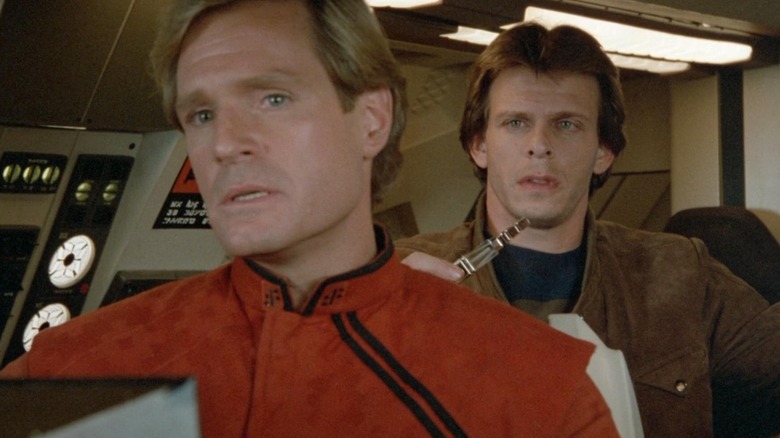
This political bent becomes apparent as soon as we realize that the Visitors are not here to help humanity. Rather, these aliens have been deceiving everyone by concealing their true appearance (a reptilian physiognomy with lizard-like slits for eyes), along with their plans to take over Earth for good. "V" illustrates just how easy it is for evil to take root when people don't band together to oppose injustice or cruelty, as well as how swiftly an authoritarian regime can seize control. By the time journalist cameraman Michael Donovan (Marc Singer) discovers the truth, it's a little too late.
It's a promising setup, which begs the question: Why hasn't "V" found a mainstream fanbase like the beloved, long-running "Stargate" property? Unfortunately, the miniseries' initial success and glowing critical reviews led to aggressive behind-the-scenes meddling that wound up botching the project's unique franchise potential. Budgets ballooned overnight, and there was constant off-screen pressure to dilute the story's political overtones in favor of something more schlocky. So, what exactly went wrong here?
Kenneth Johnson's original vision for V was eventually abandoned
Convincing NBC to greenlight Kenneth Johnson's intended script for "V" had already proven to be an uphill battle. For starters, the show's extraterrestrial focus was shoehorned in after NBC decided that its original script was too convoluted for the average American viewer (per The New York Times). Then, after the first episode's explosive success, the network tried to capitalize on the hype, which led to tighter production schedules and rushed timelines. This, combined with the liberal use of special effects (then a rarity in television, making it unclear how much the show would actually cost), contributed to the series' extremely bloated budget.
In the meantime, NBC failed to convince Warner Bros. that more episodes of "V" were viable, but it did green light a sequel miniseries titled "V: The Final Battle." To add insult to injury, Johnson wasn't asked to return, as the sequel was supposed to be "quick and cheap and dirty" (via Vanity Fair). Since Johnson had come up with the show's impressive foundational concept, NBC thought he wouldn't be a good fit for what was meant to be a cash grab.
"V: The Final Battle" doesn't hold a candle to its predecessor, but it performed quite well when it aired in May 1984. Drawing good viewership, however, isn't the same thing as telling a worthwhile story, as the sequel feels like a far cry from Johnson's inspired mix of grounded and genre elements. Later additions to the sci-fi franchise were even schlockier and more ridiculous, including "V: The Series" and the 2009 "V" remake starring Morena Baccarin (herself a "Stargate" veteran, as it were). Over 40 years after its debut, the original "V" exemplifies the squandered potential of a sci-fi franchise that could've been so much more.